Month: July 2025

Reading of the Week: Something Old & Something New – With Papers from World Psychiatry and Lancet Psychiatry

From the Editor

He was keen to discuss his new therapist who introduced him to CBT concepts and noted his negative thoughts. The therapist was helpful and thoughtful – but not human. My patient was using an AI chatbot.

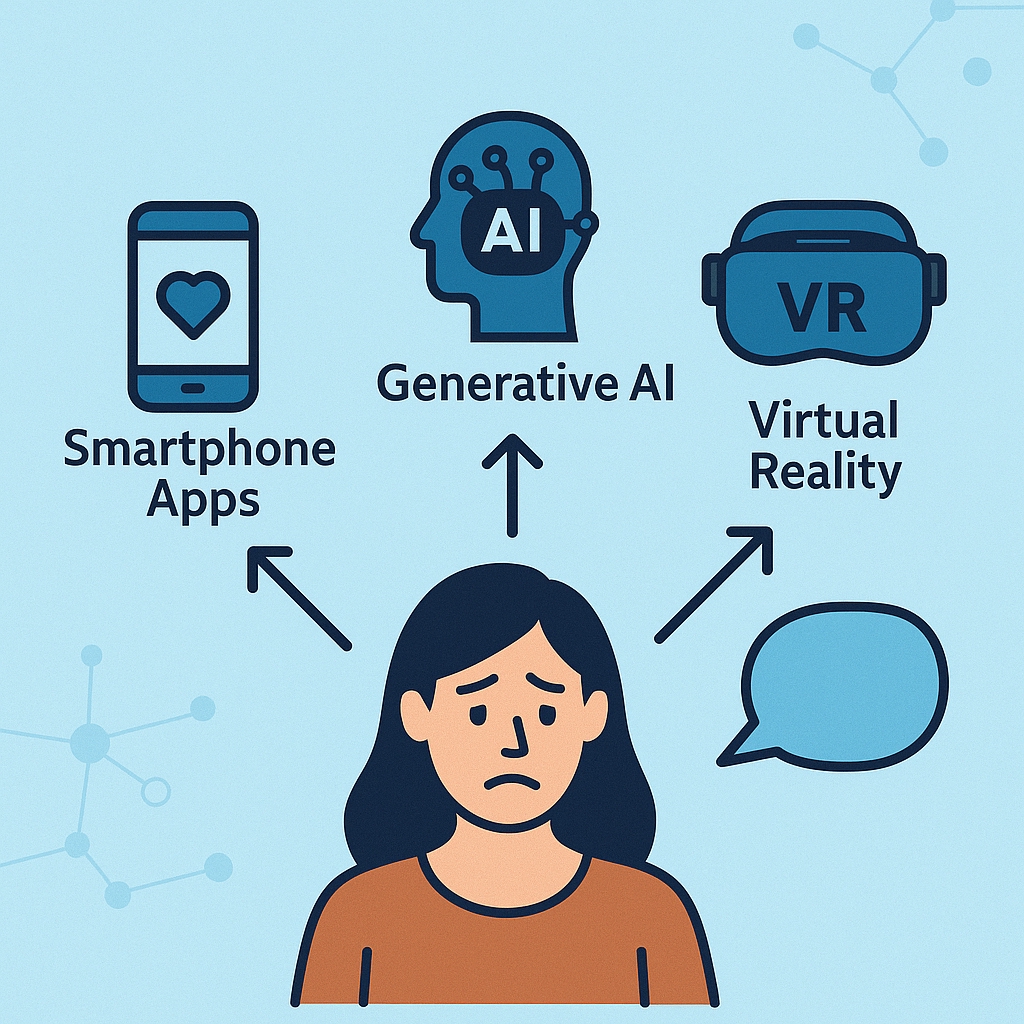
More and more patients are looking to AI for information and therapy. What to make of it all? And what is the role of other cutting-edge innovations? In the first selection, Dr. John Torous (of Harvard University) and his co-authors attempt to answer these questions in a new review for World Psychiatry. They focus on, yes, generative AI, as well as apps and virtual reality. The review is sparkling and comprehensive, stretching over 11 000 words and with 269 references. “New tools such as LLMs have rapidly emerged, while relatively older ones such as smartphone apps and virtual reality have quickly expanded. While each tool has offered evidence of clinical impact, broad real-world impact remains aloof for all.” We consider the paper and its implications.
Made with ChatGPT

In this week’s other selection, Dr. Robert M. Post (of The George Washington University) and his co-authors write about lithium in a new Lancet Psychiatry paper. They offer a fresh take on this old medication; they argue that it is a disease-modifying agent, like monoclonal antibodies for multiple sclerosis. “Conceptualisation of lithium as a disease-modifying agent might help to increase clinical use by doctors, especially early in the disease course to better serve our patients.”

DG

Continue reading

Reading of the Week: Physicians, Heal Thyselves – the New Nature Study; Also, Med Student Mental Health and Rodriguez on Her Depression & Healing

From the Editor

Today, we talk more about physician mental health problems than even a few years ago. But what would meaningful action look like? What are the evidence-based interventions?

Katherine Petrie (of the University of New South Wales) and her co-authors attempt to answer these questions in a new Nature Mental Health paper. They did a systematic review and meta-analysis by examining 24 studies involving almost 2 400 practicing physicians. “Our results indicate that a range of physician-directed interventions produce positive effects on symptoms of common mental disorders and that these moderate effects are maintained over time (up to 12 months).” We consider the paper and its implications.

In the second selection, from BMJ Mental Health, Yusen Zhai (of The University of Alabama) and co-authors draw on US survey data to look at trends of clinically significant anxiety, depression, suicidal ideation, and service utilization among medical students. The findings are troubling. “This study reveals a rising prevalence of clinically significant anxiety and depression self-reported by US medical students from 2018 to 2023.”

Finally, in the third selection, Ph.D. candidate Alexandra K. Rodriguez discusses her struggles with severe depression when she attended medical school. In a personal essay for PLOS Mental Health, she speaks about her recovery and the power of the arts. “When I dealt with suicidality, I could not conceptualize a future, let alone one with meaning. Sharing time creating with friends and singing lyrics that resonated with me helped me reframe my lowest period as an inflection point, one from which I could envision both fulfillment and joy.”

DG

Continue reading

Reading of the Week: Antidepressant Discontinuation – the New JAMA Psych Study; Also, Obesity Meds and Nazaryan on His Father’s Depression

From the Editor

“New Research Questions Severity of Withdrawal From Antidepressants”

– The New York Times

“Antidepressant Pullback Symptoms Fewer Than Thought, Study Shows”

–  Bloomberg

Millions of North Americans take antidepressants – about one in seven Canadians – yet these medications remain controversial. A 2019 Lancet Psychiatry study, which drew heavily from online surveys, found that roughly half of patients who quit these meds experienced severe withdrawal symptoms, sparking much debate – and many, many questions from our patients.

How common are discontinuation symptoms? Which one is most commonly experienced? Michail Kalfas (of King’s College London) and his co-authors attempt to answer these questions with a new JAMA Psychiatry paper. They did a systematic review and meta-analysis by analyzing 50 studies involving almost 18 000 people. “This systematic review and meta-analysis indicated that the mean number of discontinuation symptoms at week 1 after stopping antidepressants was below the threshold for clinically significant discontinuation syndrome.” We consider the paper and its implications.

Celebrities use them; politicians discuss them; our patients ask about them. Are semaglutide and sister drugs game changers for those with mental health problems who struggle with obesity? To explore the opportunities and challenges of these new medications, in a new episode of Quick Takes, I speak with Dr. Mahavir Agarwal (of the University of Toronto), Lisa Schaefer (of Obesity Canada), and Dr. Sanjeev Sockalingam (of the University of Toronto). “Imagine a world where you have all the effects of antipsychotics, but none of the side effects.”

Finally, in the third selection, journalist Alexander Nazaryan discusses his father’s mental illness and its impact on his life. In a deeply personal essay for The New York Times, he notes the long shadow of illness. “My father never got to become a famous physicist or see his son go to M.I.T. Worse, he couldn’t ask for help until it was too late.”

DG

Continue reading

Reading of the Week: Nudging Sobriety – the New JAMA Psych Paper; Also, Torous & Topol Weigh Generative AI and Wilson on Thick Skin

From the Editor

Substance work can be lifesaving. But it’s also challenging, as many patients continue to misuse illicit drugs or drop out of care or both. Evidence supports using incentives, including financial ones, to nudge patients toward sobriety. This approach, known as contingency management, includes tools such as vouchers and prizes.

But what forms of nudging work best? And how much of a financial incentive is needed? In a new JAMA Psychiatry paper, Carla J. Rash (of the University of Connecticut) and her co-authors attempt to answer these questions by looking at contingency management. In a systematic review, they drew on 112 protocols from 77 studies, analyzing types of nudges like vouchers (which may be exchangeable for, say, retails items) and prizes (a chance to win things like gift cards) and the amounts of money involved. The authors walk on a familiar path – the literature goes back four decades – but provide a meaningful update. “Based on these findings, weekly incentive magnitude estimates are $128/week for voucher protocols and $55/week for prize-based protocols.” We consider the paper and its implications. 

ChatGPT is the most downloaded app in history with people using it for everything from finding recipes to writing emails. How could generative AI be used for mental health? In a perspectives paper for The Lancet, Drs. John Torous (of Harvard University) and Eric J. Topol (of the Scripps Research Translational Institute) discuss this important and timely topic. “Despite considerable promise, research is still required to establish AI’s benefit and safety for promoting mental health.”

And in the third selection from Academic Psychiatry, Dr. Ariel E. Wilson, a resident of psychiatry at Kaiser Permanente Oakland, writes about patient rights, certifiability, and the weight of making good decisions. The author asks if psychiatrists need to have thick skin. “The challenge in psychiatry lies in finding a balance – creating our own semi-permeable membrane that allows us to protect ourselves from feeling the sting of every emotion we encounter, while also maintaining empathetic and trusting relationships with our patients.”

DG

Continue reading