From the Editor
He was keen to discuss his new therapist who introduced him to CBT concepts and noted his negative thoughts. The therapist was helpful and thoughtful – but not human. My patient was using an AI chatbot.
More and more patients are looking to AI for information and therapy. What to make of it all? And what is the role of other cutting-edge innovations? In the first selection, Dr. John Torous (of Harvard University) and his co-authors attempt to answer these questions in a new review for World Psychiatry. They focus on, yes, generative AI, as well as apps and virtual reality. The review is sparkling and comprehensive, stretching over 11 000 words and with 269 references. “New tools such as LLMs have rapidly emerged, while relatively older ones such as smartphone apps and virtual reality have quickly expanded. While each tool has offered evidence of clinical impact, broad real-world impact remains aloof for all.” We consider the paper and its implications.
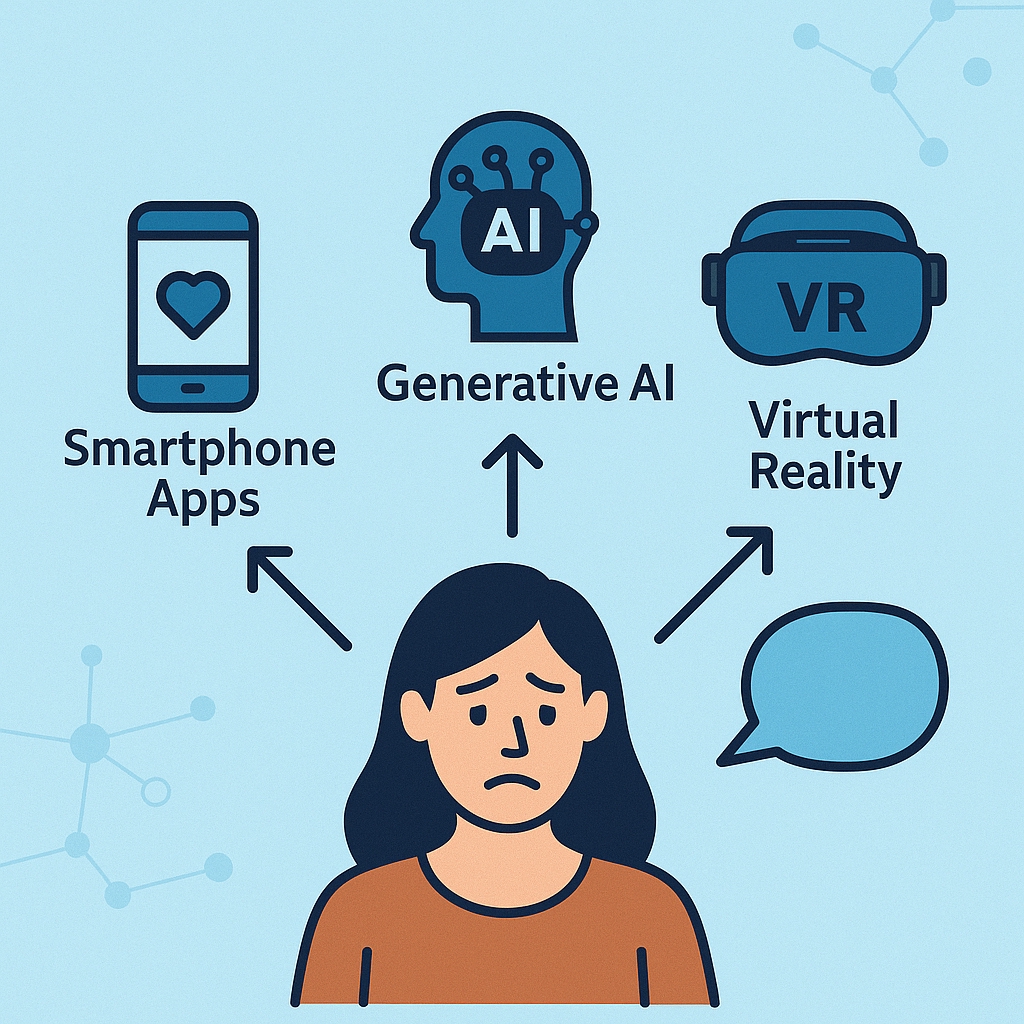
Made with ChatGPT
In this week’s other selection, Dr. Robert M. Post (of The George Washington University) and his co-authors write about lithium in a new Lancet Psychiatry paper. They offer a fresh take on this old medication; they argue that it is a disease-modifying agent, like monoclonal antibodies for multiple sclerosis. “Conceptualisation of lithium as a disease-modifying agent might help to increase clinical use by doctors, especially early in the disease course to better serve our patients.”
DG
Selection 1: “The evolving field of digital mental health: current evidence and implementation issues for smartphone apps, generative artificial intelligence, and virtual reality”
John Torous, Jake Linardon, Simon B. Goldberg, Shufang Sun, et al.
World Psychiatry, June 2025

The surge in telehealth related to the COVID-19 pandemic has transformed the behavioral health field, yet the nature of the emerging domain remains in flux. Synchronous telehealth (video visits) rapidly expanded access to care during the pandemic, and psychiatry recorded the highest use of these visits compared to other medical specialties. However, the reliance of traditional telehealth on clinician availability limited scalability, and growth is already contracting. Recent data indicate that telehealth visits in 2024 were less than 50% of their COVID-19 peak…
Asynchronous digital health – such as the use of smartphone apps, virtual reality, and generative artificial intelligence, including large language models (LLMs) – offers unique opportunities to scale care delivery. Unlike traditional telehealth, these tools can function as self-help, coach-guided, or clinician-led interventions, providing flexibility and accessibility outside of immediate clinician interactions. While initial enthusiasm for these technologies remains high, a notable gap in robust, real-world evidence continues to preclude their integration into routine care… Hybrid models that utilize both traditional telehealth and asynchronous digital health reflect the latest evidence and represent a promising approach to increase access and quality of care. However, blending the use of novel technologies into care requires careful consideration… The optimal dose and balance of human and digital support, delivered in new hybrid or blended formats, presents a new frontier.
So begins a paper by Torous et al.
The paper focuses on three areas:
Smartphone apps and digital phenotyping
“The interest in smartphones extends beyond their potential to deliver apps and interventions. These same devices are also capable of surveying patients in real time, enabling ecological momentary assessment for the vast majority of the population. In addition, data from smartphone sensors can generate behavioral metrics (e.g., sleep patterns, sedentary periods) and information on environmental exposures (e.g., local temperature, light exposure, greenspace) that can provide personalized contexts and temporal trajectories for how individuals experience mental illness. Often referred to as digital phenotyping, recent evidence on this approach in youth and adults provides promising signals with clinical validity.
“A recent review exploring machine learning applied to digital phenotyping noted that mood disorders, anxiety disorders, and schizophrenia spectrum disorders are the three most studied conditions across all health care, even beyond mental health. Relapse detection in schizophrenia and symptom prediction in mood disorders have strong pilot results with replication and external validation which provide promising generalizable clinical signals.”
Virtual reality
“Virtual reality is emerging as a significant innovation in the field of mental health treatment. In using immersive simulations, it addresses a key limitation of traditional mental health interventions, which are often restricted to clinical settings and rely on patients recalling experiences and subsequently applying therapeutic techniques in their daily lives. A recent review of the field found that a growing body of research supports the efficacy of virtual reality-based interventions across different mental health conditions.
“The unique capacity of virtual reality to recreate real-world environments has been particularly effective in augmenting cognitive-behavioral therapy (CBT), otherwise known as VR-CBT. The majority of randomized controlled trials (RCTs) of VR-CBT approaches have been conducted in anxiety disorders, with a recent meta-analysis finding that they were superior to waiting lists or psychoeducation controls. However, significant heterogeneity between effect sizes was evident, and active comparisons yielded non-significant differences.”
Generative artificial intelligence
“Few innovations have garnered so much interest in mental health as generative artificial intelligence… A new generation of artificial intelligence-driven chatbots is becoming increasingly prevalent in digital mental health, evolving from early rule-based chatbots. However, these latter chatbots are still common, and a 2022 review suggested that, across all of health care, 96% of chatbots were driven by decision-tree-like logic and not actual artificial intelligence… Recent advancements have shifted toward machine learning-powered models, particularly LLMs. These models, trained on vast datasets from the Internet and other sources, address many of the limitations of rule-based systems. Their ability to generate human-like responses has made them valuable not only as tools but also as virtual companions… Preliminary research has demonstrated the potential of LLMs across various stages of mental health care. While much of this work has not been replicated, these pilot studies underscore the broad range of applications. For prevention, LLMs can offer low-risk, personalized psychoeducation, effectively raising mental health awareness by utilizing high-quality resources…”
Dr. Torous and his colleagues also weigh challenges to engagement and implementation, and digital mental health for minorities and in low-resource contexts. Here, we consider engagement.
“One of the most widely cited challenges to the utilization of mental health digital tools is low engagement, which refers to a lack of uptake and/or poor adherence to interventions in service users.” They make several suggestions and we focus on three.
Personalized fit and integration into daily life
“Systematic reviews report that customizable, personalized content which aligns with users’ values and culture supports better engagement, while one-size-fits-all approaches are less engaging. Digital mental health interventions need to better align with users’ needs and expectations, and be tailored to be inclusive for minority groups and by age. Customizable reminders and assessments are reported as beneficial to enhancing engagement. It has been suggested that personalized coaching could enable digital mental health interventions to better align with end users’ needs.”
Human support
“Multiple reviews report that professional guidance – whether from therapists, coaches, counselors, or other health professionals – is crucial for user engagement and adherence. End-users consistently prefer digital mental health interventions that include professional support, finding these more engaging and safer than unguided or self-guided interventions, which could be viewed as impersonal or distressing. Some reviews report that end-users prefer a digital mental health intervention as a complement to existing, in-person therapy rather than a replacement…”
Digital literacy
“The effectiveness of digital mental health interventions has been closely tied to factors such as digital literacy, familiarity with technology, and availability of training. Limited technological skills and low digital literacy among users are substantial barriers to effective usage of digital interventions, and these issues are compounded when end-users are confronted with technological barriers. Programs designed to teach digital literacy to people with serious mental illness have shown promising pilot results and offer a tangible solution that should be expanded.”
A few thoughts:
1. This is a remarkable review, published in one of the biggest journals in our field.
2. If you read one paper on digital mental health this year, you should read this one.
3. Obviously, the above summary doesn’t well capture the nuance and detail of the paper.
4. Here are three take-aways:
- These are early days. Though there is evidence and great promise, results are heterogenous and often lacking in vigour (like comparing an app to a wait-list control).
- Engagement is problematic. As the authors note: “Even among individuals who consent to participate in a study on a mental health app, as many as 50% never download the app. Furthermore, those who download the app are unlikely to use it for more than a few days, and even fewer complete the entire treatment program.”
- Cool isn’t enough. Integration into routine care requires hard work, supported by implementation science strategies like co‑design, clinician training, and service infrastructure.
4. Torous et al. offer suggestions for better engagement, including the need for human involvement (like coaching). Is a human touch the key to successful digital interventions?
5. Interested in voicing your opinion on AI and medicine? Dr. Torous and Dr. Eric Achtyes (of Western Michigan University) are studying physician attitudes to AI. They ask physicians to complete a confidential survey which should take under ten minutes. See:

The full World Psychiatry paper can be found here:
https://onlinelibrary.wiley.com/doi/10.1002/wps.21299
Selection 2: “Lithium as a disease-modifying drug for bipolar disorder”
Robert M. Post, Victor W. Li, Michael Berk, Lakshmi N. Yatham
The Lancet Psychiatry, 9 June 2025 Online First

Despite first-line recommendations in guidelines, the use of lithium remains extraordinarily low. Its use is declining relative to other agents, including atypical antipsychotics and anticonvulsants, for the management of bipolar disorder. For instance, in a 2020 study of nationally representative data from the USA, Rhee and colleagues found that prescription rate increased from 12.4% to 51.4% for antipsychotics and 47.0% to 57.5% for antidepressants from 1997–2000 to 2013–16, whereas the rate for mood stabilisers (including lithium) decreased from 62.3% to 26.4% and specifically for lithium from 30.4% to 17.6%…
A 2018 systematic review of observational studies noted that lithium is superior to other agents, including lamotrigine, valproate, carbamazepine, quetiapine, olanzapine, unspecified anticonvulsants, and many other typical and atypical antipsychotics… We suggest that lithium be re-evaluated to determine whether it warrants recognition as a disease-modifying drug.
So begins a paper by Post et al.
They argue that there is a theoretical basis to view lithium as a disease-modifying agent. “Lithium reduces the risk of cardiovascular disorders, dementia, osteoporosis, and all-cause mortality in patients with bipolar disorder, and is arguably the only agent capable of addressing both the progression of the underlying psychiatric disorder (neuroprogression) and the progression of medical comorbidities (somatoprogression).” They focus on several areas; here, I highlight three:
- Oxidative stress. “Oxidative stress is more pronounced during mood episodes or after multiple episodes, and is probably mediated by mitochondrial dysfunction. Lithium has been shown to reduce oxidative damage to cells by reducing the superoxide dismutase to catalase ratio, thereby reversing the oxidative stress changes in patients experiencing mania.”
- Telomeres. “At the chromosome level, telomeres are abnormally shortened by childhood stressors, high numbers of depressive episodes, and implacable anger. Lithium lengthens telomeres in patients with bipolar disorder in a time-dependent manner by directly catalysing telomerase.”
- Cognition. “Patients treated with lithium have better visual memory and potentially other cognitive measures than patients not on lithium, and also appear to be better protected against dementia in old age. In individuals without bipolar disorder, lithium is now postulated to act as a potential disease-modifying drug in Alzheimer’s disease via its inhibition of GSK3β…”
They also argue for a clinical basis in seeing lithium as a disease-modifying agent.
Acute mania
“A 2019 Cochrane review that included 4220 patients across 36 randomised control trials for monotherapies compared lithium with placebo and other medications for bipolar disorder. Lithium showed clear efficacy, with high certainty of evidence for inducting response and remission of acute mania relative to placebo…”
Bipolar depression
“Lithium is not well studied in acute depression. Several crossover studies with placebo in the 1970s and 1980s had positive results for lithium but problematic methodology. The Systematic Treatment Enhancement Program for Bipolar Disorder (STEP-BD) trial was a randomised controlled trial and so used more modern methodology than a crossover trial; the trial showed that mood stabilisers with or without antidepressants were similarly effective for treating acute bipolar depression, and more than 30% of patients received lithium as their mood stabiliser in this trial.”
Maintenance treatment in bipolar
“Evidence supports the efficacy of lithium in preventing relapse of mood episodes. A Cochrane review that included studies done until 2001 confirmed the maintenance efficacy of lithium in preventing relapse of mood episodes. Since then, three maintenance trials that used modern trial methodology with Kaplan–Meier survival analysis all confirmed the efficacy of lithium in preventing relapse of mood episodes and manic episodes… Beyond randomised control trials, a meta-analysis of observational studies totalling more than 14 000 patients with bipolar disorder with 1–7.5 years of follow-up showed that, as maintenance treatment, lithium was superior to valproate, lamotrigine, olanzapine, quetiapine, carbamazepine, and unspecified antipsychotics or anticonvulsants for rehospitalisation rates, relapse rates, and required medication rotations or combinations.”
A few thoughts:
1. This is an excellent paper on a relevant topic.
2. Regardless of whether or not you find the core argument persuasive, the authors have thoughtfully summarized the evidence for lithium’s effects on different phases of bipolar disorder.
3. More controversially, they argue that lithium is so effective at so many levels that it’s best understood as a disease-modifying one – not unlike biologics for MS. “Patients with bipolar disorder treated with lithium appear to live longer and be healthier than patients not treated with it. Lithium treatment is associated with a noteworthy decline in risk for the comorbid medical disorders that are more common in people with bipolar disorder such as cardiovascular disease, dementia, and cancer.”
4. There is much to like in this paper, though a note of caution. The authors do include results from animal models, lab findings, and a mix of different types of studies (RCTs, observational studies).
5. Perhaps, on this much, we can all agree: lithium is a great medication for those with bipolar disorder. The declining use of it relative to other medications is deeply problematic.
The full Lancet Psychiatry paper can be found here:
https://www.thelancet.com/journals/lanpsy/article/PIIS2215-0366(25)00097-5/abstract
Reading of the Week. Every week I pick articles and papers from the world of Psychiatry.
August 1, 2025 at 5:09 pm
I appreciate that the comment section of this blog site includes comments from families about issues related to psychiatry. Given Canada’s lack of mental illness literacy campaigns that include essential information about disorders like schizophrenia, I very much wish that the Canadian Psychiatric Association (like the American Psychiatric Association) would include this kind of content on its website. I discuss this issue in this article:
https://dawsonross.wordpress.com/2025/05/19/guest-blog-a-plea-to-the-canadian-psychiatric-association/