Tag: hunter

Reading of the Week: Drs. Maunder and Hunter’s New Book

From the Editor

We are going to teach you how to keep your head above water while you manage your complicated life, even when it feels overwhelming. Writing a book that teaches how to cope, however, feels like a monumental act of hubris. Ask our partners, friends, or kids, and they will tell you that our confidence that we can add value to your struggle, whatever it is, is not based on our having any innate coping superpowers. Rather, we know the evidence, and we have learned how to teach it.

Drs. Robert Maunder and Jonathan Hunter, psychiatrists affiliated with the University of Toronto, open their new book with this comment.

It’s a complicated world, and some people struggle. The authors try to answer a question that is both ordinary and profound: What can we do when life becomes overwhelming? Drs. Maunder and Hunter’s new book, Coping: Fix Problems, Find Meaning, Feel Better, is intended for a general audience and points a way forward, with an optimistic tone, hundreds of citations, and clear advice. The book is about coping. It’s also about trauma, adversity, and finding strength.
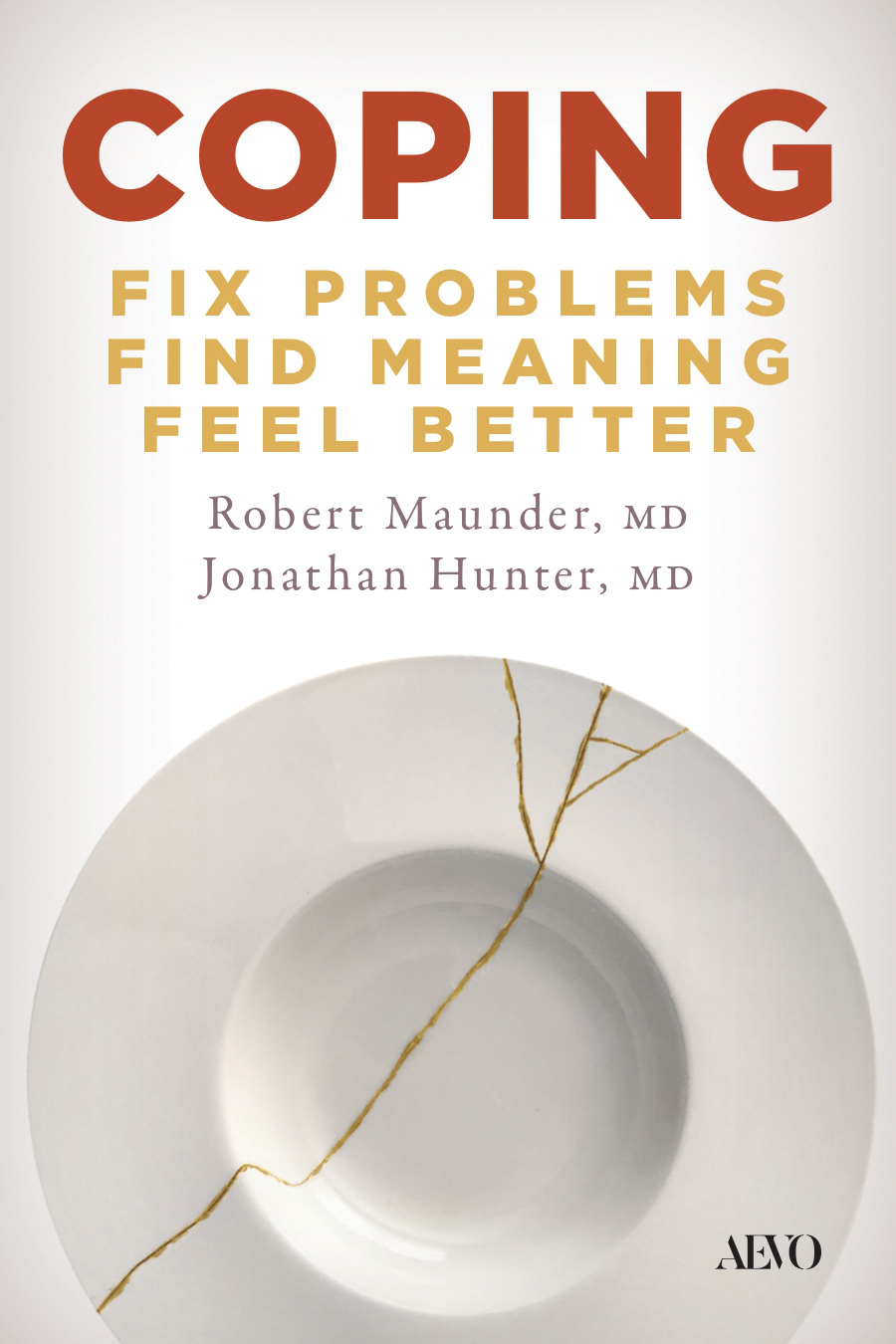
This week, there is only one selection: an excerpt from their new book, chosen by the authors.

How should we think about this work? At some level, it’s a really smart self-help book, offering clear suggestions on important topics. How can we sleep better? Page 87 offers tips, drawing on CBT-I. There is also discussion of box breathing (p. 102), cutting back on device time (p. 157), and more. 

The book isn’t just about living better – it’s about acknowledging that some are living through extraordinary circumstances. They open by talking about working with patients and providers during the SARS outbreak. The book includes interviews with patients. They also discuss deeper topics like CBT and DBT. At points, the book touches on philosophy; the excerpt that follows includes a discussion of Nietzsche.

The book’s central ideas are simple: fix what you can; feel better about what you can’t fix; and, when suffering persists, live meaningfully.

Thus, the book is really a break from the typical self-help books that populate the shelves of bookstores. They don’t peddle glib recommendations, such as the need to start every day by making your bed. They instead tap the literature and offer good – though not necessarily easy – advice. Coping is ultimately less a promise to make life easier than an invitation to develop a better toolkit to deal with adversity. “Coping as fully and as effectively as you can with all the adversity that is inevitable in your life will reveal who you are.”

During the pandemic, patients would often ask about maintaining mental health during social isolation – as did friends and family. Rowan Diamond and Dr. John Willan (both of Oxford University) wrote a short paper for The British Journal of Psychiatry that I often mentioned, outlining several strategies that could help. Reading Coping, I thought about those conversations – and I thought about incorporating the Maunder-Hunter suggestions into my discussions with patients now; I also thought about the patients to whom I could recommend the book. Frankly, many would benefit.

Of course, this raises a larger question: At a time when we speak more about mental health, why are we collectively doing so badly? Studies suggest that people are more anxious and depressed, feel more isolated, and rate their mental health as poorer. National data finds more homelessness, drug misuse, and workplace absenteeism. In terms of coping, then, we seem to be getting a failing grade. Drs. Maunder and Hunter touch on this topic – we live in “impossible times,” they write in the last chapter. Perhaps we will need to wait for their next book to have a better understanding of how we got here.

In the meantime, Coping is an excellent book on an important topic.

A special word of thanks to the University of Toronto Press for making this Reading possible.

Note: there will be no Readings for the next two weeks.

DG


Continue reading

Reading of the Week: Improving Self-Esteem in Youth – the New JAMA Psych Paper; Also, Black Females & Suicide and Dr. Jon Hunter on the End

From the Editor

Can we help youth before the onset of full disorders to build skills and avoid deeper problems? Several school-based efforts, offering DBT and mindfulness skills, have been tried without much success. Ecological momentary interventions (EMIs) – provided to patients during their everyday lives and in natural settings, giving unstructured recommendations with structured interventions – is a newer therapy that has gained attention.

But does it work? In a new paper for JAMA Psychiatry, Ulrich Reininghaus (of the University of Heidelberg) and his co-authors describe an RCT focused on youth with low self-esteem who have had past adversity, involving 174 Dutch participants. “A transdiagnostic, blended EMI demonstrated efficacy on the primary outcome of self-esteem and signaled beneficial effects on several secondary outcomes.” We consider the paper and its implications.

In the second selection, Victoria A. Joseph (of Columbia University) and her co-authors look at US suicide rates in Black females. In their American Journal of Psychiatry letter, they analyze suicides over two decades, drawing data on age and region from a national database. They conclude that: “increasing trends in suicide death among Black females born in recent years and underscores the need to increase mental health care access among Black girls and women, and to reduce other forms of structural racism.”

And in the third selection, Dr. Jon Hunter (of the University of Toronto) contemplates endings – including his ending – in a personal and moving paper for CMAJ. He notes the need to clean up his possessions. But what about his practice and the many patients that he has followed for years? “I’d rather not shy away from the uncertainty and loss of the ending, and to try to help one more time.”

DG

Continue reading

Reading of the Week: The Best of 2016 (and a Look Ahead to 2017)

From the Editor

It’s a Reading of the Week tradition that we end the year by considering the best of the previous 12 months.

And this year we have had great material to consider. Readings were drawn from diverse publications, including journals, but also newspapers and magazines; one Reading was a speech given by the Prime Minister of the United Kingdom. (On the rich diversity of material, I made a similar comment last year.)

If once no one seemed to discuss mental illness, today these issues are being talked about.

But instead of just looking back, let’s take a moment to look ahead.

For those of us concerned about mental health services, 2017 looks like it will be a great year.

Consider:

· Though the provinces and the federal government failed to make an historic deal in 2016 that would invest in mental health services, federal and provincial ministers of health all agree that mental health needs to be a priority, and some type of deal is likely to happen.

· In 2016, Starbucks Canada made headlines for its investment in mental health benefits for employees; it’s highly likely that other companies will follow this lead in the coming months.

· In the past year, more people spoke out about their mental health problems, including a famous singer and an Olympic swimmer; in 2017, more people will find their voice and share their stories.

So – Happy New Year.

Thanks to all those who made suggestions for Readings. And thanks to Dr. David Goldbloom for his three guest contributions, as well as to my father and to my wife for their editing.

There will be no Reading next week.

DG Continue reading

Reading of the Week: The New Maunder-Hunter Book

From the Editor

Patrick is not participating in physiotherapy, and is thus not eligible for discharge. To the staff on the orthopedics ward at the hospital where I work, that’s a Big Problem.

On Tuesday afternoons, I finish at the Birchmount campus of The Scarborough Hospital and drive to the General, where I see patients on medical and surgical floors. And on a recent Tuesday, I met Patrick.

For the record, Patrick has more than one Big Problem. Patrick smokes and he drinks too much. Patrick has diabetes and lung changes. Patrick is obese. And it’s the combination of all of the above that led to the fall that left him with the fractured hip and the surgery. If Patrick is doing badly – this is his second hospitalization in fifteen months – it’s not for lack of health-care effort. Since his last discharge, he has seen an endocrinologist, his family doctor, and a respirologist. Patrick has home care. Patrick is, in other words, a heavy user of the health-care system. And if we are serious about restraining health costs in light of an aging population, we need to find better ways of dealing with people like Patrick.

This week’s Reading: an excerpt from the new Maunder-Hunter book. In it, the authors forward the following idea: people like Patrick can be better helped if we think about attachment theory.

As you will recall, attachment theory is based on experiments with children exposed to strangers. To summarize (and possibly oversimplify) some very clever experiments: after seeing the stranger, if the child seeks out the parent, and is soothed, it’s considered healthy, or secure attachment, as opposed to insecure attachments, like avoidant attachment and resistant attachment (where the child is less interested in the parent or is difficult to soothe).

This is a terrific and important book – and of interest to all clinicians.

It’s thoughtful and relevant. Do you see patients? You should get this book.

DG

Continue reading