Tag: Patel

Reading of the Week: Psychosocial Care After War – The New Lancet Psych Paper; Also, AI vs Physicians (JAMA) and the Latest in the News

From the Editor

He survived the civil war. But nightmares haunted him and he rarely left his apartment. My patient had survived, yes, but his mental health problems, untreated in his home country, tormented him. In a world of war and violence, my patient’s experiences – the mental illness and the lack of care – are all too common. 

With few psychiatrists and psychologists, could non-specialist providers help fill the treatment gap? Anushka R. Patel (of Harvard University) and her co-authors attempt to answer that question in an impressive new systematic review and meta-analysis published in Lancet Psychiatry. Drawing on a quarter century of studies and involving more than 10 000 survivors, they compared non-specialist care with a relatively inactive control. “Our findings support the overall effectiveness of non-specialist provider-delivered psychosocial interventions for violence survivors…” We consider the paper and its implications.

In the second selection, from JAMA, Dr. Ezekiel J. Emanuel and his co-authors write thoughtfully if controversially about artificial intelligence. While many assume that medicine will be reshaped by the collaboration of physicians and computers, they suggest otherwise, focusing on five cognitive medical tasks. “That in the near future AI alone may provide better patient care than physicians or physician-controlled hybrids at 5 fundamental cognitive medical tasks is unsettling but seems probable.”

Finally, we review the latest news with articles from The Toronto StarThe Wall Street Journal, and The Globe and Mail. The topics: addiction treatment, the bias of therapists, and the PTSD and research of Margaret McKinnon.

DG

Continue reading

Reading of the Week: RCTs & Mental Health – the New CJP Paper; Also, AI and Discharge Summaries (Lancet DH), and Mehler Paperny on Action (Globe)

From the Editor

How has psychiatric research changed over time?

In the first selection, Sheng Chen (of CAMH) and co-authors attempt to answer this question by focusing on randomized controlled trials in mental health in a new paper for The Canadian Journal of Psychiatry. Using the Cochrane Database of Systematic Reviews, they look at almost 6,700 RCTs published over the past decades. They find: “the number of mental health RCTs increased exponentially from 1965 to 2009, reaching a peak in the years 2005–2009,” and observe a shift away from pharmacologic studies.

RCTs: the gold standard of research

In the second selection, Sajan B. Patel (of St Mary’s Hospital) et al. consider ChatGPT and health care in a new Lancet Digital Health Comment. Noting that discharge summaries tend to be under-prioritized, they wonder if this AI program may help in the future, freeing doctor to do other things. “The question for the future will be how, not if, we adopt this technology.”

And in the third selection, writer Anna Mehler Paperny focuses on campaigns to reduce stigma in a hard-hitting essay for The Globe and Mail. She argues that action is urgently needed to address mental health problems. She writes: “We need more than feel-good bromides. Every time someone prominent utters something about how important mental health is, the follow should be: So what? What are you doing about it? And when?”

DG

Continue reading

Reading of the Week: Lithium vs. Newer Meds for Bipolar – What’s Best? Also, Nudging Vaccines and Beale on Her Illness Experience & Being a Doctor (BMJ)

From the Editor

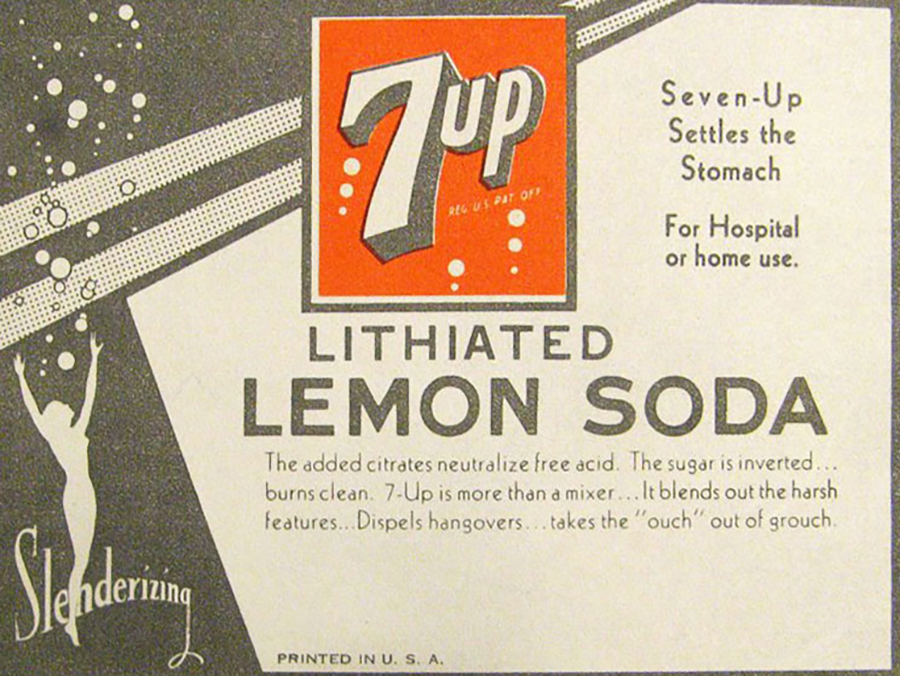
In the past, lithium had a large role – in the treatment of bipolar, yes, and before that, as a general remedy for a variety of conditions. Indeed, lithium could be found in various things, including pop (see the picture of the ad for 7 Up below). But times have changed. Lithium prescriptions are less common, and bipolar management increasingly involves other medications. (And, no, 7 Up doesn’t contain that salt anymore.)

How does lithium compare to these medications for people with bipolar? Dr. Jens Bohlken (of the University of Leipzig) and his co-authors do a retrospective study drawing on a national database from Germany. “When treatment failure was defined as discontinuing medication or the add-on of a mood stabilizer, or antipsychotic, antidepressant, or benzodiazepine, lithium appears to be more successful as monotherapy maintenance treatment than olanzapine, citalopram, quetiapine, valproate, and venlafaxine.” We look at the big study, and mull its implications on this side of the Atlantic.

wxwbs-1443730637-blog-456

Can we nudge people to vaccinate? As the world works to get more shots in arms, Dr. Mitesh Patel (of the University of Pennsylvania) argues that behavioural economics will be important. In Nature, he writes that we have a golden opportunity to learn from the vaccine roll-out: “Each institution should report its vaccination efforts and performance, and conduct rapid experiments on how best to encourage people to get their vaccines – especially their second doses.”

Finally, some physicians have commented that being touched by illness has helped them become better doctors. Dr. Chloe Beale, a British psychiatrist, agrees to disagree in a blog for BMJ. “I can’t give the expected, tidy narrative of emerging stronger for having my illness.”

DG

Continue reading

Reading of the Week: Who is at Risk for Daily Cannabis Use? What Should Every Physician Know About Global Psychiatry? And Hussein on Her Psychotic Break

From the Editor

It’s legal. It’s also addictive.

As clinician, we worry about who may be at risk of heavier use of cannabis. In a new paper published in The Canadian Journal of Psychiatry, the University of Montreal’s Erika Nicole Dugas and her co-authors draw on data to try to identify early risk factors for daily use, drawing on 23 potential risk factors. Their findings are plausible – could the list be used for early interventions?

school-tests

At risk?

Also, this week, we consider my podcast interview with Harvard University’s Vikram Patel, who talks about mental health services in low-income nations. Dr. Patel is fresh off his win of the John Dirks Canada Gairdner Global Health Award, called the Canadian Nobel by some. (I do ask him what he plans to do with the prize money.)

And, in our third selection, singer Ladan Hussein discusses her psychosis – “I returned home to Toronto in January 2018, broken, dishevelled and deranged” – and her recovery.

DG

Continue reading