Page 5 of 54

Reading of the Week: Lived Experience of Postpartum Depression & Psychosis – the New World Psych Paper; Also, Involuntary Treatment and Family Stress

From the Editor

“You are normal and then the next thing, you know, you’re crazy.”

So comments a woman about her postpartum depression. Typically, we describe this illness with a list of symptoms. But how do patients experience it? In a new World Psychiatry paper, Dr. Paolo Fusar-Poli (of King’s College London) and his co-authors attempt to answer this question with a “bottom-up” approach, looking at both postpartum depression and psychosis. “To the best of our knowledge, this is the first bottom-up review of the lived experience of postpartum depression and psychosis. Experts by experience co-designed, co-conducted and co-wrote the study, leveraging an established methodological template developed by our group to investigate the lived experience of psychosis [and] depression…” We look at the paper and its implications.

Should people with substance problems be forced into treatment? Across North America, some are proposing this idea, including governments in British Columbia and Alberta. In a new Canadian Journal of Psychiatry paper, Benedikt Fischer (of the University of Toronto) and his co-authors look at the issue and the evidence. “Involuntary treatment for severe SUD is a complex and contentious concept that requires careful in-depth consideration before its adoption.”

In the third selection, a paper written anonymously for The BMJ, the author describes the challenges for families of those with severe mental disorders. He notes his deep frustration with visits to the ward, often leaving him in tears. “Perhaps family support needs to become part of the culture on mental health wards, and we should recognise the need for help in communicating.”

DG


Continue reading

Reading of the Week: When Does Grief Become a Disorder? The Lancet Review; Also, Time to End Daylight Saving Time? And Dr. Hickey on Her Anxiety

From the Editor

After the unexpected loss of his spouse, my patient sank deeply into grief. He was tearful during our sessions, explaining that a part of him had died, too. Weeks turned to months. Was this a normal response to a profound loss? Or something more problematic? DSM-5 seeks to clarify the issue by recognizing prolonged grief disorder – though the disorder is controversial and has attracted much criticism. When The New York Times covered the topic in 2022, Joanne Cacciatore (of Arizona State University) commented: “I completely, utterly disagree that grief is a mental illness.”

Clare Killikelly (of the University of Zurich) and her co-authors shed light on prolonged grief disorder with a new review, just published in The Lancet. They write about the disorder, the differences from grief, its treatment, and more, drawing on 142 citations. “Grief is a universal experience. However, for a minority of individuals, grief becomes a debilitating, devastating mental health disorder with serious implications on a personal and societal level.” We examine the review, highlight four take-aways, and reflect on the broader debate.

Spring forward, fall back. Twice a year, we adjust our clocks (and our brains) to and from daylight saving time. In the second selection, Dr. David Dongkyung Kim (of the University of Toronto) and his co-authors argue that daylight saving time should be eliminated. In their JAMA Commentary, they draw on the literature. “Daylight saving time transitions cause acute disruptions in human circadian rhythm, and the medical literature shows detrimental effects for public health.”

Finally, in the third selection, Dr. Joanne Hickey (of Memorial University) discusses anxiety and her expectations. In a personal CMAJ paper, the hematologist reflects on her work – and on her own journey, including her anxiety, the decision to take medications, and her need to come to terms with her perfectionism. “Anxiety has been my life companion, though I often didn’t recognize it. It masqueraded as that internalized need to control.”

DG

Continue reading

Reading of the Week: Are the Kids Alright? The New JAMA Paper on Mental Disorders & Children; Also, the Remarkable Life of Dr. Mary Seeman

From the Editor

Are children experiencing more mental disorders than before, or are we simply getting better at screening for them? Many have opinions and there is debate among psychiatrists and within our society.

In a new JAMA paper, Janet R. Cummings (of Emory University) and her co-authors provide new data shedding light on this issue. Drawing on US government databases covering 22 states and from 2010 to 2019, they looked at diagnoses and demographics among economically disadvantaged children. “This observational study found that the percentage of publicly insured children diagnosed with any mental health or neurodevelopmental disorder increased from 10.7% in 2010 to 16.5% in 2019.” We consider the paper and the accompanying Editorial – and wonder if this reflects better screening or more illness. 

In this week’s other selection, we look at the life and career of Dr. Mary Seeman, who died in 2024. In an obituary for The Canadian Journal of Psychiatry, Dr. Robert B. Zipursky (of the University of Toronto) and his co-authors note her many contributions to psychiatry. “Although Mary was 89 years old at the time of her death, her passion, humour, curiosity, and productivity had not abated. It endures now in the legacy of her scientific work, in her teaching and clinical care and in the many people she inspired to follow her example.”

DG


Continue reading

Reading of the Week: Gone to the Dogs? The New BJP Study on Dog-assisted Interventions; Also, BC Decriminalization & the Latest in the News

From the Editor

He presented for the appointment with his dog. He told me that getting the chocolate lab – who had been trained by a national, not-for-profit organization – was the best single thing to help him. For the record, the dog was beautiful.

More and more of our patients are turning to animal interventions. But is there evidence to support this trend? In a new The British Journal of Psychiatry paper, Emily Shoesmith (of the University of York) and her co-authors look at dog-assisted interventions (DAIs), describing a review involving 33 papers. “DAIs may show promise for improving mental health and behavioural outcomes for those with mental health or neurodevelopmental conditions, particularly for conditions requiring social skill support. However, the quality of reporting requires improvement.” We discuss the paper and its clinical implications.

In the second selection, John F. Kelly (of Harvard University) reviews the successes of drug decriminalization in Portugal and its failures in British Columbia. In a new Editorial for JAMA Psychiatry, he notes key differences in their approaches. He also mulls the importance of such public-policy experimentation. “As demonstrated in Portugal, persistent, patient, thoughtful analysis, and sensitive, systemic planning is needed to ensure lives are saved and other outcomes improved.”

Finally, we explore the latest news with articles from The New York TimesThe Globe and Mail, and NBC News. The topics: one firefighter’s battle with OCD, overdose deaths in North America, and a new mental-health awareness campaign.

DG

Continue reading

Reading of the Week: Preventing Mental Disorders After Disasters – the New BMJ Ment Health Paper; Also, Healthy Device Use and Dr. Qayyum on Regret

From the Editor

Floods. Hurricanes. Fire. Extreme weather seems to be more common these days – resulting in some experiencing PTSD and other mental disorders. In an age of climate change, what can mental health services offer? Is it possible to prevent major mental illness with interventions like CBT?

Ahlke Kip (of the University of Münster) and her co-authors attempt to answer these questions in a new meta-analysis and systematic review which assesses the efficacy of psychological and psychosocial interventions after exposure to natural hazards. In the BMJ Mental Health paper, they looked at 10 RCT studies involving more than 5 000 participants, including both civilians and disaster responders, focusing on symptoms of PTSD, depression, and anxiety. They didn’t find superiority to passive control conditions. “The current evidence does not allow for any recommendations regarding prevention programmes in the aftermath of natural hazards.” We consider the paper and its implications.

In the second selection, Joseph Firth (of the University of Manchester) and his co-authors weigh in on youth and digital device usage. In a paper for World Psychiatry, they sought “directly actionable advice” for parents and youth and then drew on the literature to create tips for teenagers. “We sought to produce a set of best-practice approaches, on the basis of available evidence and guidelines, for adolescents and their parents looking to improve their device usage patterns.”

And in this week’s third selection, Dr. Zheala Qayyum (of Harvard University) writes about guilt and time in a paper for Academic Psychiatry. The child and adolescent psychiatrist describes an unkind act in her youth – and an opportunity to make amends decades later. She also notes the tie to training and education. “Only by sharing and reflecting on our own moments, successes, failures, and vulnerabilities, can our trainees recognize and respond to such instances in their own experience.”

DG

Continue reading

Reading of the Week: AI Chatbots for Mental Healthcare – the New NEJM AI Paper; Also, Neuromodulation for Schizophrenia (AJP)

From the Editor

Thought logs. Homework. Exposure. Psychotherapy is evidenced for the treatment of many mental disorders – but access is problematic. Can technology help? Is AI a game changer?

In a new NEJM AI paper, Dr. Michael V. Heinz (of Dartmouth College) and his co-authors attempt to answer these questions. In an RCT, they compared 210 participants receiving a chatbot intervention (Therabot) with a control group, analyzing symptoms of mood, anxiety, and disordered eating. “As the first RCT of its kind, our study supports the feasibility, acceptability, and effectiveness of a fine-tuned, fully GenAI–powered chatbot for treating mental health symptoms.” We consider the paper and its implications, and tap the expertise of Dr. John Torous (of Harvard University).

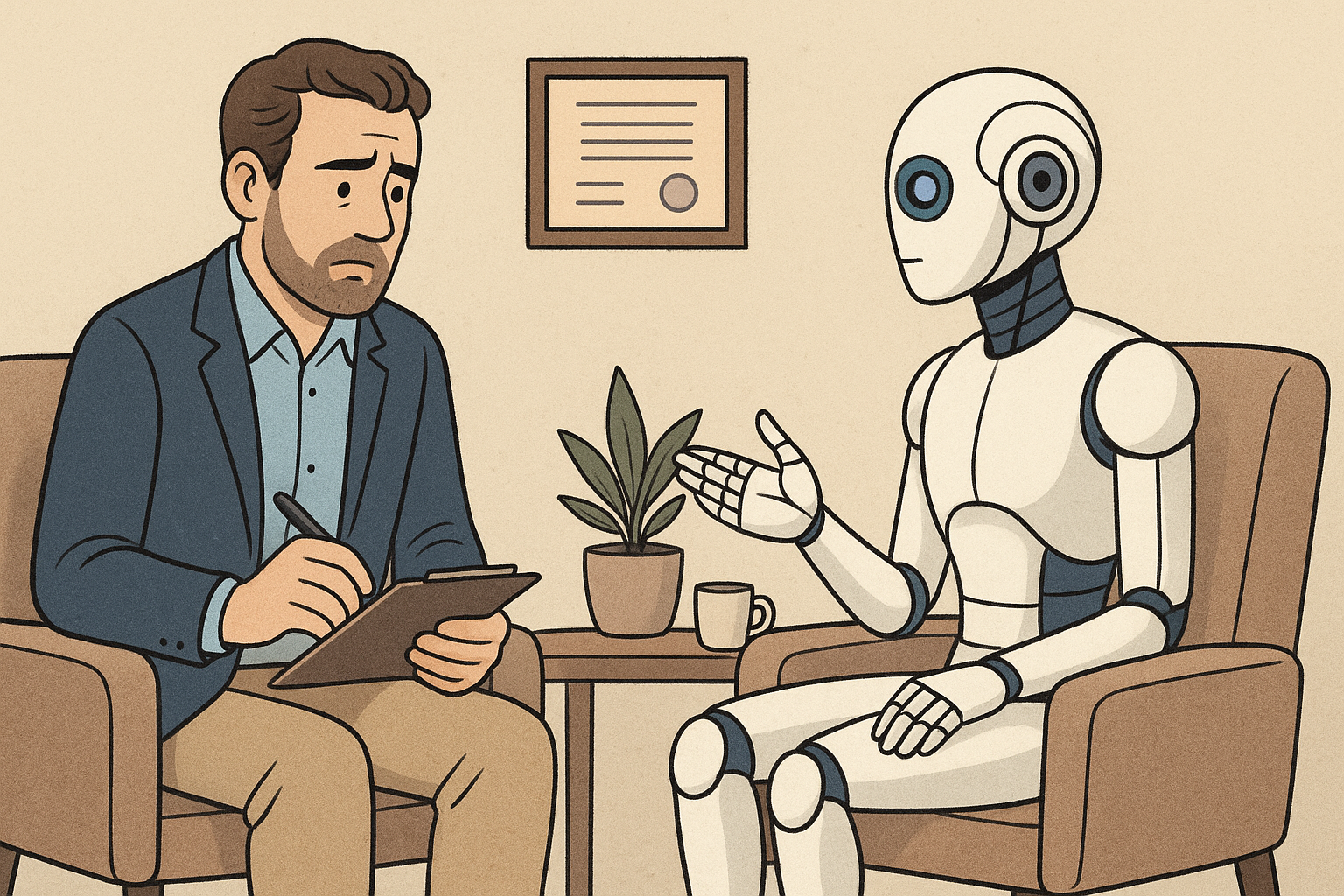
An AI bot for better mental health?

In this week’s other selection, we look at a new review from The American Journal of Psychiatry. Drs. Nicholas H. Neufeld and Daniel M. Blumberger (both of the University of Toronto) provide an update on neuromodulation strategies for schizophrenia, drawing on nearly 140 citations and reviewing different technologies “that span electrical, magnetic, and ultrasound forms of stimulation.” They note: “The evolution of interventions holds the promise of fewer adverse effects and a noninvasive approach, increasing the scale at which these interventions may be offered in hospital and community settings.”

DG

Continue reading

Reading of the Week: ADHD – with Papers from JAMA Psych, PLOS One & Psych Services

From the Editor

He had struggled for years with mood and ADHD. While we discussed different medication options, my patient was very focused on psychedelics; he explained that his friends had found microdosing to be helpful, especially for their attentional problems.

Psychedelics have entered the mainstream: research is active; patients seem increasingly interested; and, yes, investors offer up billions in the rush to find potential treatments (and profit). But is there evidence for psychedelics for those with ADHD?  Dr. Lorenz Mueller (of the University of Basel) and his colleagues attempt to answer that question with a new paper, just published in JAMA Psychiatry. They describe the first double-blind, placebo-controlled phase 2A randomized clinical trial. 52 participants received repeated doses of LSD (twice weekly) or placebo over six weeks. “In this randomized clinical trial, repeated low-dose LSD administration was safe in an outpatient setting, but it was not more efficacious than placebo in reducing ADHD symptoms.” We consider the paper and its implications.

The molecular structure of LSD – pretty but useful for ADHD?

In the second selection, Vasileia Karasavva (of the University of British Columbia) and her co-authors look at ADHD and social media in a new paper for PLOS One. In a two-part study, they analyzed 100 popular videos on ADHD, finding many views but uneven quality. While they note the “democratizing” of mental health information, they warn: “TikTok’s anecdotal content could lead some viewers to misattribute normal behaviors or those better explained by other conditions to be signs of ADHD…”

In the third selection, Dr. Zilin Cui (of Boston University) writes about ADHD – as a provider and also as a patient. In a personal Psychiatric Services paper, the physician discloses long-standing problems and a diagnosis. She also writes about cultural considerations. “Instead of continuing to dwell on what I cannot do, I now have different tools and strategies to chart my path forward. Now, I can finally tell myself that I am enough.”

DG


Continue reading

Reading of the Week: Task-sharing in Therapy for Perinatal Depression – the New Nature Med Study; Also, Yoga, and Donelle on Grief After Her Daughter’s Suicide

From the Editor

She was so excited about the pregnancy; in our sessions, she expressed joy. But, as with some women after childbirth, her mood declined. She couldn’t properly care for her son, which she reported with shame and guilt. Perinatal depression is common – and yet many women in Canada and other high-income countries don’t receive care.

What can be done to help them? Could nonspecialist providers – like nurses, midwives, and doulas – be trained up to deliver psychotherapy effectively? Can telemedicine be used? In a new paper for Nature Medicine, Daisy Singla (of the University of Toronto) and her co-authors attempt to answer these questions. In their study, SUMMIT, they conducted a pragmatic, noninferiority trial comparing specialist and nonspecialist providers, delivering care in person or through telemedicine. Participants received eight treatment sessions of behavioural activation. They found noninferiority with both providers and modality of treatment. “This trial suggests compelling evidence for task-sharing and telemedicine to improve access to psychotherapies for perinatal depressive and anxiety symptoms.” We discuss the paper and its implications.

Daisy Singla

Alternative treatments – think mindfulness, acupuncture, yoga – have been historically popular with patients but generally lacking in evidence. Times have changed: mindfulness as a psychotherapy, for instance, is included in the CANMAT depression guidelines. What about yoga? Does depression care include the downward dog? In the second selection, a new episode of Quick Takes, I speak with Dr. Vanika Chawla (of Stanford University) who is part of that university’s lifestyle medicine team and a registered yoga teacher. “I think yoga is a wonderful way to expand providers’ toolbox of existing treatments.”

And in the third selection, Caroline Donelle writes about the suicide of her daughter. In a deeply personal essay for The Globe and Mail, she notes the loss, her decision to move across the country, and her slow healing. “I’m not the person I was when she died and never will be again. I’ve evolved and grown in unexpected ways.”

DG


Continue reading

Reading of the Week: Physician Suicide – the New JAMA Psych Paper; Also, Homelessness & Substance (JAMA)

From the Editor 

It’s a demanding profession that can push us. Not surprisingly, there is some evidence that physicians may be at higher risk of completing suicide than the general population. But are we?

Hirsh Makhija (of the University of California, San Diego) and his co-authors attempt to answer this question in new JAMA Psychiatry study. Drawing on a US national database, they compared suicides among male and female physicians to the nonphysicians, over five years, finding that suicide rates for female physicians were 47% higher than for women in the general population. They also looked at mood, mental health, and other problems. “Comprehensive and multimodal suicide prevention strategies remain warranted for physicians, with proactive consideration for those experiencing mental health issues, job problems, legal issues, and diversion investigations.” We review the paper and its implications, and look at the accompanying Editorial.

In this week’s second selection, Ryan D. Assaf (of the University of California, San Francisco) and his co-authors report on homelessness and substance use. In a new paper for JAMA, they surveyed 3 200 people, finding that 37% reported using any illicit substance regularly (more than three times per week), most commonly crystal methamphetamine. “In a representative study of adults experiencing homelessness in California, there was a high proportion of current drug use, history of overdose, and unmet need for treatment.”

Note that there will be no Readings for the next two weeks.

DG

Continue reading

Reading of the Week: Psychiatry & Daily Life with Papers on Mood Variation, Loneliness, and the Fear of Miscarriage

From the Editor 

In recent months, we have covered topics such as emerging evidence for a new medication treatment for alcohol use disorder, a new, short therapy for PTSD, and recommendations for managing insomnia. But what about psychiatry and daily life? This week, we make a bit of a pivot and ask: Should we have more morning meetings? How do we understand loneliness? And is the fear of miscarriage in need of its own (Greek-based) medical term? 

How does mood and anxiety vary over the course of the day, the week, and the season? In the first selection, Feifei Bu (of University College London) and her co-authors try answer that question in a new paper for BMJ Mental Health. Drawing on nearly a million observations, they assess time-of-day association with depression, anxiety, well-being, and loneliness. “Generally, things do indeed seem better in the morning.” We consider the paper and its implications – including whether morning meetings are, in fact, ideal.

Early morning, better mood?

Loneliness is increasingly recognized as a societal problem. A few years ago, the UK government created a Cabinet position to focus on the issue; Time magazine applauded “the World’s First Loneliness Minister.” In a new review for Nature Mental Health, Brendan E. Walsh (of the University of South Florida) and his co-authors push past the rhetoric and focus on the concept – or, rather, a couple of them. Walsh et al. then analyze demographics and propose treatments. “This Review is intended to be heuristic and to inspire future inquiry research across disciplines, including public health, psychology, healthcare, and social work/community health.”

And in the third selection, nurse Ruth Oshikanlu and Dr. Babatunde A. Gbolade (of the University of Leeds) discuss the fear of miscarriage. In a British Journal of Psychiatry letter, they argue that pregnant women worry about it, and a formal medical term (and more research) is needed. “We believe that apotychiaphobia, our proposed label for the fear of miscarriage experienced by pregnant women, goes beyond semantics. It entails appreciation for the emotional turmoil that many pregnant women face in silence.”

DG

Continue reading