An excerpt from the second edition of Dr. Joel Paris’ excellent book, made available to me by the author.
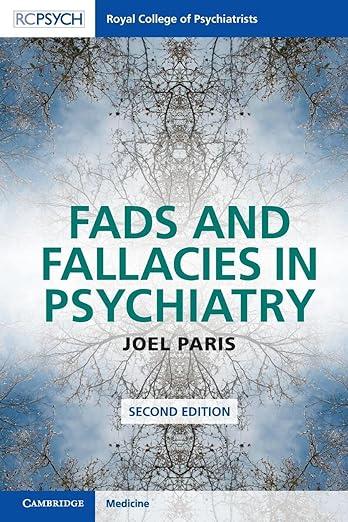
It’s excellent. Enjoy.
DG
An excerpt from the second edition of Dr. Joel Paris’ excellent book, made available to me by the author.
It’s excellent. Enjoy.
DG
From the Editor
How much exercise is enough to prevent illness?
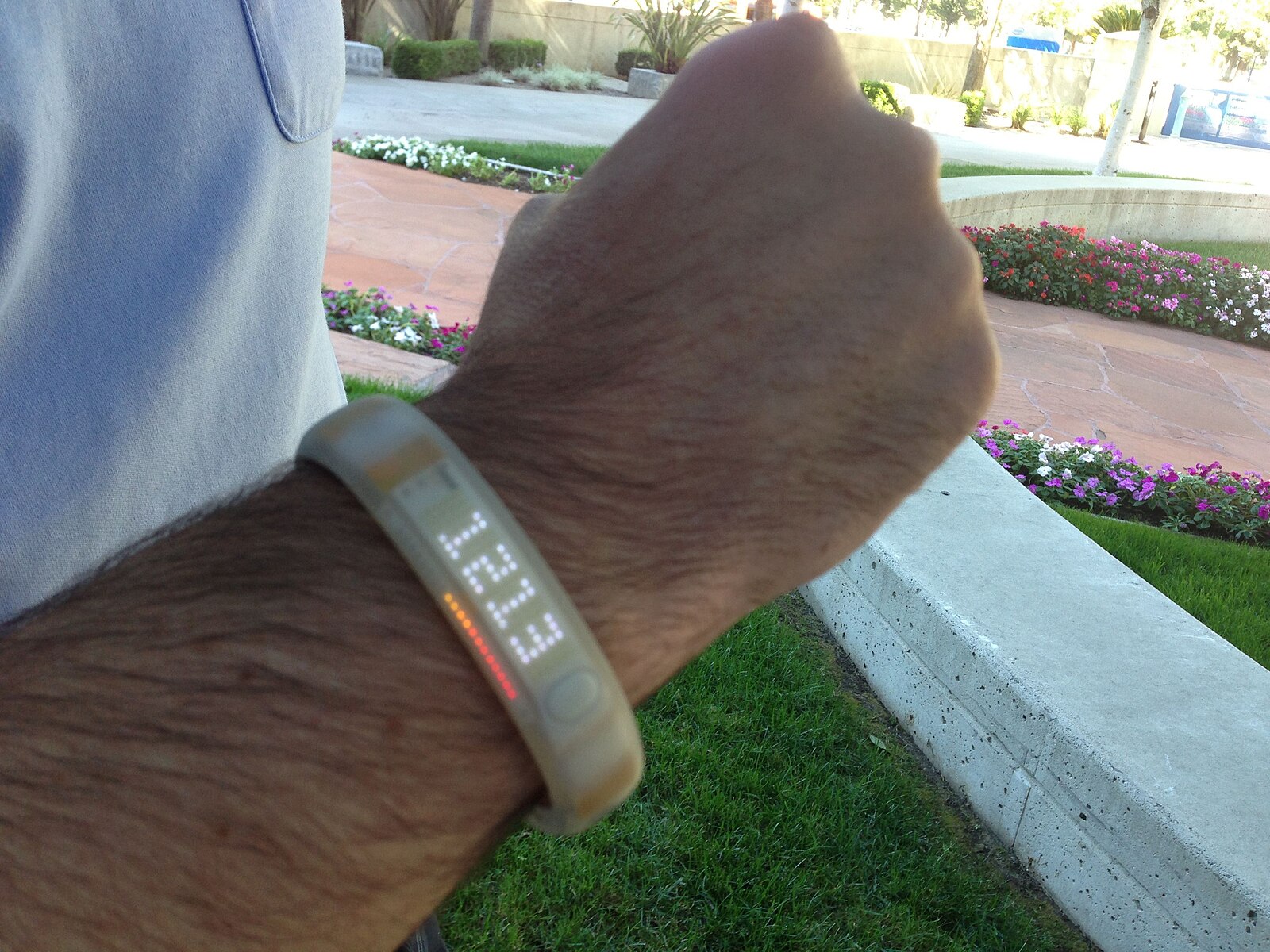
In the first selection, Ding Ding (of The University of Sydney) and her co-authors attempt to answer that question in a new, clever study for The Lancet Public Health. They did a systematic review and meta-analysis involving 57 studies that looked at daily step count and health outcomes, including depression. “Although 10 000 steps per day can still be a viable target for those who are more active, 7 000 steps per day is associated with clinically meaningful improvements in health outcomes and might be a more realistic and achievable target for some.” We consider the paper and its implications.
In the second selection, Isabelle Toler and Lindsey Grubbs (both of Case Western Reserve University) look at medical records and language in a paper for The New England Journal of Medicine. In a unique approach, they observe themes in the TikTok videos of patients who are frustrated by what their physicians have written about them. “In the context of a system of medical documentation in which patients have little power to shape their own narratives, clinicians should respect the channels they have chosen to use to share their stories and listen to the messages they convey.”
And in the third selection, psychologist Harvey Lieberman reflects on therapy and ChatGPT in an essay for The New York Times. As a therapist and an octogenarian, he is skeptical of the therapeutic aspects of ChatGPT – but, with use, he partly changes his mind. “I concluded that ChatGPT wasn’t a therapist, although it sometimes was therapeutic. But it wasn’t just a reflection, either.”
Note: there will be no Reading next week.
DG
From the Editor
Even with medications, the voices tormented him. My patient explained that his every move was commented on.
In avatar therapy, patients engage audiovisual representations of their voices, with the goal of reducing their influence. In the first selection, a new paper from Lancet Psychiatry, Lisa Charlotte Smith (of the University of Copenhagen) and her co-authors look at a new form of avatar therapy, with an immersive 3D experience. In this RCT, participants had enhanced usual care or the therapy; the severity of auditory hallucinations was then measured at 12 weeks. “Challenge-VRT showed short-term efficacy in reducing the severity of auditory verbal hallucinations in patients with schizophrenia, and the findings support further development and evaluation of immersive virtual reality-based therapies in this population.” We consider the paper and its implications.

In the second selection, Dr. Mark Ainsley Colijn (of the University of Calgary) writes about psychosis and rare genetic variation. In a Canadian Journal of Psychiatry paper – part of the new Clinician’s Corner series – he offers suggestions for antipsychotic meds. “When providing care for individuals with psychosis occurring on the background of rare genetic variation, psychiatrists should take the time to educate themselves accordingly to ensure the safe and rational prescribing of antipsychotic medications in this population.”
And in the third selection, from JAMA, Dr. Kumara Raja Sundar (of Kaiser Permanente Washington) comments on patients who use ChatGPT. The author, a family doctor, notes that many physicians can be paternalistic – but he urges against that instinct. “If patients are arming themselves with information to be heard, our task as clinicians is to meet them with recognition, not resistance. In doing so, we preserve what has always made medicine human: the willingness to share meaning, uncertainty, and hope, together.”
DG
From the Editor
He was keen to discuss his new therapist who introduced him to CBT concepts and noted his negative thoughts. The therapist was helpful and thoughtful – but not human. My patient was using an AI chatbot.
More and more patients are looking to AI for information and therapy. What to make of it all? And what is the role of other cutting-edge innovations? In the first selection, Dr. John Torous (of Harvard University) and his co-authors attempt to answer these questions in a new review for World Psychiatry. They focus on, yes, generative AI, as well as apps and virtual reality. The review is sparkling and comprehensive, stretching over 11 000 words and with 269 references. “New tools such as LLMs have rapidly emerged, while relatively older ones such as smartphone apps and virtual reality have quickly expanded. While each tool has offered evidence of clinical impact, broad real-world impact remains aloof for all.” We consider the paper and its implications.
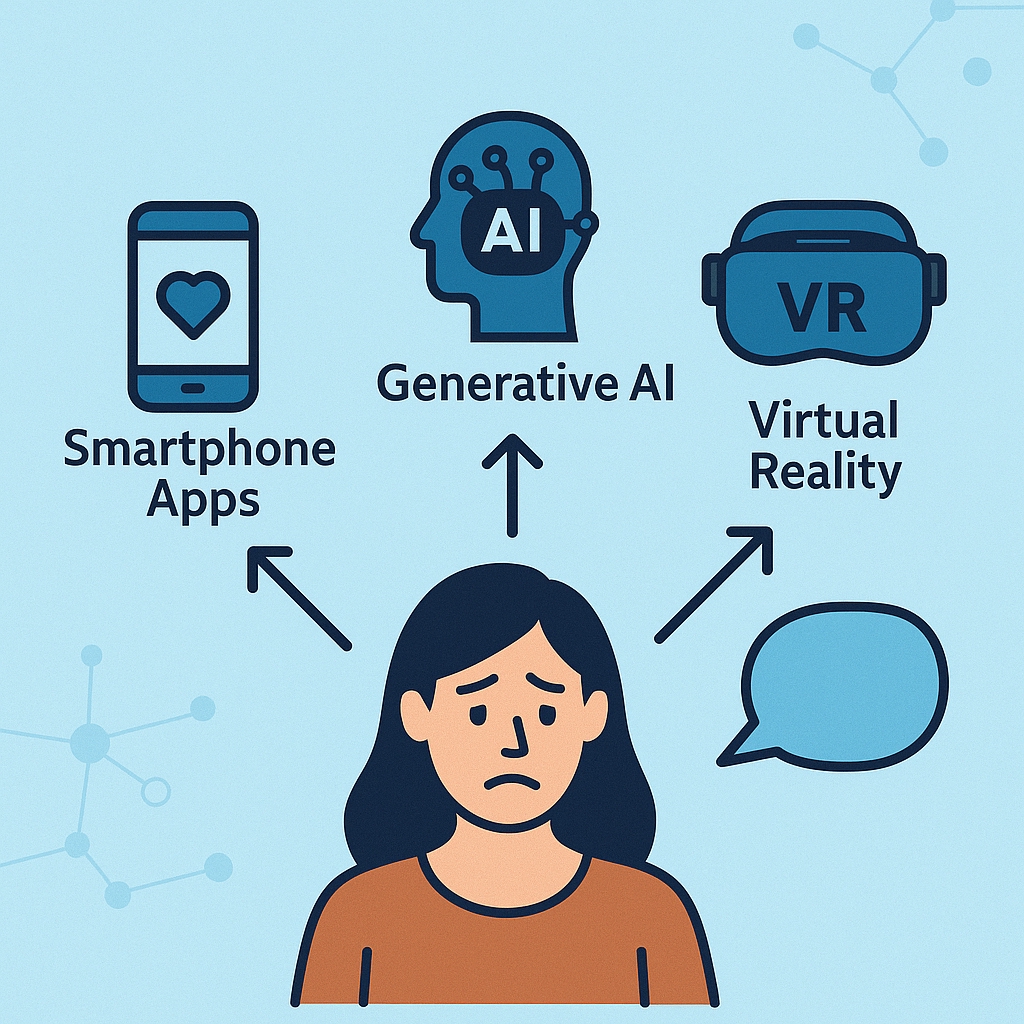
Made with ChatGPT
In this week’s other selection, Dr. Robert M. Post (of The George Washington University) and his co-authors write about lithium in a new Lancet Psychiatry paper. They offer a fresh take on this old medication; they argue that it is a disease-modifying agent, like monoclonal antibodies for multiple sclerosis. “Conceptualisation of lithium as a disease-modifying agent might help to increase clinical use by doctors, especially early in the disease course to better serve our patients.”
DG
From the Editor
Today, we talk more about physician mental health problems than even a few years ago. But what would meaningful action look like? What are the evidence-based interventions?
Katherine Petrie (of the University of New South Wales) and her co-authors attempt to answer these questions in a new Nature Mental Health paper. They did a systematic review and meta-analysis by examining 24 studies involving almost 2 400 practicing physicians. “Our results indicate that a range of physician-directed interventions produce positive effects on symptoms of common mental disorders and that these moderate effects are maintained over time (up to 12 months).” We consider the paper and its implications.

In the second selection, from BMJ Mental Health, Yusen Zhai (of The University of Alabama) and co-authors draw on US survey data to look at trends of clinically significant anxiety, depression, suicidal ideation, and service utilization among medical students. The findings are troubling. “This study reveals a rising prevalence of clinically significant anxiety and depression self-reported by US medical students from 2018 to 2023.”
Finally, in the third selection, Ph.D. candidate Alexandra K. Rodriguez discusses her struggles with severe depression when she attended medical school. In a personal essay for PLOS Mental Health, she speaks about her recovery and the power of the arts. “When I dealt with suicidality, I could not conceptualize a future, let alone one with meaning. Sharing time creating with friends and singing lyrics that resonated with me helped me reframe my lowest period as an inflection point, one from which I could envision both fulfillment and joy.”
DG
From the Editor
“New Research Questions Severity of Withdrawal From Antidepressants”
– The New York Times
“Antidepressant Pullback Symptoms Fewer Than Thought, Study Shows”
– Bloomberg
Millions of North Americans take antidepressants – about one in seven Canadians – yet these medications remain controversial. A 2019 Lancet Psychiatry study, which drew heavily from online surveys, found that roughly half of patients who quit these meds experienced severe withdrawal symptoms, sparking much debate – and many, many questions from our patients.
How common are discontinuation symptoms? Which one is most commonly experienced? Michail Kalfas (of King’s College London) and his co-authors attempt to answer these questions with a new JAMA Psychiatry paper. They did a systematic review and meta-analysis by analyzing 50 studies involving almost 18 000 people. “This systematic review and meta-analysis indicated that the mean number of discontinuation symptoms at week 1 after stopping antidepressants was below the threshold for clinically significant discontinuation syndrome.” We consider the paper and its implications.
Celebrities use them; politicians discuss them; our patients ask about them. Are semaglutide and sister drugs game changers for those with mental health problems who struggle with obesity? To explore the opportunities and challenges of these new medications, in a new episode of Quick Takes, I speak with Dr. Mahavir Agarwal (of the University of Toronto), Lisa Schaefer (of Obesity Canada), and Dr. Sanjeev Sockalingam (of the University of Toronto). “Imagine a world where you have all the effects of antipsychotics, but none of the side effects.”
Finally, in the third selection, journalist Alexander Nazaryan discusses his father’s mental illness and its impact on his life. In a deeply personal essay for The New York Times, he notes the long shadow of illness. “My father never got to become a famous physicist or see his son go to M.I.T. Worse, he couldn’t ask for help until it was too late.”
DG
Continue readingFrom the Editor
Substance work can be lifesaving. But it’s also challenging, as many patients continue to misuse illicit drugs or drop out of care or both. Evidence supports using incentives, including financial ones, to nudge patients toward sobriety. This approach, known as contingency management, includes tools such as vouchers and prizes.
But what forms of nudging work best? And how much of a financial incentive is needed? In a new JAMA Psychiatry paper, Carla J. Rash (of the University of Connecticut) and her co-authors attempt to answer these questions by looking at contingency management. In a systematic review, they drew on 112 protocols from 77 studies, analyzing types of nudges like vouchers (which may be exchangeable for, say, retails items) and prizes (a chance to win things like gift cards) and the amounts of money involved. The authors walk on a familiar path – the literature goes back four decades – but provide a meaningful update. “Based on these findings, weekly incentive magnitude estimates are $128/week for voucher protocols and $55/week for prize-based protocols.” We consider the paper and its implications.

ChatGPT is the most downloaded app in history with people using it for everything from finding recipes to writing emails. How could generative AI be used for mental health? In a perspectives paper for The Lancet, Drs. John Torous (of Harvard University) and Eric J. Topol (of the Scripps Research Translational Institute) discuss this important and timely topic. “Despite considerable promise, research is still required to establish AI’s benefit and safety for promoting mental health.”
And in the third selection from Academic Psychiatry, Dr. Ariel E. Wilson, a resident of psychiatry at Kaiser Permanente Oakland, writes about patient rights, certifiability, and the weight of making good decisions. The author asks if psychiatrists need to have thick skin. “The challenge in psychiatry lies in finding a balance – creating our own semi-permeable membrane that allows us to protect ourselves from feeling the sting of every emotion we encounter, while also maintaining empathetic and trusting relationships with our patients.”
DG
From the Editor
He survived the car accident that killed his partner. Although he was physically unscathed, he struggled with PTSD, lucidly describing in our sessions the nightmares and fears that dominated his life.
How long do such symptoms last? Does time heal? Frank D. Mann (of Stony Brook University) and his co-authors attempt to answer these questions with a new study, one of the largest and longest on this disorder to date. In the first selection, we examine their Nature Mental Health paper, involving 13 000 responders to the World Trade Center attack, and spanning 20 years of data. “Our findings highlight the enduring impact of PTSD among World Trade Center responders, with substantial variability in individual trajectories. Despite overall modest declines, a subset remained highly symptomatic, underscoring the need for continued treatment.” We consider the paper and its implications.

In the second selection from Psychiatric News, Dr. Steven Reidbord, a psychiatrist based in San Francisco, notes the rising popularity of therapy and how things are changing with AI. But he suggests there is a difference between “corner-cutting” therapy and real psychotherapy, which is meant for personal change. “Psychotherapists must defend quality care against the seductive fictions that pervade social media. Our own message may be less alluring, but it has the advantage of being true…”
And in the third selection, Dr. Christine A. Sinsky (of the American Medical Association) and her co-authors look at physician vacations. Drawing on a national survey of US docs, they analyzed vacations, work during these vacations, and burnout. “These findings suggest that support for taking vacation and efforts to reduce physicians’ obligations to perform patient care-related tasks while on vacation, such as providing full electronic health record inbox coverage, should be considered to prevent physician burnout.”
Note that there will be no Readings for the next two weeks. (The discussion of vacations is inspiring.)
And, on a pivot, to those completing their residency education at the end of this month: all the best in your careers. Enjoy this remarkable moment.
DG
From the Editor
She came into our ED feeling overwhelmed. After a recent breakup, she felt suicidal; the academic demands of grade 12 further stressed her. As a clinician, this type of adolescent presentation seems to be increasingly common.
But is it? Many people have opinions. Dr. Tanner J. Bommersbach (of the University of Wisconsin) and his co-authors attempt to shed light on the state of teen mental health with a new and important paper focused on suicidal ideation, plans, and attempts. In the first selection, we examine their American Journal of Psychiatry paper, involving almost 120 000 high school students, drawing on US survey data, and covering a decade and a half. “In this nationally representative sample… significant increases occurred in the percentage reporting past-year suicidal thoughts, suicide plans, and suicide attempts from 2007 to 2021.” We consider the paper and its implications.

In the second selection from BJPsych International, Dr. Rachel Gibbons (of the Royal College of Psychiatrists) writes about suicide. In a controversial paper, she argues that we make too many assumptions about suicide, which colour our research and undermine our understanding of patients. “Embracing the complexity of suicide may not only refine prevention but also deepen our understanding of suffering, resilience, and meaning.”
And in the third selection, playwright Dan O’Brien writes about his brother’s suicide for Esquire. In a deeply personal essay, he discusses his brother’s mental health problems and his parents’ desire to hide them. He wonders what could have been. “I would like to be helpful to some who might read this, if only to deny that the suffering of mental illness is a disgrace, and to assert that such suffering is common and survivable.”
DG
From the Editor
After completing a course of psychotherapy, he felt better and began a part-time job. The employment gave him a sense of purpose. As a physician, I could both sympathize and empathize; for many, work is a meaningful part of life, after all.
But does psychotherapy necessarily result in employment? Does therapy pay for itself with economic benefits? Otto R. F. Smith (of NLA University College) and his co-authors attempt to answer these questions in an impressive new paper in Psychological Medicine. They report on an RCT involving more than 700 Norwegian participants who were randomized to a psychotherapy program (modeled after the UK’s IAPT service) or to treatment as usual. The authors used administrative databases to analyze employment, income, and the economic benefit. “The results support the societal economic benefit of investing in IAPT-like services.” We consider the paper and its implications.

In the second selection, Dr. Calina Ouliaris (of Macquarie University) and her co-authors look at the zero suicide approach. In a Commentary for The British Journal of Psychiatry, they argue that – despite being studied and implemented in several places – it lacks evidence. “The Zero Suicide Framework is an arguably vague framework with a scant evidence base, particularly for application in healthcare settings. Despite this, the concrete goal championed… that of ‘zero suicides’, is appealing and has been widely promulgated in mental health services, ahead of evidence for the same.”
Finally, in the third selection, Dr. Chris Y. Kim (of the University of Toronto) and his co-authors weigh the use of melatonin for children and adolescents. In The Canadian Journal of Psychiatry, they are cautious, in part because of the lack of consistency of over-the-counter melatonin. “Melatonin used as a hypnotic agent for the treatment of insomnia is controversial.”
DG
Recent Comments