From the Editor
ChatGPT is the most downloaded app in history. People turn to AI for travel tips and restaurant advice. But what about its impact on those vulnerable to psychosis? Or those experiencing psychosis?
In a new research letter published in JAMA Psychiatry, Zachary Bergson (of Vanderbilt University) and his co-authors attempt to answer those questions by analyzing more than 200 000 mental health notes at an academic centre. “In this systematic analysis of AI psychosis, documented in the EHR of a large US medical setting, psychosis-worsening interactions with conversational AI were most common among patients experiencing their first episode of psychosis.” We consider the study and its implications.

In the second selection, from The American Journal of Psychiatry, Naomi Cruz (of Rutgers University) and her co-authors look at benzodiazepine dispensing in the United States, using data on 1.1 billion prescriptions. “From 2013 to 2024, the national prevalence of dispensed benzodiazepine prescriptions declined by more than one-quarter, with reductions across all patient age groups and most prescriber types as well as in the mean dose dispensed per benzodiazepine prescription.”
And in the third selection, from The Washington Post, Dr. Nebyou Belay, a psychiatrist, writes about the influence of the Internet on psychiatric diagnoses. He argues that social media can encourage people – particularly young people – to adopt psychiatric diagnoses before their symptoms have been properly assessed, blurring the line between normal distress and mental illness. “Psychiatry should help people understand what they are experiencing. Increasingly, however, the Internet gets there first.”
DG
Selection 1: “Characterizing Artificial Intelligence Psychosis in a Large Medical Setting”
Zachary Bergson, Sarah G. Vassall, Adam Wright, et al.
JAMA Psychiatry, 7 October 2026 Online First

Conversational artificial intelligence (AI) chatbots are increasingly linked to emerging or worsening psychotic symptoms, a phenomenon termed AI psychosis. Existing evidence, however, is limited primarily to case reports, viewpoints, and simulated experiments, with one published analysis of its occurrence in Denmark. While these works offer critical starting points, additional empirical data are needed to elucidate the factors characteristic of those who develop AI psychosis. Thus, we conducted a retrospective electronic health record (EHR) review at a large academic medical center to estimate prevalence, characterize affected patients, and describe the role of conversational AI in psychotic symptoms.
So begins a research letter by Bergson et al.
Here’s what they did:
- The authors conducted a retrospective cohort study drawing on electronic health records from Vanderbilt University Medical Center.
- Using Epic Clarity, the researchers “extracted clinical progress notes dated December 1, 2022, to April 15, 2026, from patients who received behavioural health care and whose records contained AI-related keywords.”
- “Only patients with a documented psychotic disorder were included.”
- Two reviewers manually examined the records. They classified patients into three groups: “neutral (eg, using ChatGPT to search for recipes), AI psychosis (psychosis-worsening chatbot use), or AI-related psychotic content (AI incorporated into a delusion without documented chatbot use)…”
- For patients in the AI psychosis group, the researchers further categorized the interactions using four predefined theoretical categories: catalyst (precipitating new symptoms), amplifier (worsening existing symptoms), coauthor (developing harmful narratives through iterative dialogue), and object (AI becoming the focus of delusional beliefs).
- The researchers reviewed medical records to determine whether the documented AI interaction occurred during a patient’s first presentation for psychotic symptoms. They also examined demographic and clinical characteristics, including psychiatric history, medication use, and previous suicide attempts.
- They performed several analyses, including chi-square tests, to compare characteristics across the three groups.
Here’s what they found:
- Of the 215 712 unique patients represented in 578 058 electronic health records, 73 patients met the study criteria. Of these, 28 were classified as having AI psychosis, 17 had neutral interactions with AI, and 28 had AI-related psychotic content without documented chatbot use.
- Demographics. Patients in the AI psychosis group had a median age of 27.5 years; most were male (67.9%) and White (75.0%). They were significantly younger than patients with AI-related psychotic content, whose median age was 36.5 years.
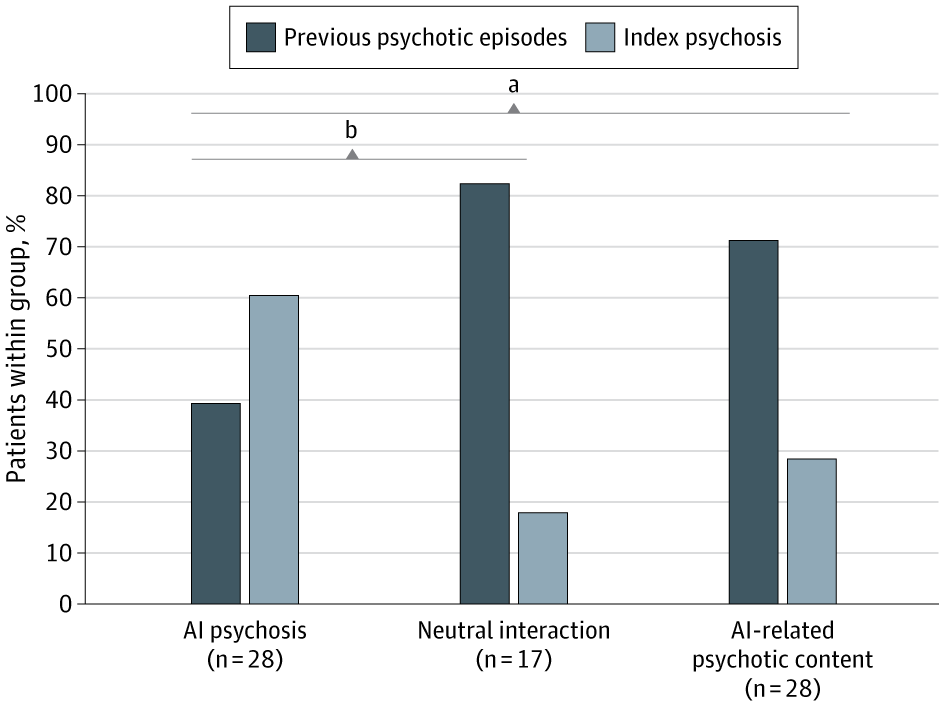
- First episode. Seventeen patients (60.7%) in the AI psychosis group were experiencing their first documented episode of psychosis, compared with 17.6% of those with neutral AI interactions and 28.5% of those with AI-related psychotic content. These differences were statistically significant.
- Types of interaction. The most common pattern was amplification, in which AI appeared to worsen existing or emerging symptoms (18 patients; 64.3%). In six cases (21.4%), AI was the focus of delusional beliefs; in three (10.7%), it appeared to precipitate new symptoms. No cases were classified in the coauthor category, which involved developing harmful narratives through iterative dialogue.
- Clinical history. The groups did not differ significantly in prior psychiatric hospitalization, history of psychotropic medication use, outpatient treatment, or suicide attempts. However, unspecified psychosis was more common in the AI psychosis group than in the neutral-interaction group.
- Chatbot use. ChatGPT was the documented AI product in 15 of the 28 AI psychosis cases (53.6%). Most interactions (85.7%) were documented after the May 2024 release of GPT-4o.
A few thoughts:
1. This is a good and helpful research letter, published in a major journal, that moves beyond case reports and offers data.
2. The main finding in a sentence: “Our findings suggest that the early phase of psychotic illness may confer particular vulnerability to symptom-worsening AI interactions.”
3. Some perspective: of the more than 200 000 people receiving mental healthcare over the study period, just 0.013% were classified as having AI psychosis. In 17 of those cases, patients were experiencing their first episode of psychosis – which is interesting but doesn’t establish causation. Indeed, AI seemed to act more as an amplifier than as a catalyst.
4. More perspective: this research letter offers some data – but not amazing data. The study has clear limitations, including its single-site design and use of a rating system that is not clinically validated.
5. Still, there are clinical implications. Commenting for another publication, a co-author notes: “There is evidence that in people who are at clinical high risk of psychosis or who are in its early stages, use of generative AI could worsen the psychosis.”
6. Should clinicians seeing patients experiencing a first episode of psychosis ask more about AI chatbot use?
The full JAMA Psychiatry research letter can be found here:
https://jamanetwork.com/journals/jamapsychiatry/fullarticle/2854891
Selection 2: “National Trends in Benzodiazepine Dispensing”
Naomi Cruz, Hillary Samples, Stephen Crystal, et al.
The American Journal of Psychiatry, 30 September 2026 Online First

Benzodiazepines (BZDs) are commonly prescribed medications in the United States. In 2019, over 90 million BZD prescriptions were dispensed nationally, and roughly 1 in 10 adults reported past-year use. BZDs are approved by the U.S. Food and Drug Administration (FDA) to treat select psychiatric and nonpsychiatric conditions, including anxiety disorders, insomnia, and seizure disorders in adults and only seizure disorders in children and adolescents… BZD use increased rapidly after the approval of the first BZD in 1960, leading BZDs to become one of the most widely prescribed classes of medication by the 1970s. In subsequent decades, concerns about potential harms emerged alongside evidence of the clinical benefits associated with BZD treatment; nevertheless, BZD use in the United States has remained high…
Examining recent national trends in BZD dispensing is critical to understand the present landscape of BZD use and to help ensure safe and effective dispensing practices. Previous studies have indicated fluctuations in BZD prescribing over the past three decades. From the late 1990s to the mid-2010s, the number of adults filling BZD prescriptions increased by 67%. This shift may be partially attributable to escalations in BZD-involved ambulatory visits with nonpsychiatric specialists, including primary care physicians who comprised roughly half of all BZD visits nationwide in 2015… Recent research suggests that BZD prescribing in the United States has declined since the mid-2010s.
So begins a paper by Cruz et al.
Here’s what they did:
- The authors conducted a repeated cross-sectional study examining national trends in benzodiazepine (BZD) dispensing in the US from 2013 to 2024.
- Data were drawn from the IQVIA Longitudinal Prescription dataset, which “includes approximately 90% of dispensed retail prescriptions, 77% of mail-order prescriptions, and 72% of long-term care facility prescriptions in the United States covered by all payment sources.”
- Using statistical analyses, they estimated “annual BZD prescription fill counts, prevalence, and mean total dose dispensed per BZD prescription stratified by patient age and prescriber type to show temporal trends from 2013 to 2024.”
Here’s what they found:
- The study identified more than 1.1 billion benzodiazepine (BZD) prescription fills among 252 million unique patients aged 2 and older between 2013 and 2024.
- Trend. The annual prevalence of BZD dispensing in the United States declined by 26.7%, from 7.5% of the population in 2013 to 5.5% in 2024. Prevalence peaked at 7.6% in 2015 before declining.
- Demographics. Dispensing declined across all age groups. The largest relative decrease was among young adults aged 18–29 (44.8%).
- Prescribers. Primary care physicians accounted for the largest share of BZD prescriptions, followed by advanced practice providers and psychiatrists/mental health specialists. Between 2013 and 2024, dispensing declined for BZD prescriptions from primary care physicians (44.3%), psychiatrists and mental health specialists (38.3%), and pain medicine specialists (62.5%).
- Dosage. The mean total dose dispensed per prescription fell by 18.3%, from 427 to 349 mg in diazepam equivalents. Decreases occurred across all age groups and prescriber types, with the largest reduction among pain medicine specialists (65.3%).
- Children and adolescents. Overall BZD dispensing prevalence declined by 10.1% among patients aged 2–17.
A few thoughts:
1. This is a good study, published in a major journal, with an amazing dataset (including 1.1 billion filled prescriptions).
2. The main finding in three words: down, down, down.
3. To be a bit more detailed on dispensing: overall prevalence, prevalence across all age groups, and total dosage all declined.
4. Good news.
5. Benzodiazepines have long raised concerns about overprescribing and overuse. The authors argue that the results “may suggest greater caution in prescribing, potentially due to growing awareness of BZD involvement in opioid-related overdoses and safety concerns relating to FDA boxed warnings.”
6. Like all studies, there are limitations. The authors note several, including: “although the data include most BZD prescription fills in the United States, our analyses do not capture all BZD prescriptions (e.g., those dispensed during inpatient hospitalizations).”
The full American Journal of Psychiatry paper can be found here:
https://psychiatryonline.org/doi/10.1176/appi.ajp.20251346
Selection 3: “They suddenly exhibited psychiatric symptoms. It traced back to videos.”
Nebyou Belay
The Washington Post, 8 October 2026

In the spring of 2019, something unusual began happening at the Tourette’s syndrome clinic at Hannover Medical School in Germany. Teenagers and young adults were arriving with sudden-onset, elaborate tic-like behaviors that looked little like the syndrome psychiatrist Kirsten Müller-Vahl had spent decades treating. Unlike Tourette’s patients – whose initial tics are often very simple, such as blinking – some of these young people made complex movements. Others shouted obscenities or peculiar phrases such as ‘flying sharks.’ Stranger still, their symptoms were sometimes remarkably similar to those of other patients.
Eventually, Müller-Vahl’s team found the connection. A young German man named Jan Zimmermann had recently launched a YouTube channel called Gewitter im Kopf – ‘Thunderstorm in the Brain’ – about his life with Tourette’s syndrome. It became a sensation. Some had watched it and subsequently developed the same unusual movements, words and phrases they had seen in Zimmermann’s videos. Researchers called the phenomenon ‘mass social media-induced illness.’ Similar presentations were soon reported elsewhere.
So begins an essay by Dr. Belay.
He continues: “Social media posts routinely present feeling socially awkward, disliking eye contact, being sensitive to noise, becoming exhausted after socializing or developing intense interests as signs of autism. All are real experiences; none are specific to autism. Yet repeated exposure to content that connects these traits to autism can lead people to understand themselves through an explanatory framework: This must be why I have always felt different.” He puts the symptoms in a larger context. “These tic-like behaviors, called functional neurological symptoms, are real and involuntary. What appeared to have been transmitted was not the distress itself but rather a template for the form that distress could take.”
As a psychiatrist, he sees “something much larger happening in mental health.” He points to TikTok and other platforms. “Social media is not simply spreading good or bad information about psychiatric disorders; it is increasingly supplying the language through which people interpret their experiences – and, in some cases, helping shape how distress is expressed.”
“The language of psychiatry is especially alluring because it is the stuff of human experience. Sadness. Worry. Difficulty concentrating. Feeling socially awkward. Becoming preoccupied with something. Feeling uncomfortable in your body or detached from yourself. These symptoms are not like an elevated blood glucose level or a tumor showing up on a scan. Rather, such experiences, in less extreme forms, are an ordinary part of life.”
He ties symptoms back to the larger cultural context. “Culture has always influenced how people understand and express psychological distress. But never before have millions of people been exposed, repeatedly and algorithmically, to the same psychiatric vocabulary, symptom demonstrations and explanatory frameworks.” He comments on his experiences as a physician. “Young people often arrive not simply with symptoms but with explanations for them. Sometimes they have spent months consuming material about a particular diagnosis – and sometimes, that diagnosis has become intertwined with their understanding of who they are.”
He closes by thinking about our times and our jobs as clinicians. “Taking someone’s suffering seriously does not require automatically accepting the explanation they have attached to it. A clinician’s job is to ask what a patient’s experiences actually are, what else might account for them, how they fit together and what they mean. But the traditional sequence has been reversed. The symptoms no longer necessarily arrive before the explanation. The explanation may already be supplied well before the patient enters the exam room.”
A few thoughts:
1. This is a good essay on an important topic.
2. As practicing clinicians, haven’t we all noticed the rise in the number of patients who believe they have autism?
3. He offers a nice perspective on autism and other popular psychiatric terms. “None of this means autism, eating disorders or dissociative disorders are not real. Nor does it mean that people who misunderstand their experiences are inventing their suffering. Suffering can be genuine even when culture helps determine the form it takes.” Thoughtful.
4. I’ve made this comment before and I’ll repeat it now: We practice in the era of TikTok; you may love or loathe social media – but it is our reality.
The full Washington Post essay can be found here:
https://www.washingtonpost.com/opinions/2026/10/08/im-psychiatrist-beware-social-media-diagnoses
Reading of the Week. Every week I pick articles and papers from the world of Psychiatry.
Recent Comments