From the Editor
Last year, Daisy Singla (of the University of Toronto) and her co-authors published an important paper on perinatal care. The SUMMIT trial borrowed a page from experiments in low-income countries where – with few providers – non-specialists have been trained up for some psychotherapies. There may be a great distance between rural India and the urban North American centres participating in SUMMIT, but Singla et al. showed impressive results at three months for those with perinatal depression.
But do the benefits continue after those first months? In this week’s first selection, a new paper from The Lancet Obstetrics, Gynaecology, & Women’s Health, Singla et al. attempt to answer that question with a secondary analysis.“Behavioural activation for perinatal depression produced sustained improvements over the 12 months since randomisation when delivered by non-specialist providers… with similar clinical outcomes and favourable economic value relative to specialist delivery.” We consider the paper and its implications.

In the second selection, Dr. William Smith (of the University of North Carolina at Chapel Hill) and his co-authors look at AI and regulations in a new Viewpoint published in JAMA Psychiatry. As AI’s role in mental health grows, they review current US state and federal government regulations. “Emerging federal and state regulatory approaches remain vague and are sometimes conflicting.”
Finally, in the third selection, Dr. Daniel Saddawi-Konefka (of Harvard University) writes about depression and stigma. The JAMA paper is personal – he describes his own experiences. He also notes that disclosing mental illness is often considered brave. “My wish is duller still, a world where getting help for your mind is as ordinary as filling your car’s gas tank.”
DG
Selection 1: “Sustained clinical and cost-effectiveness of task-sharing and telemedicine for perinatal depression: a secondary analysis of a pragmatic, factorial, randomised controlled trial”
Daisy R. Singla, Claire de Oliveira, Richard K. Silver, et al.
The Lancet Obstetrics, Gynaecology, & Women’s Health, October 2026

Evidence-based psychotherapies, such as behavioural activation, are effective in treating perinatal depression, preferred by perinatal populations, and recommended globally in international treatment guidelines, including the US Preventive Services Task Force, American College of Obstetricians and Gynaecologists, Canadian Network for Mood and Anxiety Treatments Perinatal Mood and Anxiety Disorder Guidelines… Despite their robust clinical and cost-effectiveness, fewer than 10–20% of affected women receive any evidence-based psychotherapies, including in Canada and the USA. Access barriers to psychotherapies include cost, scarce specialist providers, childcare demands, geography, and scheduling barriers.
Task-sharing and telemedicine are two scalable strategies to potentially address these persistent access gaps. Task-sharing, which involves training non-specialist providers (ie, individuals without specialised degrees or training in mental health care, such as nurses, midwives, doulas, and lay counsellors) to deliver structured psychotherapies, has emerged globally as a pragmatic and evidence-based strategy, including for perinatal depression. Telemedicine, defined here as the synchronous delivery by a trained human provider using secure, real-time audio or video communication technologies, is a promising approach to reduce geographical, transportation, childcare, and scheduling barriers.
So begins a paper by Singla et al.
Here’s what they did:
- They conducted a secondary analysis of the SUMMIT trial, a pragmatic, factorial randomized controlled trial at three university-affiliated health networks in Canada and the United States.
- Participants were pregnant or postpartum adults with depressive symptoms.
- “Participants were randomly assigned (1:1:1:1)… to receive behavioural activation from either non-specialist (nurses, midwives, and doulas with no previous experience delivering psychotherapy) or mental health specialists (≥5 years of psychotherapy experience) via telemedicine or in-person…” They were all offered six to eight weekly sessions.
- The primary outcome: depressive symptoms, measured with the Edinburgh Postnatal Depression Scale (EPDS). Anxiety symptoms were also measured. Outcomes were assessed at 3, 6, and 12 months.
- The researchers also examined health-care costs and quality-adjusted life-years to assess cost-effectiveness.
Here’s what they found:
- There were 1 230 participants; 617 were assigned to treatment delivered by non-specialists and 613 to specialists; 941 received treatment by telemedicine and 289 in person. Follow-up data were available for 1 042 participants at 12 months.
- Demographics and illness experience. Participants had a mean age of 33.27 years; 47.15% identified as being Black, Indigenous, or Persons of Color, and 54.49% had not previously given birth. Most (85.73%) reported a history of depression or anxiety.
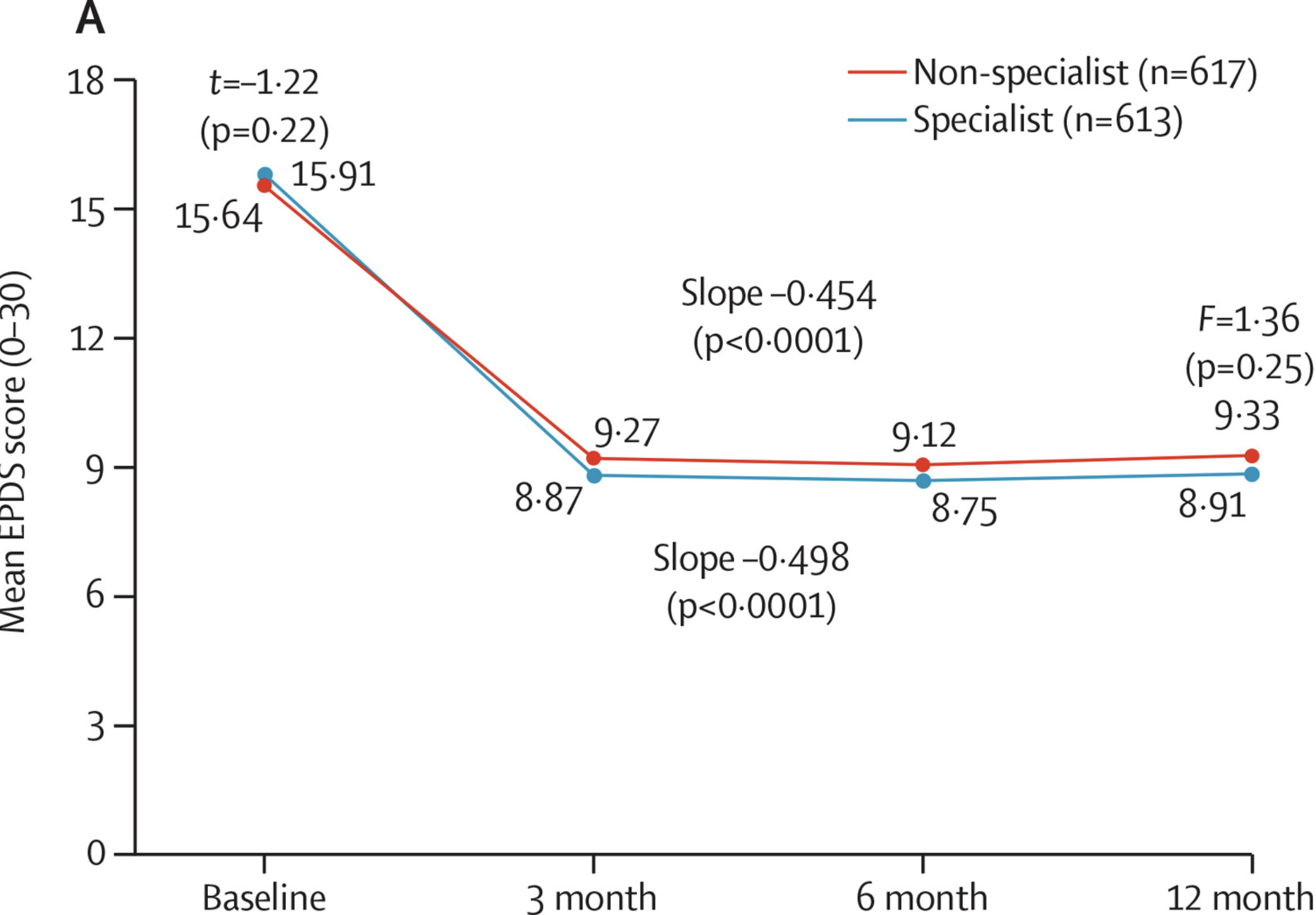
- Depressive symptoms. Symptoms improved significantly over 12 months in all groups, with no significant differences between non-specialist and specialist providers or between telemedicine and in-person delivery. 59.21% of participants had EPDS scores below the threshold for clinically significant symptoms at 12 months. (!)
- Anxiety symptoms. Anxiety symptoms showed a “significant reduction” over 12 months. Outcomes were similar across provider types and delivery modalities, including among participants with mild, moderate, or severe baseline symptoms. (!)
- Costs and cost-effectiveness. Intervention costs were lower with non-specialists than with specialists (US$441.72 vs $1 019.60 per participant) and with telemedicine than with in-person delivery (US$667.37 vs $954.69). Total health-care costs were also lower with non-specialist providers and telemedicine groups, although the differences were not statistically significant. Cost-effectiveness analyses favoured non-specialist and telemedicine delivery, with no meaningful differences in quality-adjusted life-years.
- Adverse events. None were considered related to the trial.
A few thoughts:
1. This is a very important paper – a secondary analysis, yes, but based on a major study with implications in North America and beyond.
2. The main finding in a sentence: “In this large, pragmatic, multisite, factorial trial, behavioural activation delivered by non-specialist providers and via telemedicine showed sustained improvements in perinatal depressive and anxiety symptoms over 12 months, with no meaningful differences in health-related quality-of-life compared with specialist-delivered and in-person behavioural activation.”
3. Wow.
4. The authors see implications for care delivery: “sustained improvements were observed among participants with mild, moderate, and severe baseline symptoms, suggesting that these scalable approaches could be applicable to a broad range of perinatal presentations rather than being limited to milder or transient symptoms.”
5. They push further, arguing against the status quo: “The continued reliance on specialist-only or in-person only delivery models is neither clinically necessary nor economically justifiable for providing structured, evidence-based psychotherapies such as behavioural activation.” It’s a bold statement – but one that is consistent with their data.
6. Like all studies, there are limitations. The authors note several, including a pandemic-related imbalance in participant allocation.
The full Lancet Obstetrics, Gynaecology, & Women’s Health paper can be found here:
https://www.thelancet.com/journals/lanogw/article/PIIS3050-5038(26)00254-2/fulltext
Selection 2: “The Need to Clarify Regulation of Mental Health Artificial Intelligence”
William R. Smith, Brian D. Earp, Benjamin Buck, et al.
JAMA Psychiatry, 14 October 2026 Online First

Artificial intelligence (AI) agents, including those based on large language models (LLMs), may eventually provide low-cost, scalable psychotherapeutic tools amid our mental health care access crisis. Specialized AI agents developed specifically for mental health purposes largely remain in development and testing. Some show signs of feasibility, acceptability, and efficacy in short-term trials with methodological limitations (eg, waitlist controls and brief follow-up). In contrast, general agents (those like ChatGPT that are designed for a broad range of purposes) are widely used for mental health support, but carry risks, including reinforcing responses to suicidal and psychotic prompts. Some specialized agents might prove more effective or safer than general agents, but the evidence base is in its infancy. Regardless, many users may not understand the uncertainty about agents’ risks and benefits, especially adolescents, who often use agents for mental health support without informing anyone.
Regulation is critical to optimizing risk-benefit balance. However, emerging federal and state regulatory approaches remain vague and are sometimes conflicting.
So begins a paper by Smith et al.
They focus first on federal regulations. “Federal regulatory efforts have varied. Executive Order 14365 aimed to ‘ensure…a minimally burdensome national standard’ for AI regulation while directing the Attorney General to challenge ‘burdensome’ state statutes. However, recently, Executive Order 14409 more cautiously promoted voluntary AI cybersecurity regulation, although stricter regulation was considered.”
At the state level, they observe that “statutes are proliferating.” Despite ambitious goals, they see problems including poorly defined terms.
- AI-driven therapy. Illinois and Nevada limit AI-driven therapy “both by therapists in clinical contexts and laypeople outside of such contexts. They prohibit therapists from using AI in psychotherapy, beyond administrative or supplemental support.” The authors note problems: “it is unclear whether some activities (eg, drafting safety plans or therapeutic homework) constitute support or therapeutic communication.”
- AI with clinicians. Some states “enable therapeutic use of AI with clinician involvement.” New Mexico “allows therapists to use AI that is accurate and reliable, but does not clarify the tasks for which it must be accurate or reliable. Utah encourages clinician involvement in developing specialized agents, requiring the AI to be no riskier than human therapists. Yet, the diversity of human therapists’ competence leaves the benchmark underspecified.”
- Suicide. “California and New York focus on reducing suicide risks from ‘companion chatbots’ by requiring safety protocols to ‘respond to’ suicidal ideation but leave details inadequately specified.” They wonder about the approach: “their focus on ‘companion chatbots,’ defined loosely by the ability to sustain human-like ‘relationships,’ raises questions. Might companies evade regulation by restricting the development of ‘relationships,’ such as by limiting users’ abilities to give the chatbot a personality?”
They focus on psychotherapy and see more problems with definitions. “Illinois’ prohibition on AI psychotherapy defines therapy in terms of an intention to diagnose or treat mental health – opening the same loophole the FDA faces, where companies might redefine psychotherapeutic LLMs as wellness products to escape regulation. Similarly, Nevada’s prohibition on AI psychotherapy allows LLM use for ‘self-help,’ potentially encouraging companies and users to undermine safety by shifting all oversight responsibility to users themselves.”
The paper closes with some lessons, including that “overly broad prohibition on therapeutic uses of AI may pose risk – either by encouraging less safe or effective use or discouraging the development of safe and effective clinical models.”
A few thoughts:
1. This is a timely and relevant commentary.
2. AI is evolving quickly – is the regulatory framework keeping up? The authors note vague regulations and overreaching ones.
3. Is a more coherent approach needed?
4. This paper focuses on the American experience. Of course, the larger public policy issues – the rapid evolution of AI and the early days of regulatory changes – are relevant both within and beyond the US.
The full JAMA Psychiatry paper can be found here:
https://jamanetwork.com/journals/jamapsychiatry/fullarticle/2854924
Selection 3: “It Shouldn’t Be Brave”
Daniel Saddawi-Konefka
JAMA, 10 September 2026

I have depression. I see a psychiatrist, and I have off and on taken medication for it. There is no confession here, and nothing that took me any courage. It is just true, the way a lot of things about a person are just true.
My depression was worse when I was a child. For most of my life since, it has sat in the background, something I keep an eye on and manage. A few years ago, a stretch got bad enough that I was on edge almost all of the time and was much shorter with the people I love. One night my then 4-year-old spilled a cup of water at dinner, and I felt a sharp, unearned flash of anger. I did not act on the anger, but it stayed with me. He was 4. It was water. I decided I wanted better, for my loved ones and for me. So I sought help, and that is when I reconnected with a mental health professional. There was no rock bottom. I was not doing well, and I did something about it, the way you might about anything else.
So begins an essay by Dr. Saddawi-Konefka.
He notes a problem with the culture of medicine, which “still treats needing help as a weakness, and around it sit real professional consequences.” The barriers “are a well-documented reality. Layered on top is the quiet belief, held privately, that needing help is a personal failing.” He also describes how “the illness fights back.” He notes: “Depression argues against its own treatment. It tells you that nothing will help or that you do not deserve help, and depression drains the very initiative that seeking help requires.”
He speaks of bravery and mental illness. “That word, brave, is worth sitting with. The usual reaction to help seeking is often automatic, and it is intended with kindness. Someone shares that they are seeing a therapist, and people tell them how brave they are, how much they admire their honesty. But listen to what it assumes. Something is called brave when it is dangerous, because bravery emerges in response to threat. So every time we praise the courage it took someone to ask for help, we are implying that asking for help was dangerous, that the fear was warranted. Although that may be a sincere compliment, I believe it says more about us than about them.”
He compares mental health with physical health. “You start a statin for your cholesterol and no one decides it means something about you. You carry an inhaler for your asthma, step up your treatment when a bad stretch hits, and no one reads any of it as a comment on your character. The mind is the exception.”
“The world I want is duller than the one our praise suggests. In that world, someone says she has therapy on Thursday the way she says she has a dentist appointment, and the sentence is exactly that boring. No one leans in. No one hears courage in it. No one quietly revises what they think of her. A trainee mentions a medication change between seeing patients, and it draws about as much notice as a change in his coffee order. It is information with no weight because the thing it describes carries nothing that needs to be unusual.”
A few thoughts:
1. This is a terrific essay.
2. It’s also well argued.
3. This line is excellent and worth repeating: “You start a statin for your cholesterol and no one decides it means something about you.”
4. So much has changed in attitudes towards stigma and mental illness. Progress, yes. But there is still much work to be done. He closes on a positive note: “I am hopeful that medicine will get there, and that someone in the future will come across this essay and not quite understand why it had to be written. By then, no one will think to call it brave.” Beautiful.
The full JAMA paper can be found here:
https://jamanetwork.com/journals/jama/fullarticle/2853933
Reading of the Week. Every week I pick articles and papers from the world of Psychiatry.
Recent Comments