From the Editor
The voices became quieter, and the paranoia lessened. But my patient continued to complain about his lack of motivation. He left the hospital, but he never rejoined the workforce. Negative symptoms are difficult to treat.
Could an app help? In a new JAMA Network Open paper, Abhishek Pratap (of Boehringer Ingelheim Pharmaceuticals) and his co-authors attempt to answer that question. They describe a randomized clinical trial of 457 individuals with negative symptoms of schizophrenia, comparing those receiving an app (CT-155) intervention featuring evidence-based psychosocial treatments against an active control. “These findings support CT-155 as a potential adjunctive therapy for patients for an indication of negative symptoms of schizophrenia with a high unmet need for FDA-approved pharmacologic treatments specifically targeting negative symptoms.” We discuss the paper and its implications.
As more and more people turn to chatbots for mental health advice, we should ask: how can we make them safer? In a new Comment from npj Digital Medicine, Joanna M. Streck (of Harvard University) and her co-authors describe experimentation with an AI chatbot and the lessons learned. “We describe suicide safety monitoring features for a chatbot implemented in a high-risk clinical setting and make recommendations for chatbot design alongside human-monitoring and triage.”
Finally, in the third selection, Dr. Danilo Rojas-Velasquez (of Harvard University) writes about clinical notes and language in a paper for Academic Psychiatry. He offers suggestions for learners, noting how language affects care – a topic now even more relevant with the growing use of AI scribes. “We watch language do its quiet work, and we write notes that will, in turn, shape how the next team thinks.”
DG
Selection 1: “A Digital Therapeutic Intervention for Negative Symptoms of Schizophrenia: A Randomized Clinical Trial”
Abhishek Pratap, Shaheen E. Lakhan, Cassandra Snipes, et al.
JAMA Network Open, 25 September 2026 Online First

Negative symptoms of schizophrenia are a main contributor to poor outcomes and long-term disability. Despite being a critical concern for patients, there are no US Food and Drug Administration (FDA)–approved pharmacologic treatments specifically targeting negative symptoms. Among negative symptom dimensions, motivation and pleasure (MAP) symptoms (ie, anhedonia, avolition, asociality) are strongly linked with poor functional outcomes and quality of life…. Although several neural and psychological processes underlying MAP negative symptoms have been identified, pharmacologic interventions have been ineffective. In contrast, psychosocial treatments with core mechanisms such as goal setting, addressing defeatist beliefs, and reward processing have shown small to moderate improvements in MAP symptoms. However, psychosocial treatments remain difficult to access in routine care, as they are time intensive and require trained professionals.
Digital therapeutics are a novel treatment modality that, particularly when developed with patient involvement, may help reduce stigma or judgment while offering flexibility and autonomy to integrate therapeutic techniques into daily routines. People with schizophrenia generally use mobile devices at rates comparable to that of the overall population, although disparities remain… CT-155/BI 3972080 (CT-155) is an investigational digital therapeutic for people with MAP negative symptoms of schizophrenia. Codesigned with patients, CT-155 integrates multiple evidence-based psychosocial treatment components and, by targeting reward pathways, aims to enhance engagement in positive experiences and goal-directed behavior.
So begins a paper by Pratap et al.
Here’s what they did:
- They conducted a phase 3, multicentre, double-blind, parallel-group randomized clinical trial at 66 US sites involving adults with schizophrenia who had been receiving stable antipsychotic treatment and had moderate-to-severe motivation and pleasure (MAP) negative symptoms.
- Exclusion criteria: patients taking more than two antipsychotics.
- Participants were randomized 1:1 to CT-155, a smartphone-based digital therapeutic, or a digital control. Both interventions were delivered through the same study app, and investigators were blinded to treatment assignments. CT-155 used evidence-based psychosocial strategies – including behavioral activation, cognitive restructuring, and social-skills training – to target defeatist beliefs and to facilitate goal attainment. The digital control provided daily disease-related educational content designed to match engagement without providing therapeutic components.
- Primary outcome: change from baseline to week 16 on the Clinical Assessment Interview for Negative Symptoms–Motivation and Pleasure (CAINS-MAP) score.
Here’s what they found:
- A total of 457 people with schizophrenia were randomized: 227 to CT-155 and 230 to the digital control group.
- Demographics. The mean age was 45.8 years. Most participants (60.6%) were male, and about two-thirds had been diagnosed with schizophrenia for more than 10 years.
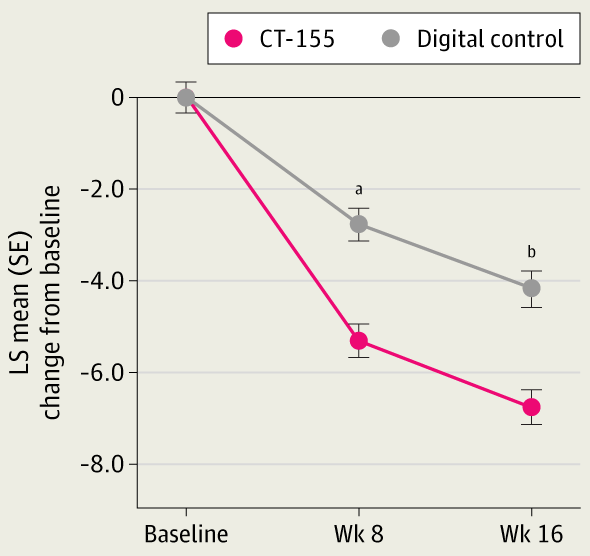
- Primary outcome. At 16 weeks, CT-155 produced a significantly greater reduction in motivation and pleasure negative symptoms than the digital control (mean change, −6.8 vs −4.2; between-group difference, −2.6). The effect size was small to moderate (Cohen d = −0.36).
- Timing. The benefit was already apparent at 8 weeks, when the between-group difference in CAINS-MAP scores was −2.5; the benefit was maintained through week 16.
- Negative symptoms. The improvement was particularly evident in the motivation-and-pleasure domains, including social, recreational, and vocational functioning.
- Positive symptoms. There was no meaningful difference between groups in positive symptoms.
- Safety and engagement. Most participants remained engaged through week 15 (70.4% with CT-155 and 76.5% with digital control). Serious adverse events occurred in 1.3% of the CT-155 group and 2.2% of the control group, and none were considered treatment-related.
A few thoughts:
1. This is a good study with a promising result, published in a solid journal.
2. The main finding in three words: the app worked. More detail: the effect size was small to moderate.
3. Who doesn’t read this paper with hope and optimism for the future? Negative symptoms haunt those with schizophrenia; an effective app would be a welcome addition to the toolkit. And apps could be scaled up as well, making them relevant in high-income nations – but also in low- and middle-income ones.
4. But should we be cautious about the main finding? CT-155 was compared with an active control – but the details are light on it. Was the comparison somewhat lopsided, as is often the case in such studies? The engagement was strong (very strong, actually) but, in the real world, patients often hesitate to download apps, never mind using them regularly.
The full JAMA Network Open paper can be found here:
https://jamanetwork.com/journals/jamanetworkopen/fullarticle/2854497
Selection 2: “Preparing AI chatbots to respond to patient distress and suicidality in high-risk healthcare settings”
Joanna M. Streck, Dallas Swendeman, W. Scott Comulada, et al.
npj Digital Medicine, 22 September 2026

Generative artificial intelligence (AI) chatbots are rapidly proliferating for behavioral health support by individual users independently and within healthcare settings. AI chatbots leverage large language models (or LLMs) that use natural language processing, machine learning, and deep learning to simulate human-like conversations, which respond to users’ input in real-time. On-demand chatbot availability when human clinicians are not available, coupled with LLMs’ improving abilities to simulate behavioral health support, has brought increased attention to how this technology can support users, including patients with behavioral health needs, as tools embedded in clinical settings, while also reducing clinician burden and helping address mental healthcare access gaps. Patients also report beliefs that conventional behavioral treatments are ineffective, and perceive digital health tools as safe and non-judgmental…
Despite numerous calls to address clinical safety (e.g., suicide risk monitoring) with AI chatbots, there is little information available on how to implement such guardrails. There are no existing recommendations on how best to monitor suicide risk or clinical safety among users; furthermore, there is no understanding of whether and how humans (e.g., clinicians, healthcare personnel) should be involved, or the role of AI in monitoring and responding to suicidality. This is a particularly timely topic for adults with substance use disorders (SUD), such as opioid use disorder (OUD), where there are devastatingly high rates of suicidal ideation and behaviors and co-occurring serious psychiatric illness (e.g., major depression). At the same time, addiction medicine settings are beset by limited treatment capacity and overburdened providers. Thus, addiction medicine represents a high-risk setting that could benefit from AI chatbot support, provided that proper safety guardrails are in place.
So begins a paper by Streck et al.
They focus on their own experimentation: “We recently developed and tested an AI chatbot, ‘Suzy,’ for providing SUD recovery, general wellness, and local resource referral support to adults receiving medication treatment for OUD in primary care-based addiction treatment clinics at a large urban general hospital in Massachusetts.” Suzy was developed using Open Chat Studio. “We employed an iterative design process with direct user and expert feedback from clinicians and content experts to refine all safety features.”
They describe their approach to safety. “Every user message was first reviewed by a ‘Safety Router’ node, which used a fine-tuned language model, developed from clinician/subject matter expert-labeled data, to classify messages into the three risk tiers using LLM-based classification.” As well, there was human oversight. “A trained bachelors-level staff also reviewed the chatbot conversations twice daily on weekdays (at the beginning and end of business days). The staff member was trained by a licensed psychologist to review transcripts for concerning or risky statements…”
They close with recommendations.
- Safety guardrails. “We recommend that all implementers building AI chatbots to support behavioral health services consider adopting this or a similar safety monitoring approach that executes rigorous safety guardrails beyond those already available through LLM providers like OpenAI. Ideally, implementers who incorporate AI-assisted tools for behavioral health would also have trained clinicians available for suicide monitoring in close to real time, but when infeasible, AI safety architecture detecting high-risk messages could alert a trained staff member.”
- Training. “AI chatbots would ideally use trained team members (e.g., medical assistants, health workers) to conduct near real-time safety monitoring of chat transcripts and risk triage. When infeasible, the AI chatbot system could be programmed to send an immediate alert to the clinician or care team when a safety node is activated to prompt outreach to assess safety.”
- Communication. “AI is increasingly used to draft replies to patient portal messages in healthcare settings to reduce clinician workload. AI guardrails have been proposed for this situation (e.g., draft, but not send, responses for topics indicating medical risk), though these proposed guidelines do not address suicide/behavioral health risk.”
A few thoughts:
1. This is a good paper on a relevant question, published in a leading journal. Drawing on their own chatbot experience strengthens the paper and makes the recommendations more useful.
2. The recommendations are solid and thoughtful.
3. Is a human touch the key to good AI work? The authors seem to believe that it is, at least in terms of safety.
The full npj Digital Medicine paper can be found here:
https://www.nature.com/articles/s41746-026-03288-9
Selection 3: “Teaching Note Writing in the Age of AI: Three Practical Steps”
Danilo Rojas-Velasquez
Academic Psychiatry, 3 September 2026 Online First

The consult came in the early afternoon: a ‘homeless man with polysubstance abuse, uncooperative, demanding to leave AMA, assess capacity.’ Before we had read past the one-liner, the patient had already taken shape for us, and so had the encounter we expected: brief, adversarial, ending in a less-than-ideal discharge. The resident and I prepared accordingly. At the bedside we found a man who was nervous, frightened by the pace of the workup, and exhausted from being asked the same questions too many times by too many teams. He was not demanding to leave against medical advice so much as asking, with diminishing patience, when someone would tell him what was happening. The visit was neither brief nor adversarial. What struck us afterward was not only what the consult request had missed, but how it had prepared us to miss it.
Psychiatry is a chart-heavy specialty.
So begins a paper by Dr. Rojas-Velasquez.
He discusses documentation and the influence on clinical thinking. “We learn to scan prior notes for the buzzwords that key us into early hypotheses. Buzzwords are useful because they help us capture the clinical picture, but they can also stigmatize or over-generalize. In recent years, a deliberate shift in clinical language has tried to soften the edges of how we describe patients in writing: ‘undomiciled’ instead of ‘homeless,’ ‘non-adherent’ instead of ‘non-compliant,’ ‘declined’ instead of ‘refused.’ Words travel with patients across years of charts, and the language we choose shapes how the next clinician imagines them.”
He writes about the chart itself. “The chart is not a neutral record but a durable speech act. Its descriptions travel forward as a character reference, shaping how subsequent clinicians encounter a patient. A growing literature documents that stigmatizing language in the medical record measurably alters downstream clinical decisions, including pain management and intensity of workup, and that descriptors like ‘pleasant’ and ‘cooperative’ are applied unevenly across patient race. Yet documentation is sometimes treated as a matter of mechanics: billing compliance, problem-list hygiene, the architecture of assessment and plan.”
He notes the influence of AI. “Artificial intelligence (AI) tools inherit and polish the linguistic conventions of their training data, so stigmatizing patterns already present in our charts are being laundered into outputs that feel more authoritative because they are fluent. A trainee who might once have written ‘patient seems frustrated’ may now sign a note calling him ‘hostile and uncooperative’ because that is what the model produced. The note has historically been where formulation happens. Writing was thinking, and the attending’s question of ‘why did you describe her that way?’ was a teaching moment built into the workflow. When the note arrives pre-formed, that moment is structurally removed unless we rebuild it deliberately.”
He continues: “If the chart shapes patients before we meet them, and if AI tools accelerate this process while removing the formulation step that once made documentation educational, clinical language needs to be taught as deliberately as formulation itself.”
He makes three suggestions.
- Teach note-reading (before note-writing). “On a rotation, a resident might review prior documentation, name the impression those notes created, and then compare that impression with what emerges at the bedside. The point is not to grade the prior note but to make the chart’s authorial power visible before the resident adds to it.”
- Build a ‘next reader’ pause into supervision. “Before signing a note, the trainee considers how it would read to a covering clinician at three in the morning, to the patient with portal access, and to a family member reviewing the chart.”
- Treat editing AI-drafted notes as clinical work. “If formulation is being absorbed by the model, the trainee’s task is not merely to check grammar or fill gaps, but to ask what the draft has already decided: where observations have become character judgments, where hedge words have drifted toward certainty, and where descriptors would not survive the next-reader test.”
A few thoughts:
1. This is an important commentary on AI scribes, yes, and also on the importance of language in charts.
2. Speaking of language, Dr. Rojas-Velasquez is a beautiful writer.
3. The recommendations are solid. For the record, the first one is particularly thoughtful. I remember early in residency when Dr. David Goldbloom spoke at length about notes and how to read notes. That conversation was invaluable; it was the only one of its kind during my five years of residency.
4. AI scribes offer the possibility of less time spent documenting. Is there a risk of deskilling? Or poorer quality notes? Or both?
The full Academic Psychiatry paper can be found here:
https://link.springer.com/article/10.1007/s40596-026-02434-5
Reading of the Week. Every week I pick articles and papers from the world of Psychiatry.
Recent Comments