From the Editor
We are going to teach you how to keep your head above water while you manage your complicated life, even when it feels overwhelming. Writing a book that teaches how to cope, however, feels like a monumental act of hubris. Ask our partners, friends, or kids, and they will tell you that our confidence that we can add value to your struggle, whatever it is, is not based on our having any innate coping superpowers. Rather, we know the evidence, and we have learned how to teach it.
Drs. Robert Maunder and Jonathan Hunter, psychiatrists affiliated with the University of Toronto, open their new book with this comment.
It’s a complicated world, and some people struggle. The authors try to answer a question that is both ordinary and profound: What can we do when life becomes overwhelming? Drs. Maunder and Hunter’s new book, Coping: Fix Problems, Find Meaning, Feel Better, is intended for a general audience and points a way forward, with an optimistic tone, hundreds of citations, and clear advice. The book is about coping. It’s also about trauma, adversity, and finding strength.
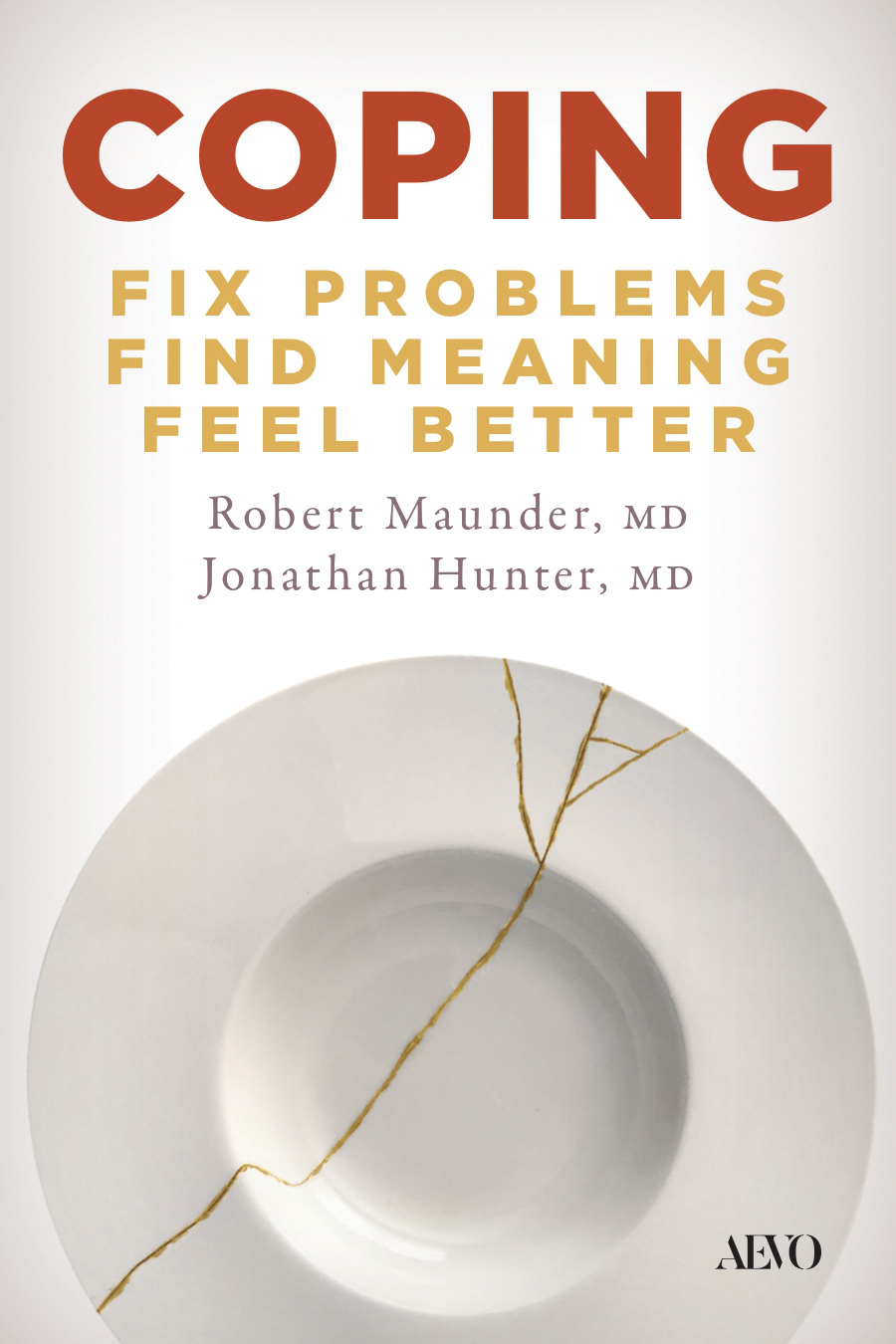
This week, there is only one selection: an excerpt from their new book, chosen by the authors.
How should we think about this work? At some level, it’s a really smart self-help book, offering clear suggestions on important topics. How can we sleep better? Page 87 offers tips, drawing on CBT-I. There is also discussion of box breathing (p. 102), cutting back on device time (p. 157), and more.
The book isn’t just about living better – it’s about acknowledging that some are living through extraordinary circumstances. They open by talking about working with patients and providers during the SARS outbreak. The book includes interviews with patients. They also discuss deeper topics like CBT and DBT. At points, the book touches on philosophy; the excerpt that follows includes a discussion of Nietzsche.
The book’s central ideas are simple: fix what you can; feel better about what you can’t fix; and, when suffering persists, live meaningfully.
Thus, the book is really a break from the typical self-help books that populate the shelves of bookstores. They don’t peddle glib recommendations, such as the need to start every day by making your bed. They instead tap the literature and offer good – though not necessarily easy – advice. Coping is ultimately less a promise to make life easier than an invitation to develop a better toolkit to deal with adversity. “Coping as fully and as effectively as you can with all the adversity that is inevitable in your life will reveal who you are.”
During the pandemic, patients would often ask about maintaining mental health during social isolation – as did friends and family. Rowan Diamond and Dr. John Willan (both of Oxford University) wrote a short paper for The British Journal of Psychiatry that I often mentioned, outlining several strategies that could help. Reading Coping, I thought about those conversations – and I thought about incorporating the Maunder-Hunter suggestions into my discussions with patients now; I also thought about the patients to whom I could recommend the book. Frankly, many would benefit.
Of course, this raises a larger question: At a time when we speak more about mental health, why are we collectively doing so badly? Studies suggest that people are more anxious and depressed, feel more isolated, and rate their mental health as poorer. National data finds more homelessness, drug misuse, and workplace absenteeism. In terms of coping, then, we seem to be getting a failing grade. Drs. Maunder and Hunter touch on this topic – we live in “impossible times,” they write in the last chapter. Perhaps we will need to wait for their next book to have a better understanding of how we got here.
In the meantime, Coping is an excellent book on an important topic.
A special word of thanks to the University of Toronto Press for making this Reading possible.
Note: there will be no Readings for the next two weeks.
DG


Recent Comments