Tag: chatbot

Reading of the Week: Shamiri Layperson-Provided Therapy in Kenya – Big Study, But Ethical? Also, a Reader Comments on Chatbots

From the Editor 

There are more psychiatrists of African origin in the US than in the whole of Africa. And I could actually say similar examples from the Philippines, or India, or many other countries. There is an enormous shortage of mental health resources…” 

So comments Dr. Vikram Patel (of Harvard University). Across low-income nations, mental health care services are profoundly difficult to access. Could Shamir (Kiswahili for thrive) – an intervention built on simple psychological concepts and delivered by laypersons – be part of the solution? 

This week, we look at a new paper from JAMA PsychiatryTom L.  Osborn (of Kenya’s Shamiri Institute) and his co-authors describe the results of a study involving adolescents with depression and anxiety symptoms. To our knowledge, this is one of the first adequately powered tests in this population of a scalable intervention grounded in simple positive psychological elements.” We look at the big paper. 

kenya-tanzania-africa-uganda-map-300x200

 But is the work ethical? In our second selection, we consider the editorial that accompanies the Osborn et al. paper. JAMA Psychiatry Editor Dr. Dost  Öngür (of Harvard University) defends the study and his decision to publish it: “Because this trial was already conducted, we considered the obligations of the journal to be different than those of investigators and prospective reviewers. The question for us was whether there is a benefit to society by publishing the study as it was conducted.” 

Finally, in our third selection, a reader writes us. Giorgio A.Tasca (of the University of Ottawa) responds to The New York Times article by Karen Brown considering chatbots. “Is scaling up an intervention with dubious research support – that results in low adherence and high dropout (and perhaps more demoralization as a result) – worth it?” 

Please note that there will be no Reading next week. 

DG  Continue reading

Reading of the Week: Suicide and Schizophrenia – Across Life Span; Also, Transgender-Inclusive Care (QT), and the NYT on Chatbots

From the Editor

This week, we have three selections.

In the first, we consider suicide and schizophrenia. In a new JAMA Psychiatry paper, Dr. Mark Olfson (of Columbia University) and his co-authors do a cohort study across life-span, tapping a massive database. They find: “the risk of suicide was higher compared with the general US population and was highest among those aged 18 to 34 years and lowest among those 65 years and older.” The authors see clear clinical implications: “These findings suggest that suicide prevention efforts for individuals with schizophrenia should include a focus on younger adults with suicidal symptoms and substance use disorders.”

In the second selection, we consider transgender-inclusive care, looking at a new Quick Takes podcast. Drs. June Lam and Alex Abramovich (both of the University of Toronto) comment on caring for members of this population. “Trans individuals are medically underserved and experience, poor mental health outcomes, high rates of disease burden – compared to cisgender individuals.”

img_9356

Finally, in our third selection from The New York Times, reporter Karen Brown writes about chatbots for psychotherapy, focusing on Woebot. The writer quotes psychologist Alison Darcy about the potential of these conversational agents: “If we can deliver some of the things that the human can deliver, then we actually can create something that’s truly scalable, that has the capability to reduce the incidence of suffering in the population.”

DG

Continue reading

Reading of the Week: Trump on Trump & the Goldwater Rule; Also, Chatbots Reviewed (CJP)

From the Editor

Should psychiatrists comment on the possible mental health problems of President Donald Trump? His niece thinks so.

In our first selection, we consider an essay by Mary L. Trump. In this Washington Post essay, the psychologist discusses the Goldwater Rule, which prevents members of the American Psychiatric Association from commenting on political figures. Trump feels that psychiatrists should speak up. “Adopting a notionally neutral stance in this case doesn’t just create a void where professional expertise should be – it serves to normalize dysfunctional behavior.” We consider the essay and the questions it raises.

barrygoldwater-58fab94e5f9b581d596956b2Goldwater of the Goldwater Rule

In the other selection, we pick another current topic, but this time we draw from a journal, not a newspaper, considering a new paper from The Canadian Journal of Psychiatry. Aditya Nrusimha Vaidyam (of Harvard University) and his co-authors do a review of chatbots for mental health; that is, “digital tools capable of holding natural language conversations and mimicking human-like behavior in task-oriented dialogue with people” (think Siri or Alexa, but for mental disorders). “This review revealed few, but generally positive, outcomes regarding conversational agents’ diagnostic quality, therapeutic efficacy, or acceptability.”

DG

Continue reading

Reading of the Week: “Talking to Machines About Personal Mental Health Problems.” JAMA on Therapy & AI

From the Editor

Will people seek therapy with computers one day, getting care from programs built with Artificial Intelligence?

The authors of a new JAMA paper consider this in a short, clever piece, titled “Talking to Machines About Personal Mental Health Problems.”

In this two-part Reading of the Week series, we look at two papers, both published in JAMA. These Viewpoint pieces make interesting, provocative arguments.

This week, we look at conversational agents.

Next week, we ask: is CBT really the gold standard for psychotherapy?

Stanford University’s Adam S. Miner and his co-authors consider conversational agents – that is software programs that “use conversational artificial intelligence to interact with users through voice or text.” Could there be therapeutic value in such a program? What are the ethical challenges?

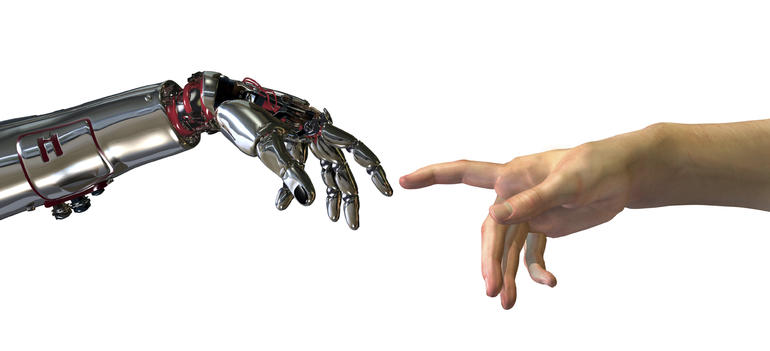
Robot and human hands almost touching - 3D render. A modern take on the famous Michelangelo painting in the Sistine Chapel; titled, "The Creation of Adam".

In this Reading, we review the paper, and consider the potential of conversational agents, with an eye on what’s currently available.

DG

Continue reading