From the Editor
This week, the three selections look at the intersection of mental health and public policy.
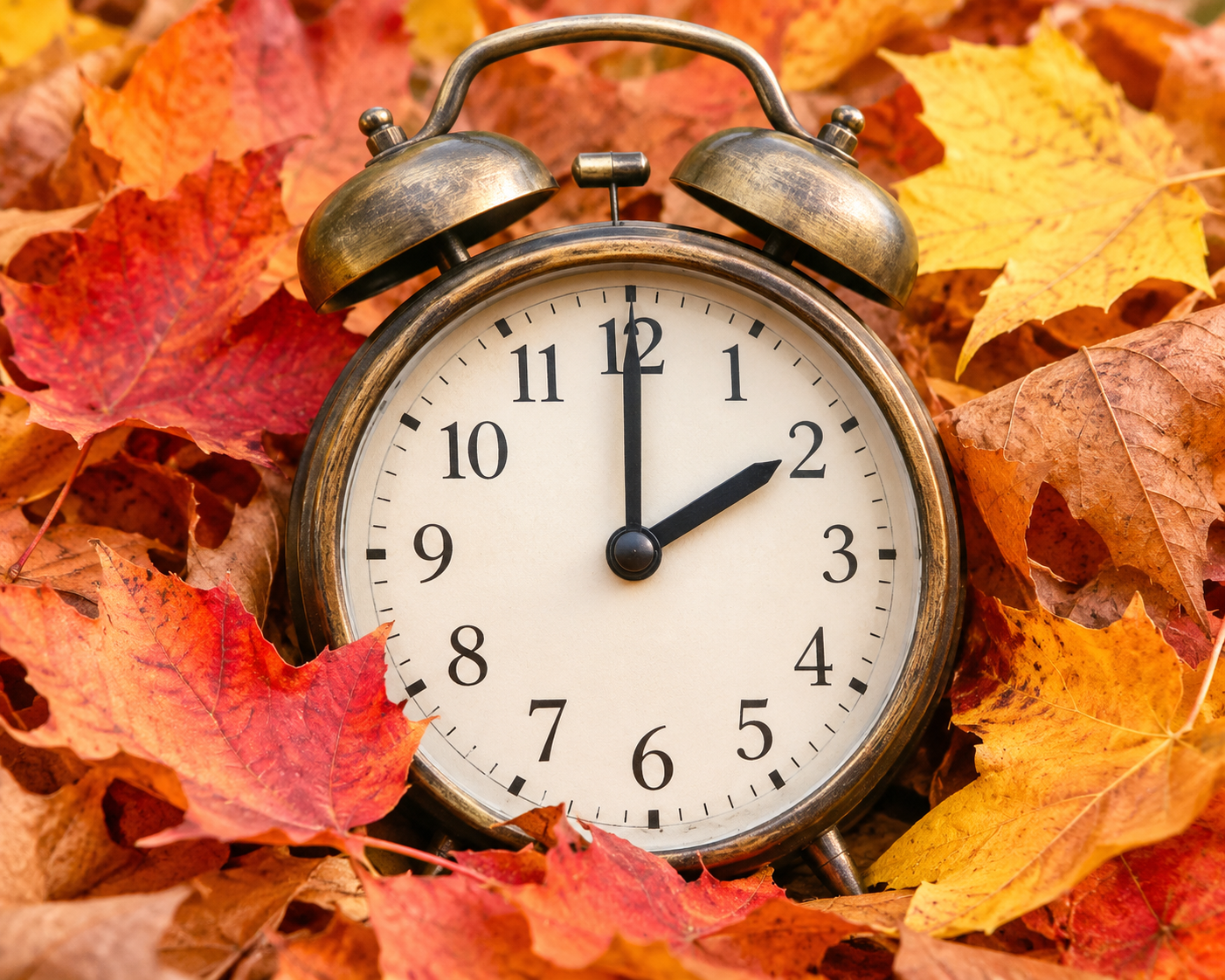
With daylight saving time ending, many North Americans set their clocks back an hour this past Sunday morning, seemingly gaining an extra hour. But several jurisdictions have ended “spring forward, fall back,” instead choosing permanent daylight saving time. What are the effects on mental and physical health? In the first selection, Dr. Raymond W. Lam (of the University of British Columbia) and his co-authors attempt to answer that question with an impressive CMAJ paper with 42 references and two tables. “Ending biannual clock adjustments may eliminate transition harms that last a few weeks, but the health effects of permanent time are likely to be chronic.”
In the second selection, a research letter published in JAMA, Dr. Lyna Z. Schieber (of the Centers for Disease Control and Prevention) and her co-authors analyzed US pharmacy data to better understand opioid dispensing in recent years. They report some good news, in part because of federal and state legislative changes: “Opioid dispensing continued to decline through 2025, extending more than a decade-long downward trend in the United States since its peak in 2012.”
Finally, in the third selection, German Lopez writes about suicides in Wyoming in the New York Times. His excellent essay describes a state facing a major problem: its suicide rate is double the US national average. He writes about the different people he has met, noting a general reluctance to talk about mental health. He also describes legislative reforms that would help. “If the state wants to lose its status as one of the worst for suicides, something has to change.”
DG
Selection 1: “Analysis of health impacts associated with adopting permanent standard time or permanent daylight saving time to inform policy in Canada”
Raymond W. Lam, Ralph Mistlberger, Patrick Baylis, and Alexandra Choi
CMAJ, 5 October 2026

Several regions in Canada are evaluating whether to implement permanent standard time (pST) or permanent daylight saving time (pDST) after eliminating the twice-yearly clock changes. Although the seasonal time changes produce long summer evenings and earlier winter mornings, the spring ‘leap forward’ causes health harms, including sleep loss and short-term increases in adverse health and injury outcomes. Most, but not all, recent reviews have suggested that ending seasonal clock adjustments would eliminate transition-related harms, and major sleep and chronobiology societies have all called for abolishing the time change and implementing pST. However, North American jurisdictions eliminating time changes largely adopt pDST. Yukon adopted pDST in 2020, with British Columbia adopting it in March 2026. Alberta and the Northwest Territories followed suit a month later. In July 2026, the United States House of Representatives passed a bill to enact pDST nationwide, which is currently before the Senate. If it becomes law, Canada will likely be pressured to follow suit.
So begins a paper by Lam et al.
The paper has seven questions and answers. Here, we summarize three.
What are the public health implications of adopting a permanent time standard for different Canadian jurisdictions?
“The public health implications of a change to pST or pDST would differ by season and geographic region across Canada. ‘Daylight saving time’ is a misnomer – it does not save daylight but instead shifts it 1 hour later. Permanent DST preserves later dusk, which facilitates evening commuting, social participation, outdoor activity, and some retail and service activity. It also delays dawn in winter months, which may leave many people waking and travelling to school or work in darkness, with potential adverse health, education, and productivity implications. In contrast, pST preserves earlier winter dawn, which better aligns with humans’ circadian rhythms and reduces pre-dawn wake-up and travel; pST also results in earlier dusk, which limits light for evening activities.
“However, a single national or provincial label such as ‘standard time’ or ‘daylight saving time’ obscures large regional differences in actual light exposure, particularly during winter, across Canada’s vast geography, complicating the choice between pST and pDST.”
How might human circadian biology respond to pST and pDST, respectively?
“Internal circadian clocks generate and regulate people’s daily sleep–wake cycles and changes in alertness, performance, many cellular and physiologic functions, and behaviours, throughout the day. The master circadian clock in the hypothalamus runs slightly slow relative to the solar day, typically requiring about 24.2 hours to complete a cycle. To maintain alignment with a 24-hour day, it must adjust by synchronizing to environmental time cues. The most important cue is daylight, which can shift circadian clocks either forward or backward depending on the time of day, and intensity and wavelength of light exposure. Morning light exposure advances the clock, compensating for its tendency to lag; evening light exposure delays the clock, resulting in circadian phase delay. Alignment between body time and social time, the local time by which work, school, and other schedules are set, is therefore facilitated by morning light and impeded by evening light.
“Modern environments already promote circadian delay. Many people spend much of the day indoors, reducing exposure to bright morning and daytime light, and electric lighting and screen use extend light exposure into the evening, thereby weakening morning phase-advancing cues and strengthening evening phase-delaying cues. This creates a misalignment, called ‘social jet lag,’ whereby social time requires morning waking for school and work before the optimal waking time determined by the body’s delayed biological rhythm… Permanent DST worsens this pattern in winter by prolonging morning darkness and extending evening light, which works against biological adjustment at both ends of the day. In contrast, the earlier summer dawn with pST, although more aligned with the circadian rhythm, might advance the circadian phase when compared with pDST, which may lead people to wake too early.”
How might pST or pDST affect physical and mental health?
“Accumulated evidence suggests that later morning light with pDST is likely to have negative health consequences, particularly on seasonal mood vulnerability. An estimated 1% to 3% of people in Canada live with winter depression, known as seasonal affective disorder (SAD), and as many as 15% of people experience milder seasonal changes in mood, sleep, appetite, and energy, termed subsyndromal SAD. People in Canada experience more frequent major depressive episodes in winter than in summer, suggesting that seasonal light exposure has relevance at individual and population levels. The worsening of sleep, concentration, energy, and ‘feeling bad about yourself’ in winter is most prominent among youth aged 12 to 17 years.
“The main biological hypothesis for SAD is circadian phase delay, with delayed morning light thought to contribute to later circadian timing and symptoms such as hypersomnia, increased appetite, low energy, and impaired concentration. Bright light therapy in the early morning, the evidence-based treatment for SAD, corrects phase-delayed circadian rhythms. In delaying morning light, pDST functions in the opposite direction to light therapy, further weakening the natural morning light cue and increasing vulnerability to seasonal mood disturbances.
“Other geographic correlation studies link later solar time to shorter sleep, cardiovascular and metabolic outcomes, traffic risk, and cancer incidence. A 2025 modelling study simulated natural light exposure and circadian disruption, mapping these variables against the prevalence of several chronic diseases, to evaluate the health impacts of different time systems. Findings suggested that pDST and pST offered health advantages compared with the current twice-yearly clock changes, but the health benefits of pDST were lower than those of pST by a third.”
A few thoughts:
1. This paper addresses a relevant issue, offers a thoughtful consideration of the literature, and is published in a solid journal.
2. To summarize: the issue is complicated.
3. Still, they offer an opinion based on the evidence. “Permanent ST may support health by preserving the winter morning light most important for circadian rhythms, sleep, and mood. Meanwhile, pDST would negatively affect sleep and mental health in winter, particularly in vulnerable groups including youth, workers among whom minorities are overrepresented, and those with sleep disorders. The preponderance of health evidence favours pST, which would align with the recommendations of sleep and chronobiology societies worldwide and help ensure that Canada does not repeat other countries’ failed past experiments with pDST.”
4. Will evidence help guide decision-making?
The full CMAJ paper can be found here:
https://www.cmaj.ca/content/198/34/E1335
Selection 2: “National and County-Level Trends in Opioid Dispensing”
Lyna Z. Schieber, Charles M. Adjei, and Gery P. Guy
JAMA, 21 October 2026

The opioid overdose crisis remains a major US public health challenge. In 2024, an estimated 7.6 million individuals 12 years or older reported misusing prescription opioids – nearly one-half of whom obtained these medications from clinicians – and 4.7 million met criteria for prescription opioid use disorder. From 1999 through 2023, nearly 308 000 deaths in the US involved prescription opioids… Understanding recent opioid dispensing trends is important for informing public health policy and clinical practice.
So begins a research letter by Schieber et al.
Here’s what they did:
- They conducted a cross-sectional study using US pharmacy data to examine national and county-level trends in opioid dispensing from 2019 to 2025.
- They used IQVIA Xponent data, which captures approximately 94% of prescriptions dispensed from US retail pharmacies.
- “Cough and cold formulations containing opioids and buprenorphine products primarily used for opioid use disorder treatment were excluded.”
- They examined opioid dose (measured as morphine milligram equivalents (MME) per person), mean prescription duration, and dispensing rates per 100 people. They also examined short-duration (≤3 days), long-duration (≥30 days), high-dose (≥50 MME/day), and extended-release or long-acting prescriptions.
- They calculated changes in dispensing between 2019 and 2025 and used statistical analyses (joinpoint regression) to estimate average annual percentage changes.
Here’s what they found:
- Dispensing. Opioid dispensing declined substantially between 2019 and 2025. The total dose dispensed fell from 400.8 to 247.8 morphine milligram equivalents (MME) per person, an average annual decrease of 7.6%.
- Overall prescribing. The number of prescriptions declined from 46.8 to 33.7 per 100 people, an average annual decrease of 5.2%.
- Prescription characteristics. High-dose prescriptions declined by 8.5% annually, while long-duration prescriptions declined by 6.0% annually. Extended-release or long-acting prescriptions declined by 8.8% annually. Mean prescription duration changed very little, from 17.0 to 16.6 days.
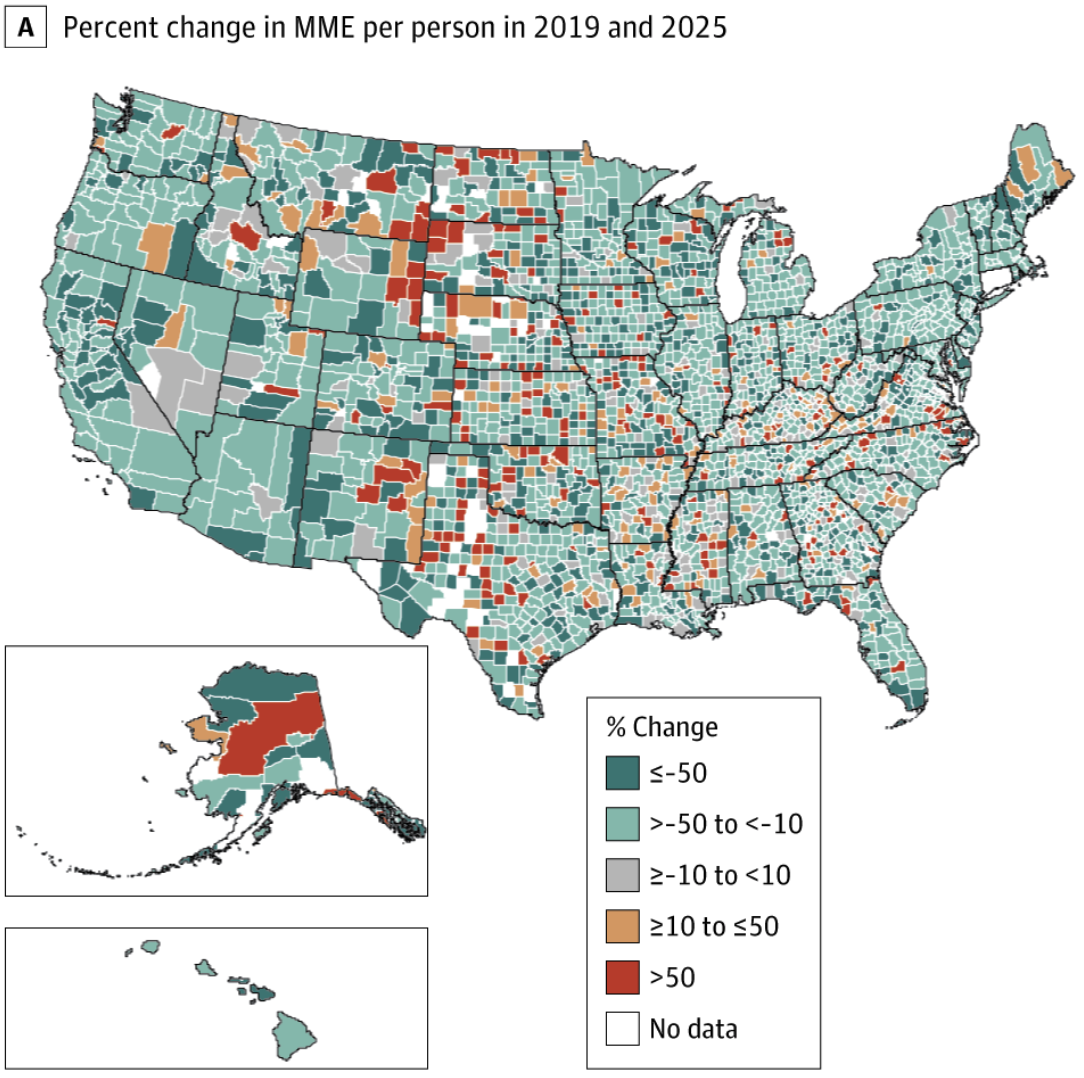
- Geographic variation. Although opioid dispensing declined in most counties, there was considerable variation: 76.0% of counties had a decline of at least 10% in MME per person, while 15.4% had an increase of at least 10%.
A few thoughts:
1. This is a good research letter offering solid data and published in a major journal.
2. The findings in three words: pretty good news.
3. Though there are several reasons for the sharp decline, legislative changes have been part of the successful effort. Consider: all 50 states have electronic databases to track controlled-substance prescriptions, and many states introduced legislation limiting the quantity and/or duration of initial opioid prescriptions.
4. The positive results varied considerably across different jurisdictions. (Look at the red zones in the above map.) There was a clear rural versus urban pattern; many of the problem areas were rural, which accounted for 61.9% of counties with increased dispensing. (!)
5. Like all studies, there are limitations. The authors note several, including limitations related to the data, which excluded “mail-order and clinician-dispensed prescriptions.”
The full JAMA research letter can be found here:
https://jamanetwork.com/journals/jama/fullarticle/2855686
Selection 3: “Why Wyoming Has More Suicides”
German Lopez
The New York Times, 4 August 2026

Ashley McRae, a counselor, regularly meets with Wyoming’s miners as part of local suicide prevention efforts. The miners initially approach her, and the topic, with skepticism.
But Wyoming, like other red and rural states, has a problem. Its suicide rate is about double the national figure. It usually ranks in the top three states for suicide, along with Montana and Alaska. The two biggest factors, experts say, are the isolation of living in a sparsely populated state and easy access to guns. Suicide attempts are typically more impulsive than the common understanding suggests, and those made with guns are far more likely to be lethal than attempts with other methods.
Denial also plays a role.
So begins an essay by Lopez.
He speaks of his travels across the state. “I was surprised by how many people contested the value of mental health care or even the concept of mental illness. In the deeply red state, some people dismiss a focus on mental health as a liberal cause. When Wyoming considered additional state-level funding for the national 988 crisis lifeline, one lawmaker, whose son died by suicide, argued that suicide was a problem more for churches, not government, to deal with.”
He notes the influence of the state’s culture. “In a state that glorifies ‘tough guy’ personas, admitting to a problem can feel dangerous, said Bruce Brown, a businessman in Gillette who has struggled with suicidal thoughts. He feared that his friends and colleagues would think less of him if they found out about his depression. ‘In that culture, you don’t show any weakness, or you’re pretty much shunned,’ he said.”
He continues: “Wyomingites who have struggled with suicidal thoughts told me they had to confront their own mental health stigma before they could get better. Mr. Brown said he had to hear from three different people that he had a serious problem before he agreed to temporarily give up his guns to friends.”
He notes efforts to address the problem. “Gov. Mark Gordon has prioritized suicide prevention since his second term began in 2023. He has focused on combating stigma around mental illness and raising awareness about suicide. So far, the results are disappointing. Suicides actually increased – again – in 2024, the most recent year for which there’s data.” He adds: “Changing culture is hard.”
What is a way forward? “Ideally, the state would pass a red flag law. Such a policy would let a vast majority of gun owners keep their weapons but allow law enforcement and family members to petition a court to temporarily take away someone’s firearms during a crisis. States have typically passed these laws in response to mass shootings, but the best evidence suggests they’re most effective for reducing suicides. That largely reflects the fact that America’s biggest gun problem is a suicide problem: About 60 percent of all gun deaths are suicides.” But he notes strong opposition. “Wyoming, however, has banned the enforcement of red flag laws. This year, it toughened its ban. Those opposing red flag laws claim the policies would let the government freely seize people’s firearms, even though these measures require court oversight.”
A few thoughts:
1. This is a great essay about Wyoming, informed by facts and interviews.
2. The writer conveys the seriousness of Wyoming’s problems exceptionally well.
3. German Lopez writes excellently on the intersection of public policy and mental health. You may agree or disagree with him, but he is worth reading. His recent column on homelessness – “We Know How to Fix Homelessness. Look at Denver.” – is a must-read. You can find it here:
https://www.nytimes.com/2026/10/13/opinion/homelessness-unhoused-denver-shelters.html
The full New York Times essay can be found here:
https://www.nytimes.com/2026/08/04/opinion/suicide-wyoming-mental-health.html
Reading of the Week. Every week I pick articles and papers from the world of Psychiatry.
Recent Comments