From the Editor
We are going to teach you how to keep your head above water while you manage your complicated life, even when it feels overwhelming. Writing a book that teaches how to cope, however, feels like a monumental act of hubris. Ask our partners, friends, or kids, and they will tell you that our confidence that we can add value to your struggle, whatever it is, is not based on our having any innate coping superpowers. Rather, we know the evidence, and we have learned how to teach it.
Drs. Robert Maunder and Jonathan Hunter, psychiatrists affiliated with the University of Toronto, open their new book with this comment.
It’s a complicated world, and some people struggle. The authors try to answer a question that is both ordinary and profound: What can we do when life becomes overwhelming? Drs. Maunder and Hunter’s new book, Coping: Fix Problems, Find Meaning, Feel Better, is intended for a general audience and points a way forward, with an optimistic tone, hundreds of citations, and clear advice. The book is about coping. It’s also about trauma, adversity, and finding strength.
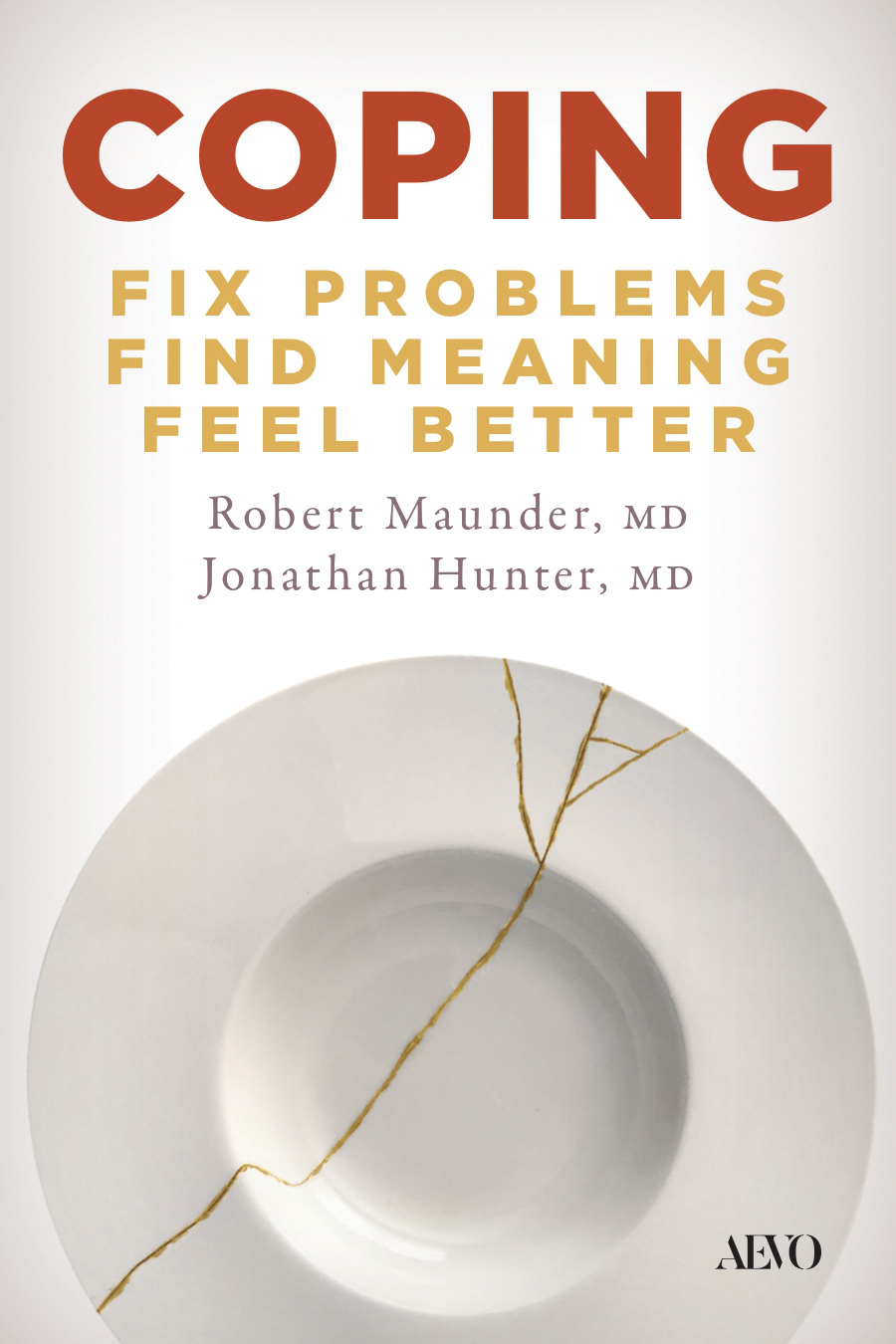
This week, there is only one selection: an excerpt from their new book, chosen by the authors.
How should we think about this work? At some level, it’s a really smart self-help book, offering clear suggestions on important topics. How can we sleep better? Page 87 offers tips, drawing on CBT-I. There is also discussion of box breathing (p. 102), cutting back on device time (p. 157), and more.
The book isn’t just about living better – it’s about acknowledging that some are living through extraordinary circumstances. They open by talking about working with patients and providers during the SARS outbreak. The book includes interviews with patients. They also discuss deeper topics like CBT and DBT. At points, the book touches on philosophy; the excerpt that follows includes a discussion of Nietzsche.
The book’s central ideas are simple: fix what you can; feel better about what you can’t fix; and, when suffering persists, live meaningfully.
Thus, the book is really a break from the typical self-help books that populate the shelves of bookstores. They don’t peddle glib recommendations, such as the need to start every day by making your bed. They instead tap the literature and offer good – though not necessarily easy – advice. Coping is ultimately less a promise to make life easier than an invitation to develop a better toolkit to deal with adversity. “Coping as fully and as effectively as you can with all the adversity that is inevitable in your life will reveal who you are.”
During the pandemic, patients would often ask about maintaining mental health during social isolation – as did friends and family. Rowan Diamond and Dr. John Willan (both of Oxford University) wrote a short paper for The British Journal of Psychiatry that I often mentioned, outlining several strategies that could help. Reading Coping, I thought about those conversations – and I thought about incorporating the Maunder-Hunter suggestions into my discussions with patients now; I also thought about the patients to whom I could recommend the book. Frankly, many would benefit.
Of course, this raises a larger question: At a time when we speak more about mental health, why are we collectively doing so badly? Studies suggest that people are more anxious and depressed, feel more isolated, and rate their mental health as poorer. National data finds more homelessness, drug misuse, and workplace absenteeism. In terms of coping, then, we seem to be getting a failing grade. Drs. Maunder and Hunter touch on this topic – we live in “impossible times,” they write in the last chapter. Perhaps we will need to wait for their next book to have a better understanding of how we got here.
In the meantime, Coping is an excellent book on an important topic.
A special word of thanks to the University of Toronto Press for making this Reading possible.
Note: there will be no Readings for the next two weeks.
DG
Selection: “Cindy”
Robert Maunder and Jonathan Hunter
Coping, 2026
The following in an excerpt from their new book.
Cindy: I had to come out as myself
Cindy is a New Yorker now, having moved there from Tennessee a decade ago when she was in her twenties. She moved after coming out as a woman, getting her bottom surgery, and putting intentional effort into figuring out where she wanted to live and who she wanted to be. Remarkably, since Cindy identifies as a biracial trans woman from the American South, her greatest coping challenges have had nothing to do with her identity. Coming out regarding her gender and the process of self-actualization that has followed have not been sources of stress but rather have been the ways by which Cindy has coped with “everything else.”
Cindy grew up as the only child of loving parents who “would have accepted me” but didn’t have the chance. Her father died when Cindy was sixteen and her mother died two years after, leaving her as an orphan as she ended high school. The death of Cindy’s father was not entirely unexpected, although he was only in his fifties, because he was chronically ill, but her mother’s death was a shock. Working as a prison guard, Cindy’s mother’s death was caught on camera. She simply collapsed at her desk and could not be revived. Cindy’s maternal grandparents had to bear the pain of burying their daughter and then died themselves shortly after. Cindy became closer to her mother’s sister, her middle-age aunt, who then also died unexpectedly. One after another, Cindy lost her supports and protectors. “Me being trans is the least interesting thing about me,” she told Jon.
Cindy was not only on her own by the time she was nineteen but at a disadvantage in rising to the challenge of becoming an adult ahead of schedule because she had lived a reclusive life up to that point, with few friends and an overreliance on playing video games alone to get by. “Coming out helped me with coping,” Cindy said. “I came out first to my uncle, my mom’s brother. By that point we had lost everyone. He had lost his sisters and his parents. I had lost my parents. And I didn’t just come out as trans; I came out as a person. He was fine with me. I think all the losses had taught us what was important in life.
“I had known since puberty that something was different. I didn’t know what I was, but I knew what I wasn’t. I hadn’t really figured it out, and then my dad died and it had to take a backseat, and then my mom died and I was just numb for a couple of years. And then I read this book about gender, and I realized who I was. I was still living in my parents’ home at that point, and I started to think for the first time about what I wanted in my life. I started to think about where I wanted to live and what I wanted to do. As I slowly started to come out as trans, I was really coming out as a person.
“I started to see a psychiatrist about the gender stuff, but she realized right away that I was okay about the gender stuff. It was everything else.”
At her uncle’s urging, she went to community college, having not yet figured out the direction she wanted to follow. “I started seeing the world as a full adult because I had no other choice, I had no one to rely on.”
“After so many losses, you kind of had to age fast,” Jon observed.
“And my development had been kind of stunted. I was kind of a recluse. I didn’t do sports or that sort of thing. I didn’t really have an idea of what I wanted to be when I was growing up. I had ‘astronaut,’ but I didn’t have a realistic plan. I was just existing.”
At community college, Cindy joined the LGBT club where she found friends. She took a public speaking course. She remembers wearing a skirt when she gave the required formal talk and that she was accepted without question. “It was never a traumatic thing for me. Come to think of it, that was around the time of Obama’s inauguration and that helped me with coping. I really felt hope for positive change. That helped.”
“So, you could see people around you making positive changes and you could feel that hope.”
“Yeah, and I got involved. I was knocking on doors for signatures to change policy things. It was a positive time.”
As she “came out as a person,” Cindy started to think more clearly about where she wanted to live and what she wanted to do. She used the money she inherited to pay for bottom surgery, and to move north where she could live in a big city and experience four seasons with a real winter. “When Trump was elected, everything changed. I started to think about how I could help people and how to make things better.” When she decided to become a social worker, she went full tilt, getting the grants that she needed to fund her education and getting her bachelor’s degree and then her master’s degree in the shortest number of years allowed.
She realized, as her world expanded through contact with a widening circle of friends, and through the exposure that comes with learning social work, how lucky she was to have grown up with loving parents who accepted her and supported her. “It isn’t like that for other people. I learned how many people have had really bad experiences with their families. I didn’t know the words at the time, but now I know that what my parents gave me was secure attachment. I think that has been a huge part of my coping.”
Cindy remembers her parents as caring people, not only for her but for others. She describes her mother as a prison guard who the inmates liked “because she treated them like human beings,” with respect. “I am my own person, but I’m also their kid.” She sees herself extending their caring orientation to the world through her social work. “I want to help people. I realized that is my main motivation. It’s also a way of coping. A good coping strategy is ‘If you can’t think of what to do, help somebody.’”
“Why do you think that offering help has been helpful for you, as a coping strategy?” Jon asked.
“Ah. Well, I was desperate for love, so helping people keeps them near, I guess. But that is not the biggest thing. Mostly, it is just ‘why wouldn’t I help them?’ It gives me something to do next and it feels right. And it answers the question ‘what do I want to do with my life?’”
“So, it has worth for you. It is sort of a value proposition.”
“I want people to have what I had. Not everyone has a loving family. I want them to experience something like that. Helping others helps to heal me. But, here’s something else: I have also coped by realizing that I can get what I want, for myself.”
* * *
Cindy faced an extraordinary life challenge. She needed to find a bridge from being a disconnected teenager with few social skills or friends while living with loving parents, to becoming a functioning adult who loves and is loved, and whose life has direction and meaning, without the benefit of parents to see her through that transition – all while grieving the enormous loss of both her parents and most of her extended family. She used many coping strategies to see her through this challenge. She actively sought out social support and friendship by becoming closer with her uncle, going to college, and joining the LGBT club. She worked on her communication skills in her speakers’ course. She leaned on the security (which means confidence and self-acceptance) that she felt within herself as perhaps the greatest ongoing gift that she received from her parents. Most substantially, she coped with enormous loss and lack of direction by becoming her true self. As she came out as a woman, she came out as a person. Hers is a story of dramatic self-actualization – all the more dramatic because it was forced on her at a time when she felt quite unprepared to emerge. Through that self-actualization, she was able to come into herself as a person who copes in deeply meaningful ways, through advocacy and altruism. These modes of looking outward for the benefit of others are rewards in themselves and also carry the meaning of maintaining the good that her parents brought to the world, which ended abruptly and much too soon. Through all of these means, Cindy is a giving person without being a self-sacrificing one. She realized that “I can get what I want, for myself.”
There is supposed to be silver lining to wrestling with apparently purposeless pain and suffering to find or create something meaningful. It is supposed to lead to personal growth. “You have to kick at the darkness,” Bruce Cockburn sang, “until it bleeds daylight.” It is not always the case that coping by leaning on personal values, and purpose, leads to fulfilling one’s potential, but sometimes it happens.
Caution is required. There are some very unhelpful versions of this idea in circulation. Many people love to quote Friedrich Nietzsche’s aphorism, “What doesn’t kill you makes you stronger,” as if it was a tough-nosed recipe for becoming resilient. The author Christopher Hitchens, when being treated for the esophageal cancer that eventually killed him, had second thoughts about the aphorism, noting that he had stopped using it because “in the brute physical world, and the one encompassed by medicine, there are all too many things that could kill you, don’t kill you, and then leave you considerably weaker.”
We find the Nietzsche of The Gay Science more useful when he describes how, with much intentional effort over a long time, you can survey your strengths and weaknesses and choose to change. “Here a great mass of second nature has been added; there a piece of first nature removed — both times through long practice and daily work at it. Here the ugly that could not be removed is concealed; there it is reinterpreted into sublimity.” You can reach beyond yourself to change according to a plan that is based on art (perhaps surprisingly for people who know Nietzsche mostly through the “whatever doesn’t kill you” quote), rather than strength or power. We can’t agree that aesthetics is the best guide to personal change, as opposed to worthier guides, like ethics, love, or solidarity, but Nietzsche’s emphasis on long deliberate effort rings true. He also identifies a central paradox, that becoming the best version of yourself, while it may depend on an honest appraisal of your own strengths and weaknesses, also comes from reaching out beyond yourself.
Becoming your best self is one of the very good outcomes that can come from dealing with loss and adversity. A big part of becoming your best self, paradoxically, is accepting yourself the way you are, realizing your best self is not someone else, it’s you, even “re-interpreting” weakness “into sublimity.” The goal is not to become someone different; it is to become authentically who you are.
As a child, Cindy’s potential was all hidden and undeveloped. She stayed in her room playing video games or played awkwardly with the other kids in her small circle. When she came out as a trans woman, she was able to become fully herself. She became more active in advocacy and activism. She fulfilled her educational potential and found a profession that felt like a calling. She made friends. She helped people. In her own words, she “didn’t just come out as trans,” she “came out as a person.” Interestingly, although coming out as a trans woman followed the deaths of every member of her immediate family, she didn’t experience it as the result of her process of grieving but as the change the allowed her to get through that process.
“Big Niko” is living out a process of becoming himself as an artist, as a scholar who will contribute to the lives of others experiencing homelessness and using art to help themselves through, and as an accepting support to “Little Niko,” who stills lives, metaphorically, within him.
Cindy and Niko share the experience that fulfilling their potential, in an authentic and substantial way, was a pre-requisite to other coping tasks. For Cindy, self-fulfillment seems to have come first, followed by all other aspects of coping. For Niko, the process has involved more bootstrapping, with much early effort at coping through learning skills, relational support and pure persistent effort, leading to the emergence of the identity he calls “Big Niko,” an achievement which has super-charged further coping.
Cindy and Niko’s experience is important because it runs counter to conventional wisdom. For example, in the Hierarchy of Needs, conceptualized by the psychologist, Abraham Maslow, self actualization is at the pinnacle of the hierarchy, and therefore not a focus of motivation until one has met their needs for physical sustenance, safety, belonging, love, and self-esteem. We think Cindy and Niko would disagree; for them it has been foundational.
Posttraumatic growth
The idea that people grow through adversity, that they are better off in the end because of what they have lost or endured, is called post-traumatic growth by those who study it. Anecdotal evidence supporting posttraumatic growth is problematic. The reports of those who have survived terrible events and report that it has led to a net benefit cannot distinguish real, permanent growth from post-hoc rationalization and wishful thinking. No matter how compelling, subjective, anecdotal reports are unconvincing as a source of evidence.
Evidence for a weak version of posttraumatic growth is plentiful. People who have been through terrible experiences often report benefits afterwards, such as increases in self-esteem, or reduced anxiety attributed to gaining a new perspective on the unimportance of trivial worries, a greater appreciation of life, or a greater investment in relationships. Whether such changes are large, or persistent is another question. Good evidence for a strong version of posttraumatic growth, which would involve transformative and enduring changes for the better, is harder to come by.
It is not just an academic question. As the psychologist, Eranda Jayawickreme, told a journalist, “This narrative around the potential to grow could be oppressive. It creates the expectation that not only do I have to recover from what happened to me, but apparently, I’m supposed to become better than ever before,” which obviously could lead to self-blame and guilt for getting through your trouble without apparently benefitting from it.
Becoming Who You Are
Given the brutal insensitivity of “whatever doesn’t kill you makes you stronger,” and the unreasonable expectations that may be conveyed by the idea of posttraumatic growth, we favour the idea that through coping with adversity as effectively as you are able (which inevitably means working at it and intentionally expanding your skills), you can become fully yourself. Importantly, the best version of you includes all your faults, weaknesses, and scars. It includes the aspects of yourself that make you proud, and the parts that push you to greater levels of self-acceptance. It includes, to quote from the title of Jon Kabat-Zinn’s classic introduction to mindfulness meditation, the “full catastrophe” of being you.
Reading of the Week. Every week I pick articles and papers from the world of Psychiatry.
Recent Comments