From the Editor
This month, Reading of the Week celebrates its 12th anniversary. Over these past years, the program has grown, with partnerships in seven countries and promotion in three more.
A quick word of thanks for your ongoing interest.

We usually think about depression on the individual level – our patients tell stories of lost jobs, broken relationships, and personal tragedies. But what are the societal costs? In a new Nature Medicine paper, Zhong Cao (of Heidelberg University) and his co-authors attempt to answer that question. They analyzed World Bank data; using labour force participation, education, and work experience, they projected the global economic burden of depression to 2050. “Overall, depression places a heavy strain on the global economy, accounting for about 0.460% of the world’s annual GDP. This burden, however, is uneven across regions.” We consider the paper and its implications.
In the second selection, from JAMA Psychiatry, Philip R. Corlett (of Yale University) weighs in on AI and psychosis in a new commentary. Does AI cause psychosis? Does it exacerbate problems for those who are vulnerable? Corlett reviews this young literature and offers his thoughts. “I suspect that they are not merely old wine in new bottles, but rather new wine in new bottles.”
Finally, in the third selection, Dr. Suzanne Garfinkle-Crowell (of the Icahn School of Medicine at Mount Sinai) writes about therapy-speak and young women for The New York Times. She describes the trend and its implications – and warns against dismissing it. “Ideally, we should create an environment in which girls can stop blaming their own brains for every problem and where they don’t feel they have to be sick to be heard.”
DG
Selection 1: “Global economic burden of depression in 154 countries from 2025 to 2050”
Zhong Cao, Yuheng Luo, Lirui Jiao, et al.
Nature Medicine, 28 July 2026

Depression is a leading contributor to the global burden of mental disorders worldwide, as measured by disability-adjusted life years (DALYs)… It was estimated that approximately 322 million people were living with depression globally in 2023… corresponding to an age-standardized prevalence rate of 3,810 per 100,000 population (3,005 and 4,611 per 100,000 population in males and females, respectively). The COVID-19 pandemic had further intensified this burden. A study estimated that the global prevalence of depression and anxiety increased by 27.6% and 25.6%, respectively, in the first year of the pandemic…
Previous studies consistently show that depression imposes a substantial societal and economic burden in selected countries. Evidence from both high- and middle-income countries suggests considerable healthcare costs and productivity losses associated with depression. However, existing estimates are largely derived from selected countries and specific settings, limiting cross-country comparability… The economic burden of depression has been primarily assessed through cost-of-illness (COI) analyses, microsimulation models, generalized linear models based on cross-sectional survey data and the value of a statistical life method to estimate the economic value of health losses… As a result, these approaches do not fully capture the macroeconomic consequences of depression.
So begins a paper by Cao et al.
Here’s what they did:
- The authors applied a macroeconomic model to estimate the economic burden of depression from 2025 to 2050, building on a framework used to model the economic effects of other health conditions.
- The investigators drew on country-level data on depression incidence and prevalence, population, education, labour-force participation, GDP, savings, and treatment costs.
- The authors used years lived with disability/disability weights as standardized measures of functional health loss.
- The model estimated two major economic pathways: reductions in effective labour supply associated with depression-related morbidity and reductions in physical-capital accumulation resulting from resources diverted toward treatment rather than savings and investment.
- Sensitivity analyses tested the robustness of the estimates.
Here’s what they found:
- The analysis included 154 countries, representing 96% of the global population. (!)
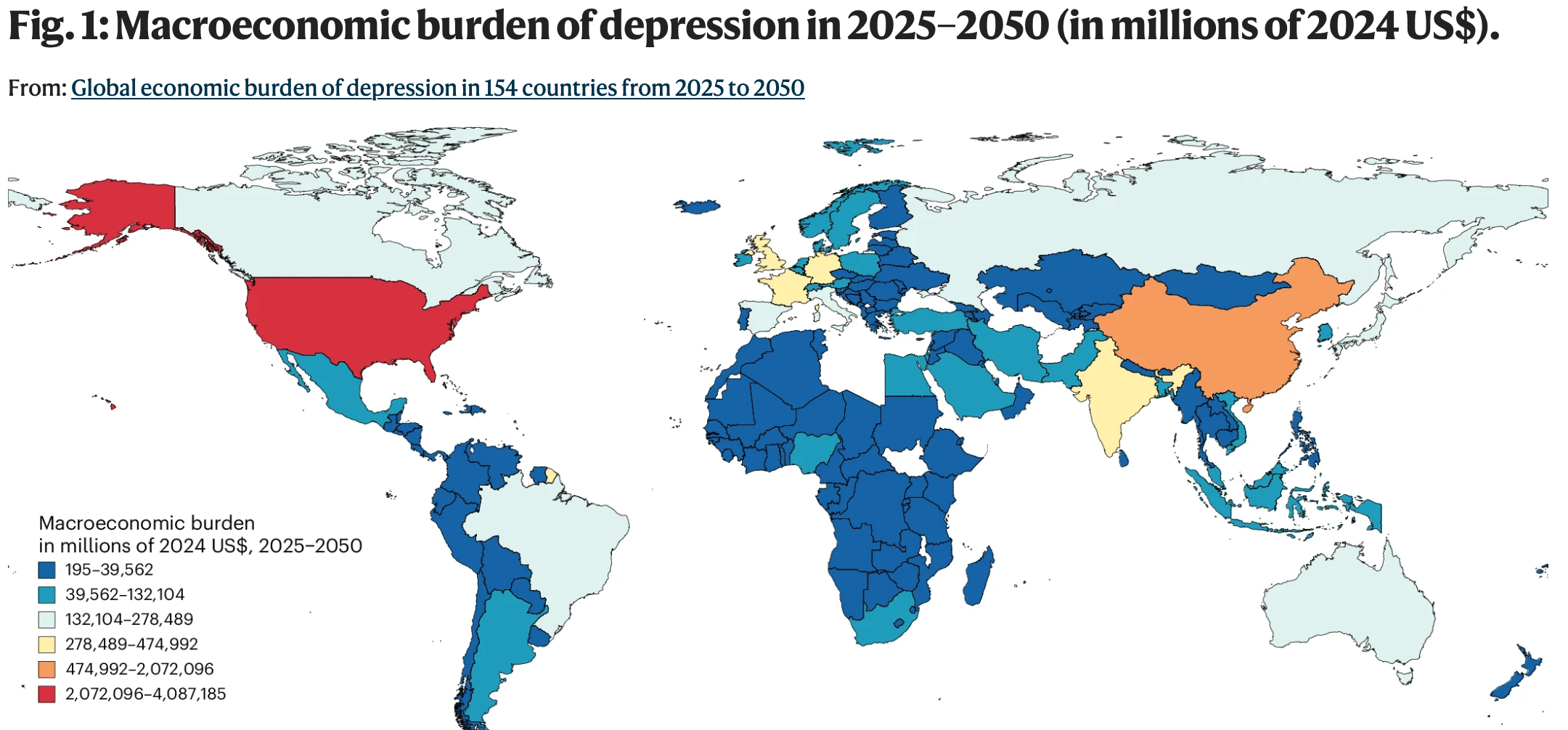
- Global economic burden. Depression was projected to cost $12 trillion (US) between 2025 and 2050, representing about 0.46% of global GDP, or approximately $1 429 per person.
- Countries. The United States and China had the largest absolute economic burdens, at $4.09 trillion and $2.07 trillion, respectively; as a proportion of GDP, Lesotho, Uganda, and Togo had the largest burdens.
- Regional differences. North America had the greatest relative burden, at 0.599% of GDP, followed by Europe and Central Asia (each at 0.506%). Low-income countries also had a relatively high burden (at 0.566%).
- Labour force. Reduced labour-force participation and productivity were the major drivers of the economic burden. The contribution from declining physical capital was considerably smaller, although it increased from 1.2% of the burden in 2025 to 9.0% by 2050.
- Suicide. When suicide mortality was included, the economic burden rose to $14 trillion. (The authors assumed that 60% of suicide deaths were attributable to depression.)
A few thoughts:
1. This is an interesting and important paper, published in a major journal.
2. Even without delving too deeply into the economics, this analysis is impressive: the economic consequences were projected within a macroeconomic growth model, rather than simply adding healthcare costs and lost wages. (Nice.)
3. The main finding in three words: depression is costly. (Not nice.)
4. As clinicians, we don’t usually think about depression from an economic perspective, but it’s an important consideration. The authors note that: “Compared with other major illnesses such as cancer or chronic obstructive pulmonary disease, depression stands out for its especially high burden of illness.” One of the reasons why: depression tends to develop when patients are young and of working age, unlike many other diseases.
5. The study suggests that the largest economic hit comes from depression’s effect on work (lower labor force participation and productivity) rather than treatment costs alone.One interpretation of the results: spending on treatment should be seen as an investment that may support human capital development and economic growth. For the record, the authors advocate action: “we need to work together to make sure that inexpensive, evidence-based therapies are available and that supportive policies are in place.” (!)
6. Like all studies, there are limitations. The authors note several, including that: “Depression may increase mortality risk through multiple pathways, including comorbid conditions and health-related behaviors.” In other words, the Cao et al. estimates should be “interpreted as conservative with respect to the broader mortality consequences of depression.”
The full Nature Medicine paper can be found here:
https://www.nature.com/articles/s41591-026-04548-7
Selection 2: “Does Interacting With Artificial Intelligence Cause Delusions?”
Philip R. Corlett
JAMA Psychiatry, 19 August 2026 Online First

We are witnessing an explosion in the development and adoption of artificial intelligence (AI) technologies. Large language models (LLMs) are trained on the statistical regularities of language to produce humanlike responses. However, LLMs give obsequious replies, perhaps by dint of their training (with human raters in the loop, who may favor agreeable responses and bots) and can readily dupe their interlocutors into believing they are intentional, even conscious, agents.
They also hallucinate, generating false information in response to prompts (though calling these errors hallucinations is not accurate, since the models do not perceive; it is more accurate to call their errors confabulations). Unleashing an inaccurate but compelling technology on an unprepared public could dramatically impact mental health.
So begins a paper by Corlett.
How to understand AI and psychosis? “I do not believe these are delusions proper, but they are delusionlike—similar instead to the recent apparent rise in conspiracy theorizing. It seems that in response to any given world event, conspiracies (like the allegation that an event is a prearranged false flag operation) flourish, particularly under uncertain and volatile circumstances. Such conspiracy theories rapidly evolve in online social networks, where other users and network recommendation algorithms reinforce the content. LLMs appear to do this in a more tailored manner, more idiosyncratic to the user (an echo chamber for one).”
How to understand this? “In this way, the interaction between LLM and user is more like folie à deux, the situation in which one truly delusional inductor partner infects another (the inductee) with their delusion. This typically happens in the context of close familial or marital relationships and extreme social isolation and is corrected (at least in the inductee) by separation.” He then offers a modern twist on the old term: “Given LLMs produce hallucinated, confabulatory content, folie simultanee might be more apt (wherein both interlocutors stoke one another’s delusions).”
How much to blame AI? “A critical question is whether LLMs induce delusionlike beliefs in individuals without other predisposing or causal factors. A notable caveat of the reports of AI delusion is that causality has yet to be definitively demonstrated. In the peer-reviewed case reports, there are other extenuating factors that may have exacerbated the psychosis (eg, stimulant medication use and prolonged sleep deprivation). Castiello et al recently showed that people who are more paranoid report perceiving animacy and agency even in dots that are moving on a computer screen. We must acknowledge the possibility that people prone to psychosis will imbue LLMs with intentions even more readily than people who are not psychotic.”
He looks at the literature:
- “In simulations of interactions between model users and LLMs, with textual analysis of their exchanges, it appears that even in Bayesian observers (whose belief updating is rational), a sycophantic LLM can produce incorrect—delusionlike—beliefs (note that these results have not been peer reviewed).”
- “A similar pattern was observed in commercial LLMs tested with the same delusionlike belief–inducing content; unsafe LLMs validated the user’s delusional premises, elaborated beyond them with new content, and attempted harm reduction from within the delusional frame (perhaps further reinforcing the delusional premise).”
He argues that there is nothing new under the sun. “When people started to experience delusions of reference with radio presenters or television newsreaders, we did not claim that the radio or television caused their psychosis.”
He suggests asking patients about AI use and grounding them with CBT techniques. In the end, he wonders about new wine in new bottles.
A few thoughts:
1. This is a good commentary, published in a major journal.
2. There is much to like here. “folie simultanee” – clever.
3. Readers can decide for themselves if this is a case of old wine in new bottles or new wine in new bottles.
The full JAMA Psychiatry paper can be found here:
https://jamanetwork.com/journals/jamapsychiatry/article-abstract/2852555
Selection 3: “I’m a Psychiatrist. I’m Hearing Something New From Young Women.”
Suzanne Garfinkle-Crowell
The New York Times, 18 August 2026

Several years ago, I started noticing something new when teenage girls or young women came to my office for their first psychiatric sessions. Patients used to dread being told that there was something, as they saw it, wrong with them. Now these young women were announcing their diagnoses — attention deficit hyperactivity disorder, obsessive-compulsive disorder, anxiety, depression — almost before telling me their names.
They had researched their symptoms on Instagram; they’d taken TikTok quizzes about them; they had cross-indexed their conditions with those of their friends. It was everyone — gravel-voiced film majors and earnest high school athletes, class presidents and girls who skipped school, girls who spent weekends in the Hamptons and girls who had to work for their spending money. The patients of this new wave were talking in therapy-speak, and their therapy hadn’t even started.
The physician part of me would instantly start thinking through an alphabet soup of treatments for the conditions these girls were reporting — D.B.T., C.B.T. and E.M.D.R. and medications to go with each.
Another part of me — the parent, the Xennial — would struggle to suppress an inner eye roll.
So begins an essay by Dr. Garfinkle-Crowell.
She continues: “If you’re a parent of an adolescent girl, you might have experienced your own version of these two reactions: either terror for your daughter’s psychological well-being or alienation from all the jargon. You might have even tried to convince your daughter that everything was fine.” She offers some advice, including that “diagnosis words may function differently for these young women from the way they do for others.” She notes: “They are not necessarily claims to cold, scientific truths, yoked to specific evidence-based treatments. Instead, research increasingly reveals, these words are often a coping mechanism, an effort to find some accepted narrative in which to situate one’s very personal pain. We should try to hear them that way: We should take the therapy-speak, to borrow an expression, seriously but not literally.”
She talks about patients in her practice. “One girl told me she had assigned herself a diagnosis of depression, which she later acknowledged she thought would make me care about her.” She sees a complicated picture: “In some cases, my patients’ self-diagnoses were spot on… In many others, however, the psychiatric label seemed more like a compromise between uncomfortable feelings and the desire for social acceptance.”
She writes about therapy-speak, which is “leading with diagnostic language, applying labels instead of describing feelings.”
“Adolescent girls and young women aren’t the only ones reaching for therapy-speak, of course. According to some measures, 50 percent of Gen Z-ers have labeled themselves with mental health conditions, and illness identities have taken hold of young people, both online and off.” Still, she notes that girls are the primary drivers of the trend. “They are the main group looking up health information online, talking about their feelings and relationships and seeking labels for what’s wrong.”
She notes problems with the trend. “It can leave friends and loved ones feeling they have no ability to help, as though they’ve got to back off and let the professionals do their thing. And it can short-circuit a young person’s already difficult progress toward self-discovery.”
How to proceed? “Small acts of translation can help. Someone who says she has A.D.H.D. may or may not fit the clinical definition, but she’s probably telling you she feels scattered, overwhelmed or afraid she’s a mess. If someone says she has anxiety, you can be pretty sure she’s nervous, uneasy or unsure of herself.”
“Ultimately, translation is an exercise in empathy, in jumping out of the limits of your own perspective.”
She closes with a call for personal action. “Language can illuminate certain parts of the truth while obscuring others. Perhaps that’s why it is believed that Claude Monet said that in order to see a thing, we must forget its name. Internet users might have been getting at something similar when they came up with the hashtag #LetsNormalizeNotCallingWomenCrazy. When it comes to therapy-speak — whether it’s used in my office or in your house — this kind of translation is an important first step.”
A few thoughts:
1. This is an excellent essay.
2. Solid advice: “We should take the therapy-speak, to borrow an expression, seriously but not literally.”
3. We practice in the era of TikTok. You may love or loathe social media – but it is our reality.
The full New York Times essay can be found here:
https://www.nytimes.com/2026/08/18/opinion/therapy-speak-daughter-trauma-anxiety.html
Reading of the Week. Every week I pick articles and papers from the world of Psychiatry.
Recent Comments