From the Editor
Only three modestly effective medications have been approved by the U.S. Food and Drug Administration (FDA) for the treatment [of alcohol use disorder]. Novel pharmacological targets are desperately needed.
A new paper begins with an old truth: for some, alcohol misuse is devastating, yet effective medications remain few. What then should we make of oral semaglutide?
In a new study published in The American Journal of Psychiatry – quoted above – Joseph P. Schacht (of the University of Colorado) and his co-authors attempt to answer that question. They report on a phase 2, double-blind, randomized, parallel-arm trial involving 50 participants with alcohol use disorder (AUD) who received oral semaglutide or placebo. “Oral semaglutide significantly reduced alcohol consumption, naturalistic alcohol craving, alcohol-related problems, and cannabis use.” We consider the paper and its implications.
In the second selection, Dr. Jeffrey S. Woods (of the University of Texas at Houston) and his co-authors describe the history of coffee. In a clever paper for Biological Psychiatry, they review the literature, ultimately concluding that coffee may be healthful. “Despite millennia of enmeshment in human culture, over the past 50 years the medical community has treated coffee with caution.”
Finally, in the third selection, Clay Routledge (of the Archbridge Institute) writes about the growing awareness of mental health problems and, ironically, our deteriorating collective mental health. In an essay for The New York Times, he sees a connection. “We should try to spend less time stuck in our heads and more time out in the world, pursuing the kinds of activities that support mental health without making us so obsessed with it.”
DG
Selection 1: “Oral Semaglutide for Alcohol Use Disorder: A Randomized Clinical Trial”
Joseph P. Schacht, Joseph T. Sakai, Kristen Raymond, and Robert Shelton
The American Journal of Psychiatry, 29 July 2026 Online First

Alcohol use disorder (AUD) has enormous personal and socioeconomic costs… AUD is characterized by dysregulated motivation for and consumption of alcohol, and targets that affect motivated and consummatory behavior may hold promise. One such target is glucagon-like peptide-1 (GLP-1), a peptide hormone secreted from intestinal endocrine L cells in response to nutrients in the gut. GLP-1 promotes insulin secretion, in a glucose-dependent fashion, through pancreatic GLP-1 receptors, ultimately lowering blood sugar and decreasing gastric emptying. GLP-1 receptors are also widely expressed in reward-related brain areas, and they modulate a satiety signal that reduces food intake, potentially by reducing food’s rewarding value…
Increased clinical uptake of GLP-1RAs has been accompanied by anecdotal reports of reduced alcohol consumption, which are supported by preclinical findings that GLP-1RAs reduce ethanol reward, intake, and conditioned place preference. Few head-to-head studies of different GLP-1RAs have been conducted… To date, three randomized trials have evaluated GLP-1RA effects on alcohol consumption. Injectable exenatide for 26 weeks did not significantly reduce heavy drinking days among treatment-seeking individuals with AUD but did reduce this outcome in a subset of patients with obesity. In a secondary analysis of a smoking cessation trial, injectable dulaglutide for 12 weeks reduced drinks per week among participants who consumed alcohol at baseline. Finally, injectable semaglutide for 9 weeks reduced heavy drinking days, drinks per drinking day, and alcohol craving among non-treatment-seeking individuals with lower-severity AUD.
So begins a paper by Schacht et al.
Here’s what they did:
- They conducted a phase 2, double-blind, randomized, parallel-group trial to test whether oral semaglutide could reduce alcohol craving and drinking among adults with moderate-to-severe alcohol use disorder (AUD).
- Participants were treatment-seeking, overweight/obesity (BMI ≥25), and had substantial recent alcohol consumption.
- Participants received either oral semaglutide (3 mg/day for 4 weeks, followed by 7 mg/day for four weeks) or a matching placebo for eight weeks. Both participants and study staff remained blinded to treatment assignment.
- Primary outcome: alcohol cue–elicited craving measured during a laboratory alcohol cue-reactivity paradigm at week six, after participants were exposed to their preferred alcoholic beverage without consuming it. Key secondary outcomes included heavy drinking days and drinks per day during the final four weeks of treatment.
Here’s what they found:
- 50 adults were randomized: 26 to placebo and 24 to semaglutide.
- Demographics. 56% of the participants were female and the vast majority, White (94%). The mean age was 51.1 years.
- Primary outcome. “Semaglutide did not significantly reduce laboratory-assessed craving or drinks per day compared with placebo…”
- Heavy drinking. It did significantly reduce heavy drinking days (b=−0.580).
- Other measures. Semaglutide also significantly reduced drinks per drinking day (b=−1.177) and naturalistic alcohol craving (b=−2.195). Semaglutide reduced alcohol-related consequences at a significantly greater rate than placebo (b=−4.618).
- Cannabis. Among the small subgroup using cannabis, semaglutide was associated with fewer cannabis use days.
- Retention and adherence. Treatment retention was high (94%); medication adherence was excellent.
- Adverse events. They were mostly mild, with only one participant discontinuing semaglutide because of an adverse reaction.
A few thoughts:
1. This is a good paper on an important topic, published in a major journal.
2. The main finding in three words: it didn’t work.
3. But the picture is more nuanced: no reduction in lab-assisted craving or drinks per day, true, but there were reductions in heavy drinking days and other measures.
4. Given the need for new treatment approaches, would a partial win prove to be potentially a big win? (This question can be asked in light of this study, and the other recent ones involving GLP-1 receptor agonists via injection.)
5. And the use of an oral agent is promising. Some patients will feel more comfortable with a medication that doesn’t involve needles.
6. The cannabis finding is also interesting.
7. Like all studies, there are limitations. The authors note several, including: the lack of ethnic diversity in the sample, as well as the fact that they were all overweight/obese. The authors conclude by suggesting that more research is needed. Their tempered enthusiasm is appropriate given the many limitations. Still, the enthusiasm is a bit contagious. Consider: “[T]hese data hint that semaglutide’s effects on heavy drinking may be greater than other FDA-approved AUD medications’ small to medium effects…”
The full American Journal of Psychiatry paper can be found here:
https://psychiatryonline.org/doi/10.1176/appi.ajp.20260003
Selection 2: “Dancing Goats, Civet Cats, and the Case of Coffee”
Jeffrey S. Woods, Joseph Cooper, and David A. Ross
Biological Psychiatry, 15 August 2026 Online First

Legend tells us that coffee’s story began with a single goat herd. Kaldi, a 9th-century Arab goat herder, noticed his flock behaved strangely after eating a particular fruit. The goats were ‘abandoning themselves to the most extravagant prancings.’ Curious and melancholic, Kaldi tried the berries himself. ‘He forgot his troubles and became the happiest herder in happy Arabia.’ One day, a man of prayer passing by noticed the ‘saltatorial madness’ of ‘a score of goats executing lively pirouettes.’ The scene was so striking that he confided in Kaldi his shame from falling asleep during his prayers and inquired how he had so much energy. The man ‘reasoned that Mohammed without doubt was revealing this marvelous fruit to him to overcome his sleepiness’.
This energizing concoction traveled across deserts and seas, fueling the rise of trade empires. One astonishing story came from Indonesia, where much of the coffee crops were grown on plantations run by Dutch colonists. The local farmers were forbidden from taking any of the precious beans they cultivated. Nevertheless, they knew their value. So, they gathered and cleaned minimally digested beans in civet feces. This method of processing now produces one of the modern world’s rarest and highly coveted coffees, kopi luwak (Indonesian for civet coffee).
Over the ensuing centuries, coffee became infused as a daily ritual in most cultures across the world.
So begins a paper by Woods et al.
“Then, in 1981 the civet poop hit the fan. A team of researchers led by Brian MacMahon were searching for environmental causes of pancreatic cancer. They surveyed 369 cases (and 644 controls) about their use of various substances including cigarettes, cigars, pipe tobacco, alcohol, tea, and (you guessed it) coffee. Astonishingly, they found the relative risk of pancreatic cancer was 3.2 in individuals who drink 5 or more cups of coffee per day… The coffee pendulum had swung from a mark of society’s upper echelon to a carcinogen.”
They note that “scientists handled the surprising result in a surprisingly responsible way: they attempted to replicate it.” They couldn’t. “Epidemiologists soon sorted it out. Heavy coffee drinkers were also overwhelmingly heavy smokers.”
The authors explore the effects of caffeine. “Caffeine’s primary neural effects occur through the adenosine system, where it antagonizes two functionally distinct receptors: A1 and A2A. A1 antagonism produces the familiar, immediate effects: heightened vigilance and subtle nudges toward movement, social engagement, and productivity. A2A receptors, on the other hand, intersect with dopaminergic motivation circuits in the striatum. In the absence of caffeine, A2A receptors in these circuits normally act as a ‘brake’ that resists effortful actions; when A2A receptors are blocked with caffeine, this ‘brake’ is released and individuals feel a reduction of perceived effort. But the sustained effects might be more notable. Remarkably, chronic antagonism of A2A receptors has been described to lower the risk of Parkinson’s disease by nearly 40% and to confer benefits in inflammation, fibrosis, and cellular energy efficiency.”
They delve further. “These more chronic effects are best understood through one of the new frontiers in psychiatric neuroscience. Allostasis is the term that describes the brain’s capacity to shift set points in response to sustained stress. With aging, we know this capacity decreases, meaning your brain and body tend to lose the ability to adapt to novel stressors. Chronic A2A antagonism appears to counteract this age-related change. It preserves people’s ability to adapt to novel stresses largely by interrupting inflammatory signaling cascades. These findings seemed to offer the mechanism by which coffee prolongs health.”
They note the complexity. Drawing on work that looked at metabolism, they write: “the reduction in all-cause mortality was comparable in both slow and fast caffeine metabolizers.” An explanation? Coffee has 2 000 potential bioagents. Understanding that a fuller clinical picture would require more data – “we would need prospective data over many years with high-fidelity nutrition data” – they offer suggestions in speaking with patients:
- Restraint. “We should stop reflexively warning patients away from black coffee. Without contraindications (uncontrolled arrhythmias, severe anxiety, or significant reflux), the benefits are clear.”
- Dosing. “Consuming roughly 2 to 4 cups of filtered, black coffee is safe for most adults and is modestly protective, with an estimated gain of 1.84 years of life.”
- Context. “A sedentary smoker drinking 6 sugar-loaded lattes is not the same as someone drinking a big mug of black coffee before a morning walk.”
They close on a practical note, suggesting that when patients ask about coffee, we offer “intellectual honesty” – that is: “if prepared properly and consumed in moderation, it is likely helping more than harming.” They advise “that subtle reframing, from guilt to guidance, may be one of the most practical interventions we can offer our patients before they even start their day.”
A few thoughts:
1. This is a great paper – thoughtful, interesting, relevant.
2. It’s also fun.
3. I’m not just saying that because it’s the only journal paper that I’ve read this year featuring a picture of a pooping cat.
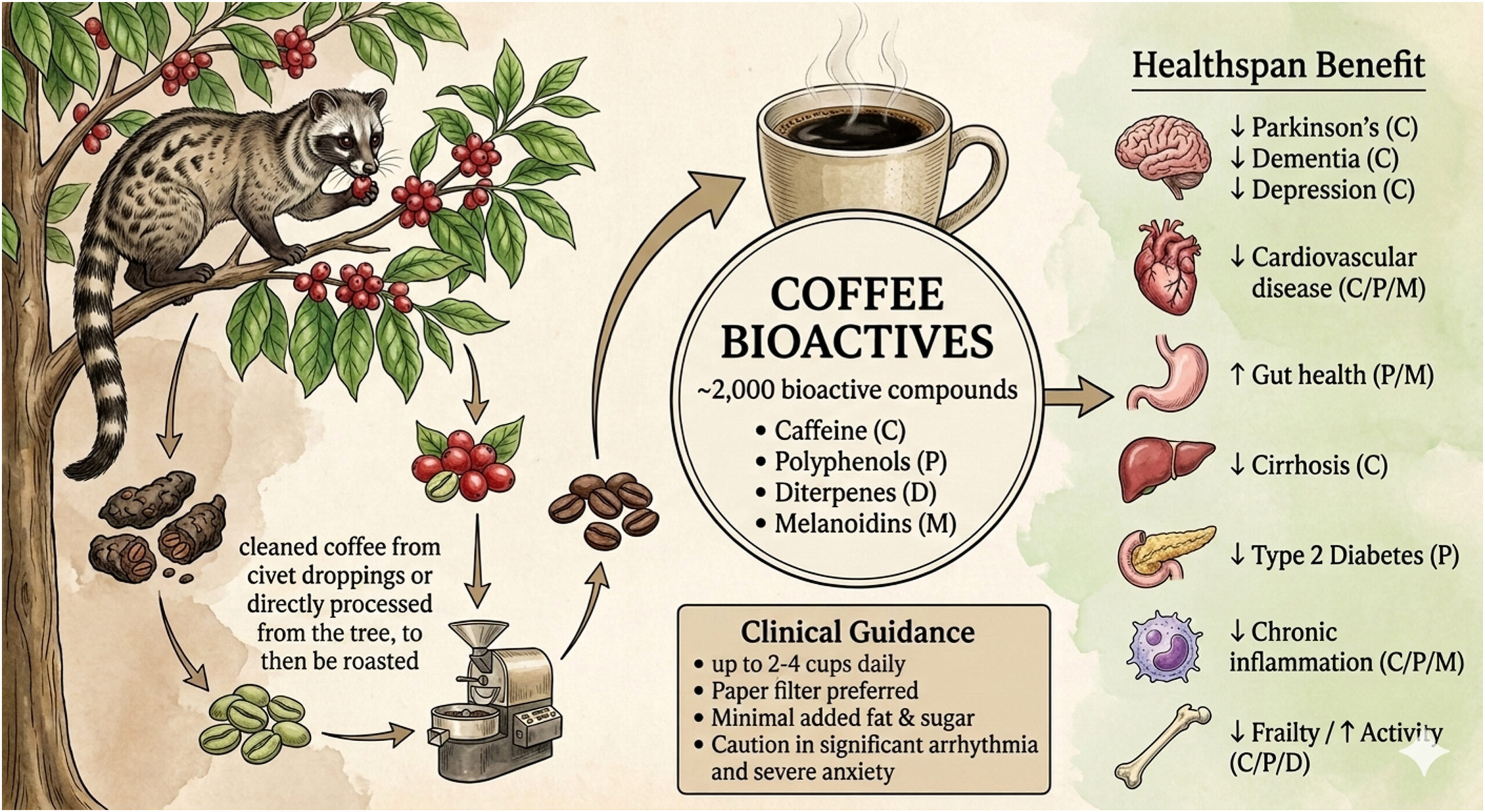
4. The authors focus on coffee – relevant for us and our patients. The final recommendation is reasonable. (For the record, I drink three cups a day.)
5. There is the larger topic of patient advice and an evolving literature. The authors’ suggestion is excellent: “The first thing we can do is demonstrate a bit of restraint.”
The full Biological Psychiatry paper can be found here:
https://www.biologicalpsychiatryjournal.com/article/S0006-3223(26)01314-4/fulltext
Selection 3: “Stop Pathologizing Ordinary Life”
Clay Routledge
The New York Times, 26 July 2026

Americans are more focused on mental health today than at any other point in our history. Public health campaigns urge us to check in on our feelings and talk openly about our struggles. Schools have adopted mental health curriculums. Employers offer mental health days…
Yet our mental health appears to be getting worse. Over the past several decades, the percentage of Americans who report being in poor mental health has been rising. Over half of U.S. doctors surveyed in 2023 reported a decline in their patients’ mental health. That same year, more than three-quarters of companies reported rising mental health concerns among their work forces.
Could our preoccupation with mental health be part of the problem?
So begins an essay by Routledge.
He argues yes. “In some ways, encouraging people to think and talk more about their mental health is a good thing. There is now less stigma around mental illness, and more people who can benefit from professional help are getting it.” But he has hesitation: “There is also reason to believe that efforts to bring attention to mental health struggles are inadvertently making us more vulnerable to psychological distress.”
“Start with our expanding conception of mental illness. The more fixated we are on mental health, the more sensitive we become to anything that might qualify as a symptom and the more we use clinical language to describe normal emotional experiences like grief, burnout and loneliness.”
He continues: “Then there’s our perception of how widespread mental illness is. By broadening what counts as a disorder, we begin to see it everywhere, including in ourselves. Research has found that when people view social media posts that normalize anxiety disorders, they become more inclined to think they have one.”
The problem, he reasons, is more than just people misdiagnosing themselves. “It’s also that these misperceptions can put people on the path to developing poor mental health – a kind of self-fulfilling prophecy. When people in one study were encouraged to adopt a broad view of what constitutes trauma, they reported greater levels of distress after watching a film clip with disturbing content and were more likely to describe the experience as personally traumatic.”
He sees a path forward and makes some recommendations:
- Exercise. “A growing body of research indicates that exercise does as good a job of reducing symptoms of anxiety and depression as psychotherapy or medication…”
- Acts of kindness. “One study randomly assigned individuals with anxiety and depression symptoms either to practice a set of cognitive-behavioral therapeutic exercises or to engage in acts of kindness toward others. Both approaches reduced anxiety and depression, but the kindness group improved more, suggesting that focusing on someone else’s problems took people’s minds off their own worries.”
- Meaning. “The more meaningful that people find their lives, the more resilient they are when facing stress and the lower their risk of depression, anxiety, substance abuse and suicide.” More: “finding meaning tends to involve outward-oriented action. That’s because we feel the most meaningful when we are doing things that provide social significance – a sense that we matter, that we play an important role in other people’s lives.”
A few thoughts:
1. This is a well-written essay.
2. The long pull of social media is well described in the essay. The author notes: “Nearly a third of American adults and half of Gen Z adults have given themselves a diagnosis of a mental illness based on information from social media.” Wow.
3. To play devil’s advocate: is overdiagnosis a small price to pay for a larger societal acceptance of mental illness?
The full New York Times essay can be found here:
https://www.nytimes.com/2026/07/26/opinion/mental-health-exercise-charity.html
Reading of the Week. Every week I pick articles and papers from the world of Psychiatry.
Recent Comments