Tag: The American Journal of Psychotherapy

Reading of the Week: Therapy, with Papers on Long-Term Effects and on Pet Therapy; Also, Lieberman on Too Much Therapy

From the Editor

Patients with depression benefit from psychotherapy. But do those effects last?

The question isn’t new, but long-term effects haven’t been well studied. An impressive new World Psychiatry study by Pim Cuijpers (of Vrije Universiteit Amsterdam) and his co-authors brings needed data to the discussion. They did a meta-analysis of 191 RCTs with 209 comparisons between treatment and control groups, involving 33 691 participants. “We conclude that psychotherapies have moderate to large effects at 3 months after randomization, which slowly decrease during the next 9 months to a moderate level, and remain stably moderate for several years.” We consider the paper and its implications.

In the second selection, from The American Journal of Psychotherapy, Michelle Geiss (of Southern Illinois University) and her co-authors analyzed a canine-assisted intervention (CAI) on an inpatient unit, drawing on semi-structured interviews with 17 psychiatric nursing staff members. “CAI was perceived by staff as a valuable complementary therapy in the inpatient psychiatric setting, offering emotional, social, and therapeutic benefits for both patients and staff.”

And in the third selection, psychologist Harvey Lieberman reflects on psychotherapy in an essay for The New York Times. As a therapist, he wonders whether too many people seek therapy. “For some people, therapy can help in ways nothing else can. But many will find that the best forms of understanding and emotional support flow from informal networks of relatives, neighbors and friends, not the health care system.”

Note: there will be no Reading next week.

DG

Continue reading
Reading of the Week: AI & Therapy

From the Editor

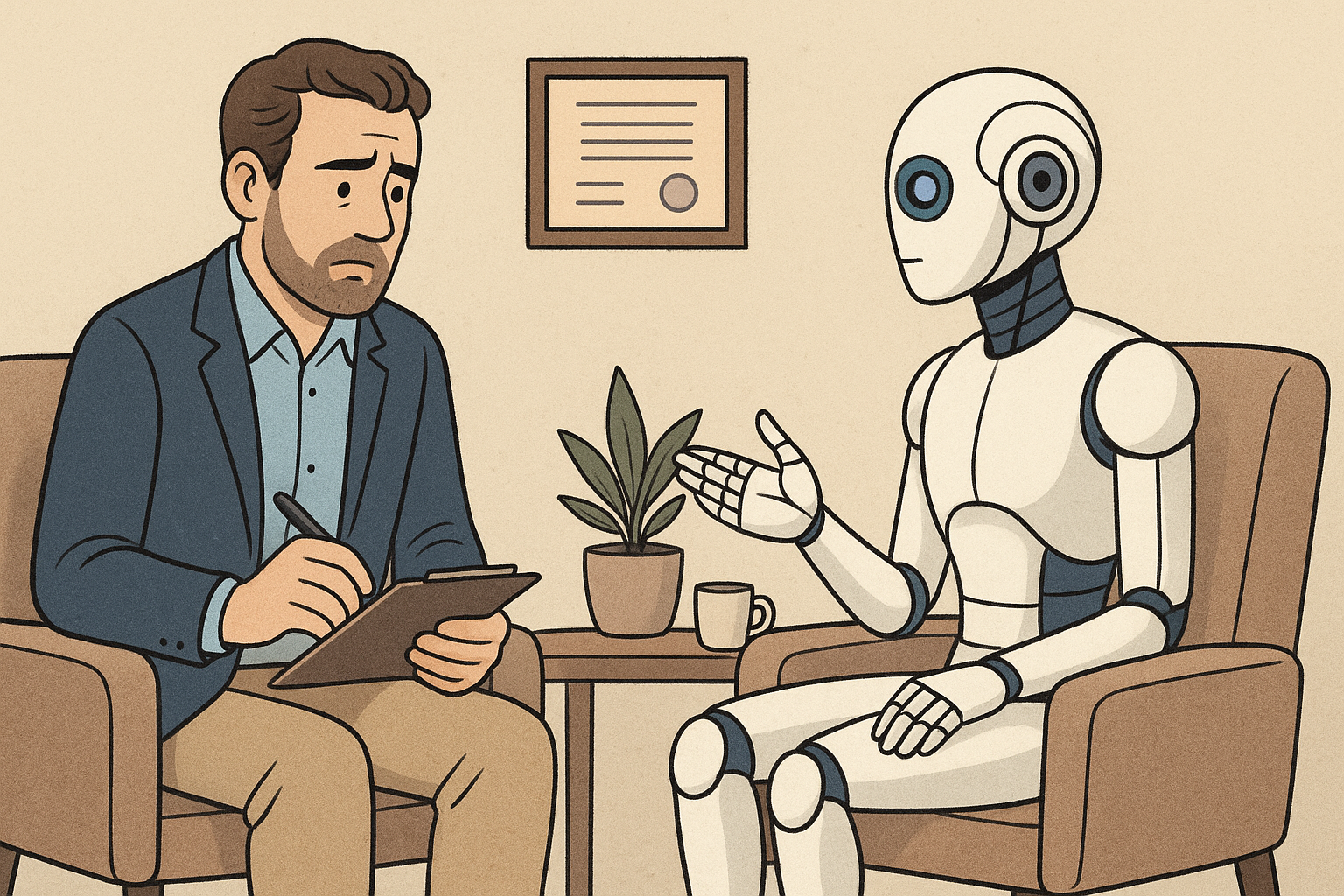
As patients struggle to access care, some are looking to AI for psychotherapy. Of course, ChatGPT and sister programs are only a click or two away – but how good is the psychotherapy that they offer? 

In a new American Journal of Psychotherapy paper, Dr. Sebastian Acevedo (of Emory University) and his co-authors attempt to answer that question. Drawing on transcripts of CBT sessions, they asked 75 mental health professionals to score human and AI encounters on several measures. So how did ChatGPT fare? “The findings suggest that although ChatGPT-3.5 may complement human-based therapy, this specific implementation of AI lacked the depth required for stand-alone use.” We consider the paper and its implications.

In the second selection, from JMIR Mental Health, Dr. Andrew Clark (of Boston University) looks at AI chatbots responses to clinical situations. Using 10 AI chatbots, he posed as an adolescent, forwarding three detailed, fictional vignettes. The results are surprising. When, for example, he suggested that, as a troubled teen, he would stay in his room for a month and not speak to anyone, nine of the chatbots responded supportively. “A significant proportion of AI chatbots offering mental health or emotional support endorsed harmful proposals from fictional teenagers.”

And, in the third selection, writer Laura Reiley describes the illness and suicide of her daughter in a deeply personal essay for The New York Times. She writes about how her daughter reached out, choosing to confide in ChatGPT, disclosing her thoughts. “ChatGPT helped her build a black box that made it harder for those around her to appreciate the severity of her distress.”

DG

Continue reading