From the Editor
Recently, I saw an adolescent who described using self-harm as a way to cope. She discussed learning different techniques through social media. “At first, I thought it was strange.”
Presentations of self-injury appear to be becoming more common. How often are healthcare visits for it? How commonly do youth report self-injury? Have these numbers changed over time? In a new study published in JAMA Pediatrics, Dr. Natasha Saunders (of the University of Toronto) and her co-authors attempt to address these questions by drawing on 42 studies with a combined population of 234 million individuals across a dozen nations over a 25-year period. They conducted a systematic review and meta-analysis, finding an average 3.5% relative annual increase. “These findings highlight a consistent rise in health care encounters and self-reported self-injury among children and youth, particularly female individuals, over the past 2 decades.” We consider the study and its implications.

In the second selection from The British Journal of Psychiatry, Dr. Gurubhaskar Shivakumar (of The University of Sydney) and his co-authors write about lithium. They note its declining use and the problems with its safety. Yet they argue that lithium remains the “king” of bipolar disorder treatment. “Ever since its discovery, lithium continues to command authority having repeatedly reclaimed its throne.”
Finally, in the third selection, Dr. Lena Palaniyappan (of McGill University) and his co-authors discuss high-risk human-AI relationships in a paper for The Canadian Journal of Psychiatry. They offer a framework and constructive suggestions – both highly relevant in the age of AI chatbots. “Risk for problematic AI engagement cuts across diagnostic categories, rooted in distress, isolation, and cognitive style.”
DG
Selection 1: “Long-Term Trends in Pediatric Self-Injury in High-Income Countries: A Systematic Review and Meta-Analysis”
Natasha Saunders, Hallie Benjamin, Petros Pechlivanoglou, et al.
JAMA Pediatrics, 16 March 2026 Online First

Self-injury, defined as the intentional infliction of injury on oneself either with or without suicidal intent, has emerged as an important public health concern among children and adolescents globally. It is estimated that approximately 10% of young individuals have engaged in self-injury at some point, with varying levels of suicidal ideation. The factors contributing to self-injury are multifaceted, encompassing emotional self-regulation, stress coping mechanisms, and the expression of psychological distress…
Although there is some overlap in known risk factors for completed suicide, suicide attempt, and self-injury, their epidemiology and intents are distinct. Nonsuicidal self-injury is 5 to 10 times more common than suicide attempts, and both are hundreds of times more common than completed suicides… Another potential contributing factor is the rise of social media and online platforms which not only potentially introduce and increase awareness of self-injury as a coping mechanism and normalize and validate self-injury behaviors among vulnerable individuals, but also directly affect mental health.
So begins a paper by Saunders et al.
Here’s what they did:
- They conducted a systematic review and meta-analysis to “provide temporal trends in self-injury rates among children and youth residing in Organization for Economic Co-operation and Development countries.”
- They drew on several databases, including MEDLINE. They included studies that were “regional and national registry–based longitudinal and cross-sectional studies conducted within general populations, comprising individuals aged 24 years and younger, and with at least 5 years of data.”
- Studies were included that “measured (1) hospitalization or emergency department or physician visits for self-injury” or “(2) surveys of self-reported self-injury.”
- They used the Preferred Reporting Items for Systematic Reviews and Meta-Analyses reporting guideline. “Articles were independently assessed for quality by 2 individuals. Random-effects meta-analyses were used to calculate overall and sex-specific pooled effect estimates…”
- Primary outcome: “the relative change in the annual rate of health care encounters for self-injury or from self-reported surveys.”
Here’s what they found:
- A total of 42 studies with a combined population of 234 054 520 individuals at study midpoints were conducted in 12 high-income countries. (!)
- Data. 35 studies used health care encounter data; seven studies, self-reported surveys.
- Increase. “Based on health care encounters, there was a 3.5%… relative annual increase in self-injury over the study period (2000-2024)…”
- Sex. The increase was higher for female individuals (3.6%) than male individuals (1.2%).
- Heterogeneity. “While most individual studies and pooled estimates indicate an upward trend, high heterogeneity suggests that these trends are not consistent across all jurisdictions.”
- Self-reported surveys. There was a 2.5% relative annual increase in self-injury.
A few thoughts:
1. This is a good study, looking at a practical problem and drawing on an impressive international dataset, and published in a major journal.
2. The main findings: up and up. That is, a 3.5% annual increase in health care visits for self-injury and a 2.5% annual increase in self-reported self-injury rates.
3. They see clinical implications: “Our findings underscore the need for enhanced support systems for children and youth in crisis, particularly among female individuals. This aligns with research indicating that female individuals are more likely to engage in self-injuring behaviors and report higher rates of internalizing disorders, such as anxiety and depression, which may contribute to this trend.”
4. Why the increase? The authors wonder about the rise of mental disorders – that is, “due to a general increase in mental health disorders more broadly, including anxiety and depression.” That said, they note a complicated picture: “existing studies examining trends in these conditions have yielded inconsistent findings.”
5. What about social media? The authors don’t really give comment on this – but it would seem plausible. Indeed, we can wonder if there is a social contagion effect. Dr. Joel Paris made that argument in a recent BJPsych Bulletin paper, considered in a past Reading. You can find it here:
6. Like all studies, there are limitations. The authors note several, including “variability in hospital coding practices across time.”
The full JAMA Pediatrics paper can be found here:
https://jamanetwork.com/journals/jamapediatrics/fullarticle/2845856
Selection 2: “Lithium: challenges of being king”
Gurubhaskar Shivakumar, Kinga Szymaniak, Erica Bell, et al.
The British Journal of Psychiatry, 5 May 2026 Online First

In the fight against the two-headed dragon that surfaced from musings of the mind, the one champion that has reigned supreme for more than half a century is lithium. Surviving precariously from one decade to the next, this humble, silvery white element continues to demonstrate its silverback status amongst the burgeoning pharmacological armamentarium that is presently used to ‘treat’ bipolar disorder. Numerous combatants belonging to the armies of antidepressants and anticonvulsants, flanked by their armigers brandishing pharmaceutical coats of arms, have successively thrown down the gauntlet to lithium, resulting in interregna marked by its displacement from prescription use. However, on each occasion, the shining knight, true to its mettle, has risen to the challenge and managed to reclaim its succession to the throne…
So begins an essay by Shivakumar et al.
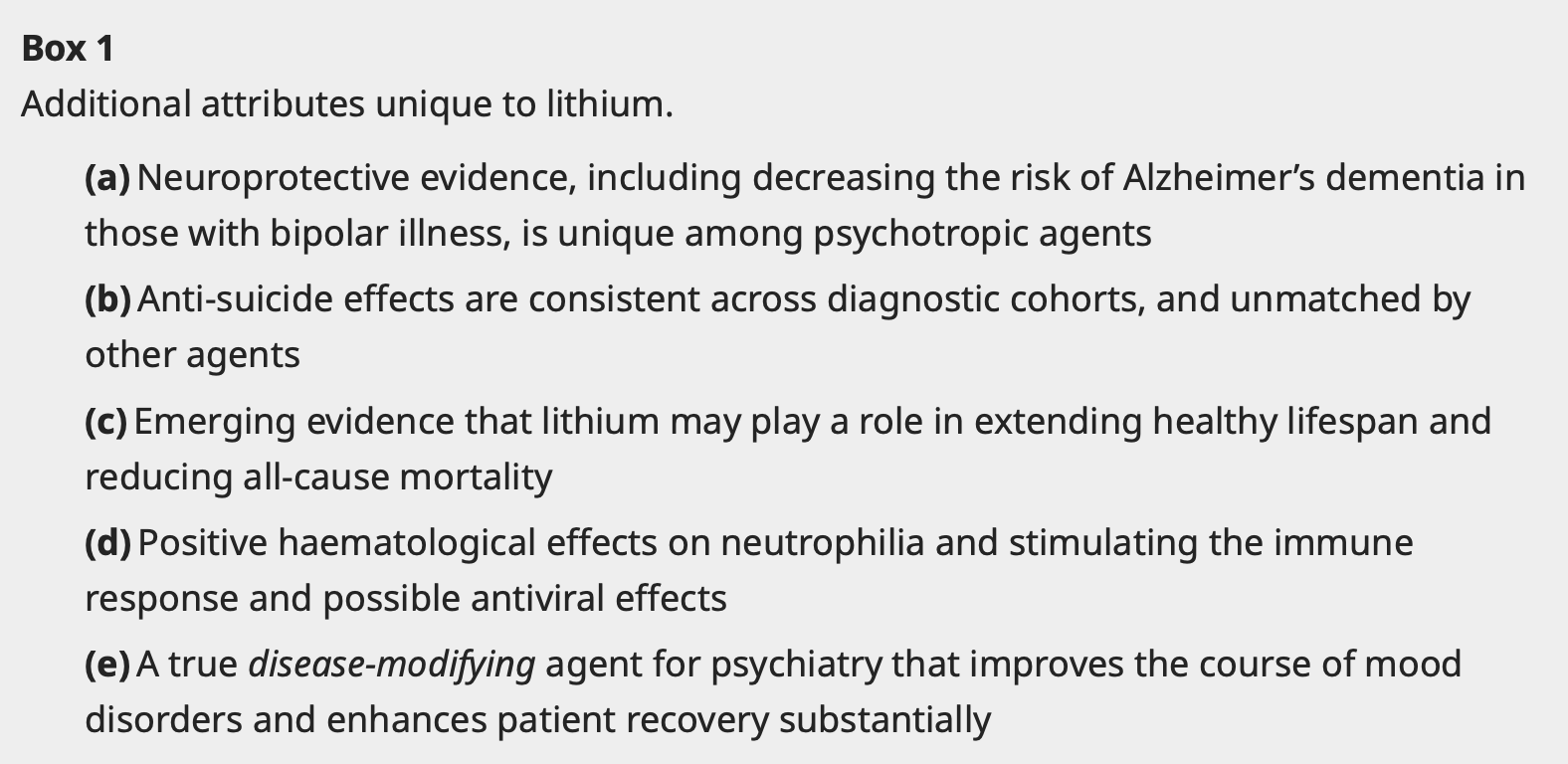
They discuss declining use despite the evidence. “The use of lithium is diminishing and under threat and its under-utilisation is puzzling given that decades of study demonstrate that lithium therapy provides enormous benefits when utilised with sound judgement. Few would question the effects of lithium in active mania, which it quells in a matter of days, and thereafter maintains mood stability in the long-term. This latter distinction – of being able to offer a lifetime of prophylactic protection from the ravages of bipolar illness, and thereby dramatically improving the prognosis of ‘lithium responders’ – constitutes lithium as offering more than temporary and symptomatic relief, and rather being a true disease-modifying agent…
They speak about the competition. “During the heyday of pharmaceutical company influence, lithium faced competition from multiple classes of agents with a diversity of actions, ranging from chlorpromazine to imipramine and the repurposed antiepileptic drugs such as valproate. Since the introduction of these agents, sold with the promise of being easier to prescribe without requiring regular monitoring, seismic shifts in prescription numbers over decades and across the globe have favoured valproate over lithium… Nevertheless, popularity trends must confront the reality of efficacy: the BALANCE trial demonstrated clearly that in maintenance treatment, relative to valproate, it is lithium that provides the lion’s share of prophylaxis either alone or in combination.” They also mention the second-generation antipsychotics. “These compounds are commonly offered both as treatment for acute mania and continued for ‘maintenance’ treatment of bipolar disorder; notably, not mood stabilisation. Unfortunately, patients who suffer from these conditions are at a significantly greater risk of relapse than those on lithium monotherapy.”
They put lithium’s problems in perspective. “Since the turn of this century, scores of researchers have attempted to counter this pervasive misapprehension with new data, and, as such, after decades of investigation and monitoring, lithium’s therapeutic (and adverse) effects should be seen as predictable, with millions of cumulative treatment-years across thousands of patients which, in sum, provide us with reliable data and guidance for prevention. Given the clear advantage that serum monitoring affords, and the relationship of circulating lithium to both therapeutic and adverse effects, there is a clear predictability to commencing and maintaining lithium for the long-term.”
They note important attributes of lithium:
- Dementia risk. “People with bipolar disorder have a threefold higher risk for dementia, and longer-term lithium treatment decreases this risk by about half.”
- Suicide risk. “2024 review by Tondo and Baldessarini found a consistent association of long-term lithium treatment with reduced suicidal risk… the risk of suicidal behaviour increases 20-fold in the months following lithium discontinuation, and reduces again when lithium is restarted.”
More:
A few thoughts:
1. This is an excellent paper. The regal theme is clever.
2. Have we been too critical of King Lithium? The authors certainly think so. They even offer a sympathetic perspective on monitoring. “In contrast to alternative agents, many of which have neither a practicable measure of monitoring safety, adherence, nor relationship to expected therapeutic doses, lithium’s propensity to be measured easily ought to be seen as a boon.”
3. Canadian data shows declining use here. Ouch.
4. Lithium has been considered in past Readings, including an American Journal of Psychiatry commentary by Dr. Robert M. Post (of George Washington University) and his co-authors. They argue that lithium is a disease-modifying agent, like a biologic for MS. That Reading can be found here:
The full British Journal of Psychiatry paper can be found here:
Selection 3: “High-Risk Human–AI Engagement: Clinical Assessment and Management Considerations”
Lena Palaniyappan, Vincent Paquin, and Etienne Barou-Laforie
The Canadian Journal of Psychiatry, 25 April 2026 Online First

The widespread adoption of conversational artificial intelligence (AI) represents a new frontier in psychosocial risk for mental illnesses, especially for adolescents and young adults. While most users engage harmlessly, a clinically significant subset may develop high-risk, problematic human–AI relationships. This spectrum of risk can vary from reinforcing insecurity, anxiety and ideas of self-harm to a phenomenon termed ‘Chatbot Psychosis’. Delusions of technology, where technology is incorporated into delusional content, are well documented in psychotic disorders. Unlike delusions that are a feature of psychotic disorders, ‘chatbot psychosis’ refers instead to the agentic influence of conversational AI in the development, revision and/or maintenance of thought dysfunction. This represents a relational risk pattern rather than a distinct diagnostic entity.
In contrast to other forms of human–machine interactions, conversational AI systems are tuned to be sycophantic, i.e., highly agreeable and frictionless in their interactions. They are designed to be human-like (anthropomorphic) in their presentation, though they are constantly accessible, lack conversational fatigue, and are devoid of the complexities and boundaries that characterise human–human interactions.
So begins a paper by Palaniyappan et al.
They discuss “the risk of problematic human–AI interaction” noting that it “arises from technological, personal, and social factors that increase susceptibility to relational displacement (substituting AI for human relationships as a primary social outlet) and belief amplification or drift (gradual changes in belief content or conviction through repeated interactions with AI). Initial engagement with AI chatbots may be driven by curiosity or entertainment, but for some, these benign entry points can shift towards higher-risk patterns as reliance increases and interactions become more emotionally salient.”
And they consider those at risk. “Individuals experiencing social isolation, loneliness, boredom, psychological distress, or major life transitions (e.g., immigration, separation, recent loss) may turn to chatbots for consistent, non-judgmental support and relief from emotional isolation. Barriers to healthcare, such as lack of trust, waitlists, and costs, increase the likelihood of seeking AI therapeutic support. People with mental health conditions that impair social functioning may find AI interaction more accessible for social connection.”
They note the engagement and availability. “Conversational AI agents introduce interactional features and specific user experience design choices that may amplify mental health risks differently from non-conversational technologies. These systems involve sustained reciprocal exchange, often starting with prompts that encourage disclosure (e.g., ‘How can I help you today?’). AI chatbots also encourage ongoing engagement through follow-up questions and offers of assistance, with round-the-clock availability.”
They offer a short ExPerT–Act framework:
Exposure. “What is the degree of exposure to conversational AI? Assess whether the use of conversational AI is frequent and escalating, as well as whether there is a decreased engagement in other social activities, with reliance on AI as a primary source of information or guidance.” Personification. “Is the role of the AI personified (anthropomorphised) and are conversations personalised? The user may have given the chatbot a name, or refer to the dyad as ‘we’ in their descriptions.”
Therapist role. “Is the AI used for validating affect, reducing uncertainties or supporting decision-making? Is it being used to confirm a belief or suspicion that others doubted?”
Actions. “Has the AI ever suggested the user to act in a way that may be harmful, or nonchalant when self-harm, intent to harm others or distrust is disclosed?”
They close with several clinical suggestions; three follow:
1. Explore with curiosity and non-judgemental questions, acknowledging the person’s motivations and positive experiences with AI. Validate the person’s need for support and understanding using a motivational interview approach.
2. Rebuild human connection; avoid triggering direct confrontation that may positively reinforce the human–AI bond at the cost of human–human bonds. Foster the patient–clinician alliance to help the person diversify or restore their social networks beyond AI.
3. Provide AI-specific psychoeducation; explain their design features, including their propensity to acquiesce without challenging beliefs, and their lack of true understanding; reduce the perception of AI as a conscious entity. Purpose-built conversational mental health apps with proven therapeutic frameworks and safety measures may reduce risk factors like social anxiety and distress, but their effectiveness in minimising harmful human–AI interactions has not been directly tested.
A few thoughts:
1. This is a helpful and thoughtful paper (part of the Clinician’s Corner series).
2. The suggestions are practical.
3. Though we as providers may have hesitation on the use of AI chatbots, they are accessible and pleasant. A new JAMA Pediatrics paper finds that one in five American youths uses them for mental health advice. (!)
The full Canadian Journal of Psychiatry paper can be found here:
https://journals.sagepub.com/doi/full/10.1177/07067437261445770
Reading of the Week. Every week I pick articles and papers from the world of Psychiatry.
Recent Comments